
Banana leaf is the large, flexible, waterproof foliage of plants in the genus Musa, widely used across tropical cuisines as a cooking wrapper, plate, and flavouring medium. Rich in epicuticular wax and heat-stable polyphenols, the leaf shields delicate food from direct heat, retains moisture, and leaches subtle grassy, aromatic compounds into food during steaming, grilling, and baking.
To treat a banana leaf as nothing more than a rustic parchment paper is to miss the biology of the plant. A sheet of processed cellulose from bleached wood pulp is chemically inert by design. It tolerates heat, repels water through synthetic siliconisation, and contributes zero flavour to the pastry or protein resting against it. The leaf of Musa paradisiaca or Musa acuminata, by contrast, is a living, layered organ. When exposed to heat, it behaves as an active culinary vessel, exchanging moisture, surface lipids, and volatile organic compounds with the food inside [1].
Understanding how this works begins not with the flavour, but with the mechanics of the plant's surface.
The physics of the wilting flame
Anyone who has tried to fold a fresh, raw banana leaf directly from the tree knows that it splits instantly along its lateral veins. The architecture of a Musa leaf consists of parallel venation extending outwards from a robust central midrib. Between these veins sit tightly packed parenchyma cells swollen with water. Under full turgor pressure, the fresh leaf is rigid and brittle.
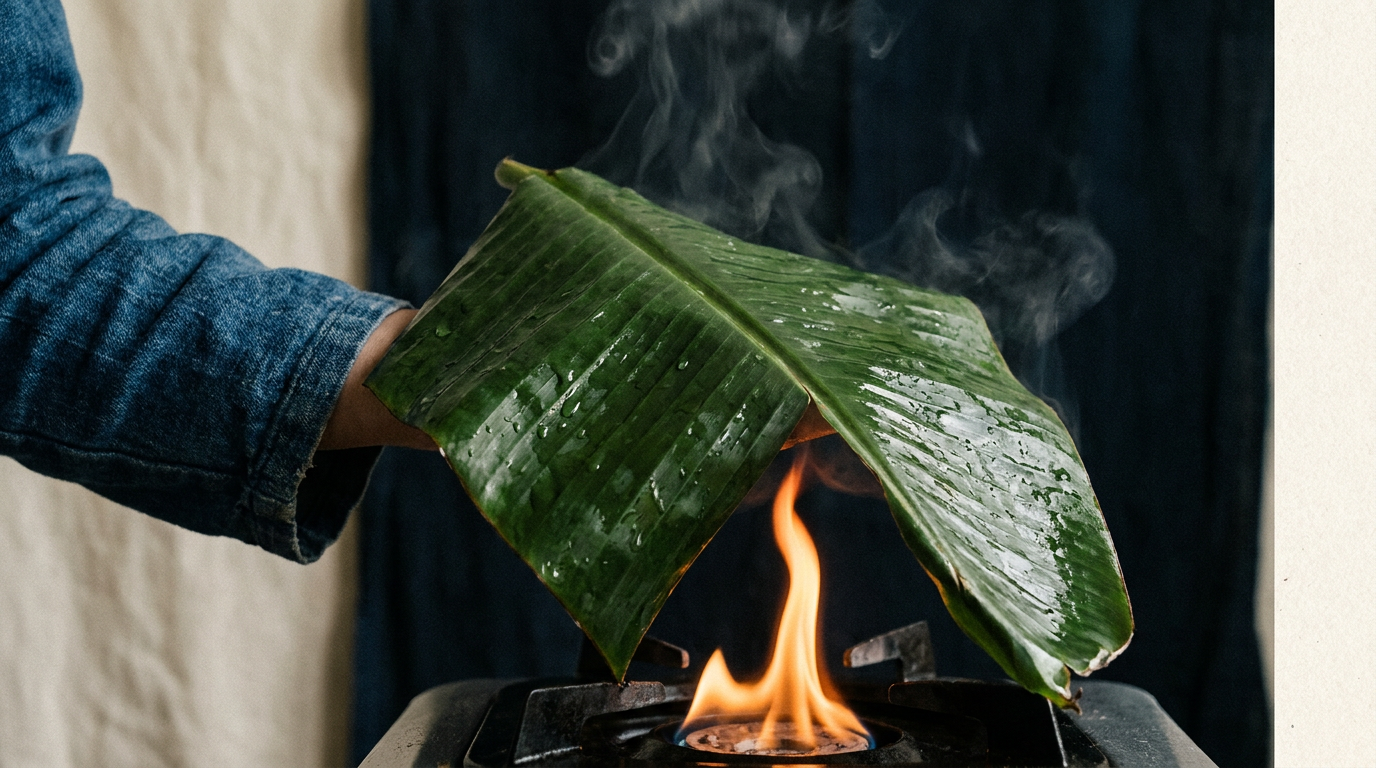
The standard culinary instruction across Southeast Asia, southern India, and Central America is uniform: pass the leaf over an open gas flame or hot charcoal for three seconds before wrapping.
This is not a sanitising step, though it clears surface dust. What the flame achieves is rapid cellular collapse and thermal transition. At roughly 60°C to 70°C, the water inside the leaf's cell vacuoles expands, ruptures the cell walls, and vents as vapour. The turgor pressure drops to zero. Simultaneously, the thin layer of crystalline epicuticular wax coating the leaf’s outer epidermis softens without scorching. Within seconds, a brittle, uncooperative sheet turns deep green, glossy, and as pliable as wet leather.
Epicuticular wax and the controlled steam chamber
The primary function of a banana leaf in nature is to survive torrential tropical rain without rotting or tearing, while preventing excessive transpiration in intense sunlight. The plant accomplishes this by depositing a complex mixture of long-chain fatty acids, primary alcohols, and wax esters across both the adaxial (upper) and abaxial (lower) surfaces [2].
In the kitchen, this wax layer provides an entirely natural non-stick hydrophobic barrier. When you wrap a piece of fish in Kerala for meen pollichathu, or masa for an Oaxacan tamal, the moisture from the food cannot penetrate the leaf wall.
Instead, the wrapped parcel forms an autogenous pressure vessel. Water evaporating from the food hits the hydrophobic internal surface of the leaf, condenses, and rolls back down into the parcel. It is an efficient, closed micro-steaming environment. Unlike aluminium foil, which reflects radiative heat aggressively and can overcook the outer perimeter of a parcel before the centre warms, a wet banana leaf conducts heat moderately. The moisture locked inside the plant tissue acts as a thermal buffer, keeping the internal temperature hovering predictably around 100°C even when the outer skin blisters over white-hot coals.
What leaches into the starch
The most distinctive property of the leaf, documented across its profile on Spiced with Science, is its polyphenolic content.
Banana leaves contain notable concentrations of epigallocatechin gallate (EGCG), chlorogenic acid, and rutin, along with various condensed tannins [3]. At room temperature, these compounds stay locked behind the leaf's cuticle. But when piping hot, gelatinised rice hits a fresh banana leaf, or when a parcel is held at steam temperatures for an hour, these heat-labile polyphenols migrate across the interface.
The sensory result is clean and unmistakable: a slightly astringent, tea-like dryness accompanied by volatile green aromas. Gas chromatography of heated Musa leaves reveals the release of small quantities of hexanal, (E)-2-hexenal, and phytol, the breakdown products of degraded chlorophyll and lipid peroxidation [4]. It is the distinct fragrance of late summer cut grass combined with vanillin and light woodsmoke. A tamal steamed in a banana leaf does not taste like a tamal steamed in a dry corn husk; the starch absorbs the volatile profile of the leaf, lending it a softer, pasture-like depth.
Material comparison: wrappers under heat
| Material | Moisture retention | Thermal behaviour | Flavour contribution | Surface adhesion |
| :--- | :--- | :--- | :--- | :--- |
| Banana leaf | High (hydrophobic wax + plant vapour) | Moderate buffer; protects delicate proteins | Grassy, tannic, lightly sweet | Low (natural wax barrier) |
| Aluminium foil | Absolute (hermetic seal) | High conduction / strong reflection; risks scorching | None (metallic taint if acidic) | High (proteins stick unless oiled) |
| Parchment paper | Moderate (water-resistant, steam-permeable) | Neutral; standard oven heat transfer | None | Extremely low (silicone coating) |
| Corn husk | Moderate to low (fibrous and porous) | Low buffer; dries out over direct flame | Sweet, dried-corn, woody notes | Low to moderate |
Serving cold versus cooking hot
There is a functional distinction between using a banana leaf as a plate and using it as a cooking medium.
In South Indian feasts (sadya), the service of food on a cold, freshly washed leaf relies on the leaf's clean, non-reactive, water-repellent surface. Hot sambar or rasam pools neatly on the leaf's glossy surface without turning it into a soggy pulp. Because the exposure is brief, the polyphenol transfer into the food is minimal; the leaf functions primarily as an elegant, compostable plate.
Cooking inside the leaf is where the chemistry shifts from passive containment to active seasoning. When wrapping for the steamer or the grill, always place the food against the darker, shinier upper side (the adaxial surface), which carries the thicker wax deposit and fewer stomata. It handles mechanical abrasion better and releases its aromatic volatile compounds evenly into the food as the heat rises.
Frequently asked questions
### Can you eat a banana leaf?
No. The leaves are high in tough structural lignin and cellulose fibres that the human gastrointestinal tract cannot break down. They are strictly an extraction and cooking medium, meant to be discarded after the meal.
### How do you store fresh banana leaves so they do not dry out?
Trim away the thick woody midrib, fold the leaves into manageable rectangles, wrap them tightly in damp cloth or a compostable bag, and refrigerate for up to a week. For longer storage, freeze them directly; freezing ruptures cell walls similarly to heat, making the thawed leaves exceptionally pliable without requiring an initial pass over a flame.
### Are frozen banana leaves as good as fresh ones for cooking?
For steaming and parcels, frozen leaves work well because the freeze-thaw cycle naturally wilts the leaf, saving the step of heating it over a flame to make it flexible. However, they lose a fraction of their bright, volatile grassy aromatics during long freezing, making fresh leaves preferable when a pronounced tea-like fragrance is desired.
### What can be substituted if banana leaves are unavailable?
If using them as a parcel for steaming, parchment paper wrapped over an outer layer of aluminium foil mimics the moisture retention and structural protection, though it provides no flavour. A layer of fresh sweetcorn husks or fresh lotus leaves provides comparable botanical aromas, but with a different aromatic profile.
Sources & citations
- Sothornvit, R., & Pitak, N. (2007). Oxygen permeability and mechanical properties of banana leaf as an edible film/wrapping material. LWT - Food Science and Technology, 40(2), 366–370. https://doi.org/10.1016/j.lwt.2005.09.010
- Buschhaus, C., & Jetter, R. (2011). Composition and physiological function of epicuticular wax on leaves of Musa species. Annals of Botany, 107(5), 871–882. https://doi.org/10.1093/aob/mcr021
- Saha, P. et al. (2013). Evaluation of antioxidant and polyphenolic content of Musa paradisiaca bract and leaf extracts. International Journal of Pharmacy and Pharmaceutical Sciences, 5(2), 224–228.
- Pino, J. A., & Febles, M. O. (2013). Volatile components of banana leaf (Musa acuminata Colla). Journal of Essential Oil Research, 25(2), 121–124. https://doi.org/10.1080/10412905.2012.751556