
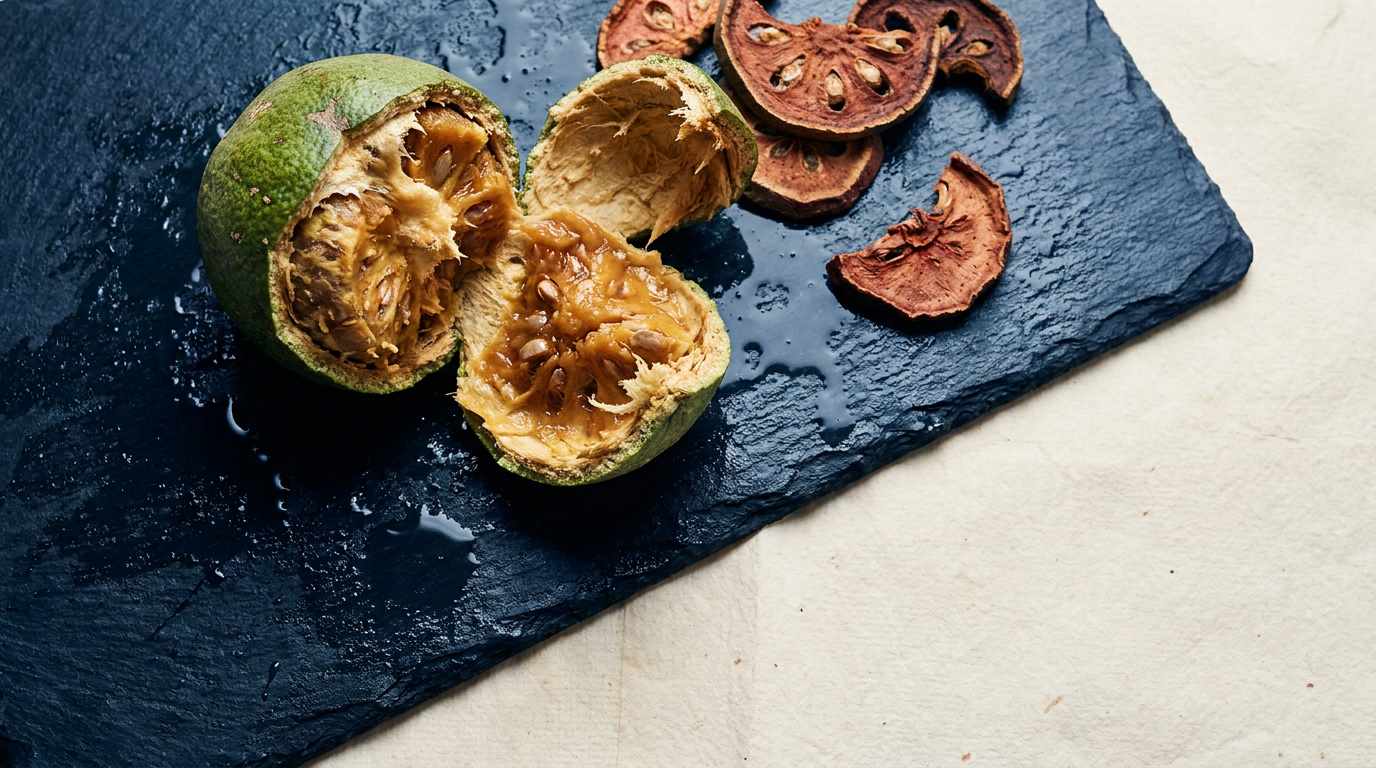
Bael (Aegle marmelos), an indigenous South Asian tree fruit known across classical Ayurveda and folk medicine, functions as a dual-action gastrointestinal therapeutic depending strictly on ripeness. While the ripe pulp is a mild, mucilage-rich laxative, the dried unripe fruit contains concentrated marmelosin and tannins that inhibit enteropathogens, reduce gut hypermotility, and treat acute bacillary and amoebic dysentery [1].
To anyone who grew up around the tree, the modern enthusiasm for gut tonics misses the point of bael. It was never an ambient wellness food. The fruit is armoured in a woody shell so dense that opening it requires a machete or a stone step. Inside, the pulp is threaded with sticky, translucent mucilage and bitter seeds. Nobody eats it out of hand for casual pleasure. Instead, Indian domestic practice divided bael into two entirely different interventions: the cooling, ripe pulp crushed into summer sharbat to clear constipation, and the rock-hard, unripe fruit sliced and sun-dried as an astringent draught for violent diarrhoea.
That functional division is not folklore hedging its bets. It is straightforward phytochemistry dictated by fruit maturation.
The maturity divide
Most modern discussions of gut health treat the digestive tract as an abstract ecosystem requiring soothing. Folk medicine, operating in climates where microbial contamination of water was an urgent seasonal reality, had to be far more mechanical. It distinguished between a sluggish colon and an infected, hyperactive bowel.
| Developmental stage | Primary active constituents | Physical mechanism | Domestic indication |
|---|---|---|---|
| Unripe / Half-ripe fruit | Marmelosin, condensed tannins, luvangetin | Astringency, mucosal precipitation, smooth muscle relaxation | Bacillary dysentery, acute diarrhoea, gut hypermotility |
| Fully ripe fruit | Pectin, neutral mucilage, volatile monoterpenes | Bulk-forming hydration, gentle osmotic softening | Summer dehydration, habitual constipation, dyspepsia |
The unripe fruit works because it contains high concentrations of polyphenols and coumarins that fall dramatically as the fruit ripens [2]. When sliced green and dried (bael giri), its astringency is physical: the tannins cross-link and precipitate surface proteins on the intestinal mucosa. This forms a temporary protective layer over irritated enterocytes, reducing fluid secretion into the lumen and blunting the inflammatory response.
Marmelosin and the mechanics of dysentery
In the laboratory, the compound that consistently isolates as bael’s principal bioactive agent is marmelosin, a furanocoumarin chemically identified as imperatorin.
In acute infectious dysentery—whether caused by Shigella species or Entamoeba histolytica—the intestinal lining experiences both pathogen invasion and violent, spasmodic peristalsis. The patient suffers not just from fluid loss, but from cramping that prevents any fluid retention. Clinical and pharmacological evaluations of unripe bael extracts have shown that marmelosin exerts an antispasmodic effect on intestinal smooth muscle, directly antagonising acetylcholine-induced contractions [3].
Simultaneously, the crude extract targets the pathogens themselves. In in vitro assays evaluating enteropathogenic bacteria, unripe bael decoctions inhibited the colonisation and enterotoxin production of Vibrio cholerae and enteropathogenic Escherichia coli [1]. It does not simply act as an inert cork; it alters the mechanical and microbial conditions of the gut lumen.
Importantly, the isolated compound never quite matches the performance of the whole dried fruit. The raw tannins supply the local astringency, the coumarins provide the smooth-muscle relaxation, and the residual gums slow gastric transit enough for the active compounds to interact with the mucosal wall. It is an efficient, low-tech formulation that required no extraction facility—just a stone, a knife, and the sun.
The summer sharbat: pectin over astringency
When the fruit ripens, its astringency declines and the pulp turns aromatic, sweet, and sticky. The chemistry shifts from antimicrobial defense to water retention.
In Indian summer heat, ripe bael pulp is soaked in water, worked through a sieve with clean hands to discard the seeds and fibrous resin, and drunk as bael ka sharbat. Here, the active agent is predominantly water-soluble pectin and mucilaginous polysaccharides [4].
Pectin acts as a classic prebiotic and bulk-forming agent. It absorbs water, coats the stomach lining, and provides an easily fermentable substrate for commensal colonic microflora. Where the green fruit stops the gut in its tracks, the orange fruit rehydrates it. Handing a dysentery patient a glass of sweet, ripe bael sharbat is a clinical error; handing someone with dry, heat-induced constipation an astringent decoction of green bael will only worsen their impaction. The plant is the same; the remedy is opposite.
Where evidence meets the kitchen
There is a temptation to take fruit like bael and repackage it into a daily powder, promising effortless digestive balance. We ought to resist this. A plant whose active constituents include high-potency coumarins and concentrated tannins is a targeted intervention, not breakfast cereal.
Furthermore, human trials on bael remain modest in size and variable in formulation. While its laboratory mechanism against enteropathogens is well-documented, it should never replace oral rehydration salts or targeted antimicrobials during severe bacterial infection. Its place is where domestic herbalism always kept it: an intelligent, accessible, mechanically sound therapy for moderate seasonal distress, based on an exact understanding of when to pick the fruit.
Frequently asked questions
### Can ripe bael fruit treat chronic diarrhoea?
No. Ripe bael pulp is rich in pectin and mucilage, which acts as a gentle bulk-forming laxative. For diarrhoea and dysentery, traditional practice and pharmacological studies specifically require the unripe or half-ripe fruit, which contains the necessary astringent tannins and marmelosin.
### What is marmelosin?
Marmelosin is a furanocoumarin (constitutionally identical to imperatorin) found in Aegle marmelos. It exhibits antispasmodic properties that relax intestinal smooth muscle and contributes to the fruit's documented antidiarrhoeal activity.
### Is bael safe for daily consumption?
Ripe bael pulp prepared as a diluted summer beverage is widely consumed across South Asia without incident. However, medicinal preparations of the unripe fruit—concentrated in tannins and furanocoumarins—should not be used as a permanent daily supplement, as excessive tannin intake can impair nutrient absorption and irritate the stomach lining.
Sources & citations
- Brijesh, S., Tetali, P., Birdi, F. T. (2009). Study on Aegle marmelos Correa's medicinal properties on diarrhoeal pathogens. BMC Complementary and Alternative Medicine, 9:47. https://doi.org/10.1186/1472-6882-9-47
- Sharma, G. N., Dubey, S. K., Nitin, S., Sati, N. (2011). Medicinal values of Aegle marmelos (L.) Corrèa: An overview. International Journal of Current Pharmaceutical Review and Research, 1(2), 12–22.
- Mazumder, R., Bhattacharya, S., Mazumder, A., Pattnaik, A. K., Tiwary, P. M., Chaudhary, S. (2006). Antidiarrhoeal evaluation of Aegle marmelos (Correa) Linn. root extract. Phytotherapy Research, 20(1), 82–84. https://doi.org/10.1002/ptr.1804
- Pathirana, R., Madhujith, T., Eeswara, J. (2020). Medicinal and functional qualities of bael (Aegle marmelos (L.) Corrêa): A review. Journal of Food Biochemistry, 44(8), e13251. https://doi.org/10.1111/jfbc.13251