
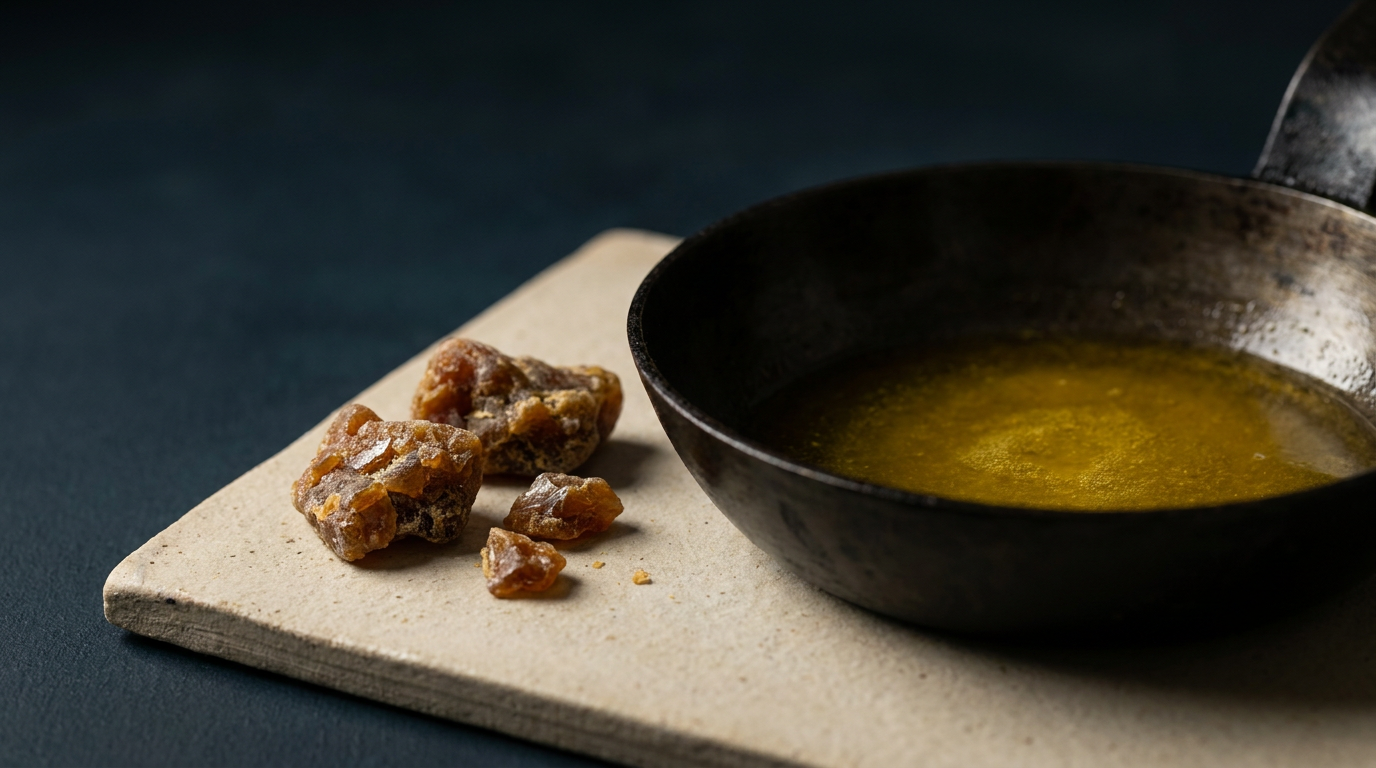
Asafoetida is a pungent, sulfurous-smelling spice derived from the dried taproot latex of several wild Ferula species, native to the arid steppes of Central Asia. Revered in Indian cookery as hing, its fierce volatile disulfides mellow in hot fat into a rich, savoury profile reminiscent of slow-cooked leeks and garlic, without containing any allium fructans [1].
There is no polite way to describe raw asafoetida. In German, it is Teufelsdreck; in medieval Latin, stercus diaboli; in English, devil's dung. Kept in an unsealed jar, it does not smell like food. It smells like a municipal gas leak, or a bin bag left in the sun on an August afternoon. Yet drop a pinhead of this resin into smoking mustard oil or hot ghee, and the room changes. The eye-watering stink collapses in seconds, replaced by the rounded, buttery aroma of roasted shallots and leeks.
Understanding this volatile transformation requires looking at what the spice actually is: not a seed or a bark, but an oleo-gum-resin extracted by wounding the living root of an overgrown, carrot-like perennial.
The Bleeding Taproot
True asafoetida comes predominantly from Ferula foetida and Ferula assa-foetida, immense umbellifers belonging to the Apiaceae (carrot) family that grow wild in the high, parched plains of Afghanistan, Iran, and Uzbekistan [2]. It is not farmed in neat orchards. Collectors track mature plants in late spring, scrape away the rocky soil to expose the massive taproot, slice off the upper crown, and shade the cut with stones or dried brush.
A milky latex seeps from the wound to protect the plant. Over several days, this sap oxidises and thickens into a reddish-brown, sticky gum. The forager returns, scrapes the gum, slices the root again, and repeats the cycle until the plant is exhausted [1].
In its pristine form, this resin is sold as hard, translucent tears. But if you have ever bought hing in an ordinary grocery shop, you have likely never handled pure tears. You bought compounded asafoetida: pure resin milled into a carrier powder, typically rice starch or wheat flour, bound with gum arabic [3]. Because the raw resin is intensely sticky and potent enough to spoil an entire cupboard, compounding makes it measurable by the pinch rather than by micro-shavings with a razor blade. You can find more details on these forms in our asafoetida reference entry.
The Chemistry of Hot Fat
The volatile profile of Ferula resin is dominated by organic sulfur compounds, which account for roughly 60 percent of its essential oil [2]. The most notable culprits are 2-butyl propenyl disulfide and 1-(methylthio)propyl 1-propenyl disulfide. Unlike the alliin and allicin in garlic, which remain dormant inside plant cells until ruptured by a knife, asafoetida’s sulfur compounds sit active and volatile in the dried sap [2].
| Quality | Pure Ferula Tears | Compounded Hing Powder | Fresh Garlic |
| :--- | :--- | :--- | :--- |
| Botanical source | Ferula assa-foetida (Apiaceae) | Ferula resin + flour/starch | Allium sativum (Amaryllidaceae) |
| Primary aroma compounds | Sec-butyl propenyl disulfides | Disulfides, diluted by starch | Allicin, diallyl disulfide |
| Fat solubility | High (dissolves slowly) | High (carrier suspends in fat) | Moderate (burns easily) |
| Carbohydrate type | Complex resin/gum | Starches + gum arabic | High fructan content |
| Potency | Extreme (use a pinhead) | Moderate (use 1/8 to 1/4 tsp) | 1–2 cloves |
Water does very little to tame these sulfur compounds. Boiling raw asafoetida in plain water disperses the stench rather than breaking it down. The transition happens through lipid-mediated thermolysis.
When asafoetida hits fat held above 130°C, the volatile disulfides degrade and interact with the lipids. High heat cleaves the more aggressive sulfur chains, leaving behind heavier, less volatile sulfides and thiols that register on the human tongue as deeply savoury, meaty, and sweet [2]. The oil acts as both a chemical reactor and a solvent, capturing the newly forged aromatic molecules and preventing them from blowing away out of the pot.
Beyond the Allium Taboo
For centuries, Western travel writers treated hing as a curious culinary masochism, but its utility in South Asian cookery is mathematically precise. In Jain kitchens, where underground bulbs like garlic and onion are forbidden because harvesting kills the entire plant, asafoetida provides the necessary allium-like complexity without violating religious strictures. In Vaishnavite and specific Brahmin communities, where alliums are avoided for their supposed heating or stimulating properties, hing serves the exact same role.
Modern gastroenterology has stumbled upon a parallel rationale. Onions and garlic are dense with fructans—fructose polymer chains that humans cannot enzymatically digest. In individuals with irritable bowel syndrome, fructans pass unabsorbed into the colon, where gut flora rapidly ferment them, producing gas, distension, and pain.
Compounded asafoetida, particularly when blended with a non-wheat starch like rice flour, produces an almost identical sensory profile in curries, dals, and braises without carrying any fermentable allium fructans [4]. The tradition of using hing alongside flatulence-inducing pulses like pigeon peas (toor dal) and chickpeas is ethnobotanical shorthand for digestive comfort, supported by modest clinical data suggesting Ferula extracts stimulate bile flow and digestive enzymes [1].
If you treat asafoetida like ground coriander or cumin, adding it to a simmer or dusting it over a finished dish, you will hate it. It belongs strictly in the hot fat of the tempering pan (tadka), flashed for ten seconds alongside mustard seeds and cumin until the foam subsides. Give it fat, give it heat, and give it respect. The devil's dung is simply waiting to be cooked.
Frequently Asked Questions
### Why must asafoetida always be cooked in fat?
The volatile sulfur compounds that give raw asafoetida its acrid, sulfurous stench are fat-soluble. Exposing the resin to hot oil or ghee degrades the harsh disulfides into milder, savoury compounds and traps the aromatics in the cooking medium. Boiling it in water does not produce this transformation.
### Is commercial hing gluten-free?
Not always. Pure Ferula resin is naturally gluten-free, but because raw tears are difficult to handle, most commercial hing is "compounded" with wheat flour (maida) to prevent caking. Celiac cooks must look specifically for compounded powders formulated with rice flour or purchase pure lump resin.
### How much asafoetida should I use in a recipe?
If you are using compounded powder from a supermarket tub, one-eighth to one-quarter of a teaspoon is sufficient for a family-sized pot of lentils. If you are using pure, uncompounded resin tears, you only need a fragment the size of a mustard seed, gently fried in fat until it dissolves.
### Does asafoetida actually help with digestion?
Yes, there is pharmacological support for this traditional usage. Studies on Ferula assa-foetida extracts indicate that its essential oils and resins stimulate digestive enzymes and enhance the activity of bile secretion, which helps accelerate gastrointestinal transit and reduce intestinal gas [1].
Sources & citations
- Mahendra, P., & Bisht, S. (2012). Ferula asafoetida: Traditional uses and pharmacological activity. Pharmacognosy Reviews, 6(12), 141–146. https://pubmed.ncbi.nlm.nih.gov/23055638/
- Iranshahi, M., & Rezaee, R. (2011). Phytochemistry and pharmacology of Ferula persica: A review. Iranian Journal of Basic Medical Sciences, 14(6), 491–504.
- Food Safety and Standards Authority of India (FSSAI). (2011). Compounded Asafoetida Standards: Food Safety and Standards (Food Products Standards and Food Additives) Regulations.
- Tuck, C., & Barrett, J. (2017). Re-challenging FODMAPs: the low FODMAP diet phase two. Journal of Gastroenterology and Hepatology, 32(S1), 11–15.