
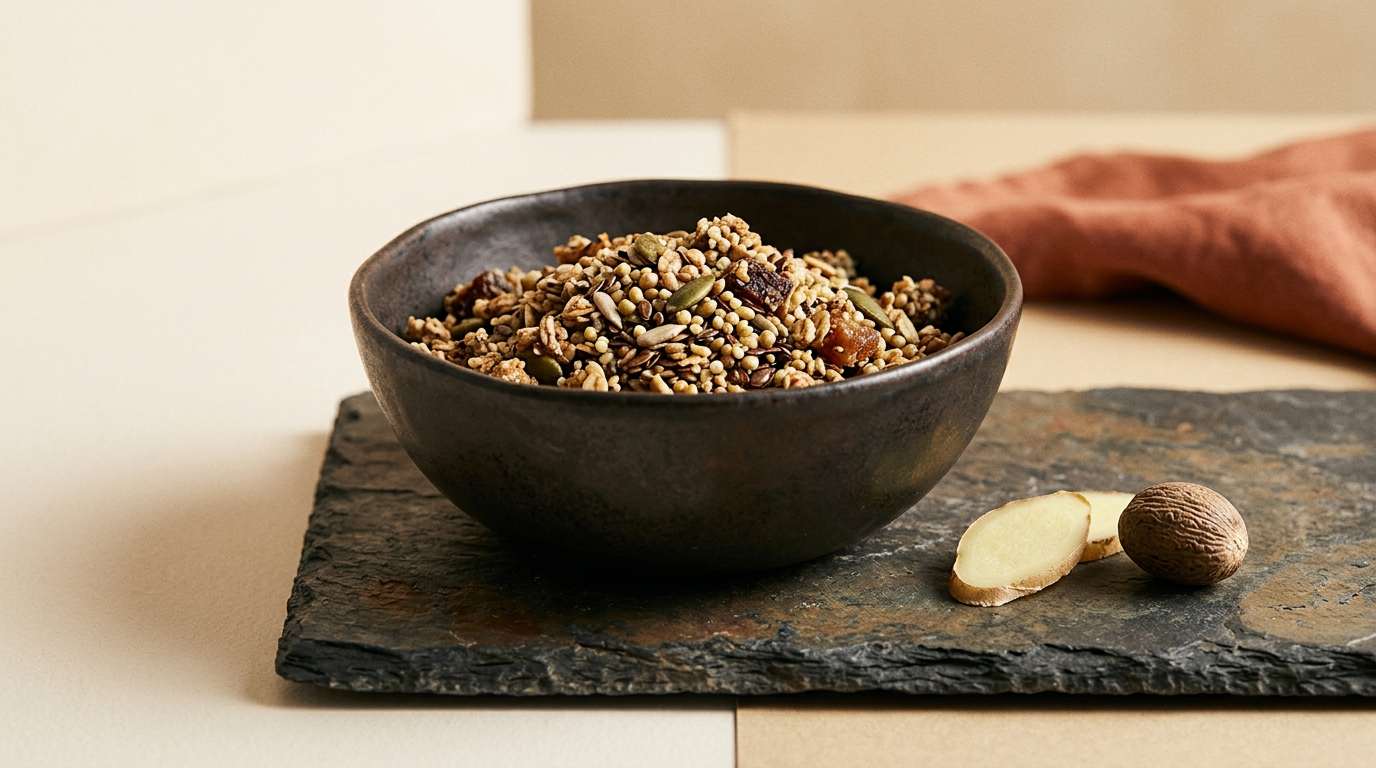
The honest reason your ancient grain cereal is ultra processed has little to do with the grain itself and everything to do with industrial manufacturing. High-heat extrusion creates shelf-stable shapes but degrades nutrients, forcing makers to add back flavor with sugar and additives. It’s a health halo hiding a familiar, highly processed core that consumers in the [/region/us](US) and UK are buying into.
The Illusion of the Grain
The breakfast aisle is a masterclass in storytelling. Boxes whisper of sun-drenched fields of quinoa, amaranth, and sorghum. We see images of rustic farmhouses and beautifully imperfect, earthy grains. We buy the promise of a simpler, more nourishing start to our day, a connection to an agricultural past that feels more grounded than our present.
And the grains themselves are worthy of the praise. They are often richer in protein, fiber, and micronutrients than modern wheat or corn. They represent a biodiverse and resilient food system [1]. So, where does the promise break down? It happens in the factory, long after the grain leaves the field.
The vast majority of breakfast cereals, even those brandishing “ancient grains” on the label, are products of a violent, high-tech process called extrusion. And understanding this process is the key to seeing past the marketing.
Deconstructing the Puff
Extrusion is the engine of the modern snack and cereal industry. Imagine a paste made from grain flour and water, forced at immense pressure through a small die, then subjected to a sudden drop in pressure and an intense blast of heat. The water in the dough instantly vaporizes, causing the mixture to puff up into a light, airy shape—a loop, a flake, a shred, a puff.
This method is incredibly efficient and cost-effective. It creates uniform, shelf-stable products that can sit in warehouses and on supermarket shelves for months without spoiling. But that efficiency comes at a steep nutritional cost.
The intense heat and pressure can denature proteins, destroy heat-sensitive vitamins like B1 and folate, and mangle delicate polyunsaturated fats. Worse, it rearranges the starch structure of the grain into a more rapidly digestible form, often increasing its glycemic index. This means that even a cereal made from a low-GI grain like sorghum can cause a sharper spike in blood sugar after it has been extruded [2].
What emerges from the extruder is a sterile, nutritionally diminished, and almost entirely flavorless puff. It’s a blank canvas. And what the industry paints with is sugar, salt, industrial oils, and a complex palette of “flavor systems.”
The Flavor Cover-Up
Because the extrusion process obliterates any subtle, nutty flavor the original grain may have had, that flavor must be added back. A slurry of sugar or corn syrup, oil, and powdered flavors is sprayed onto the still-warm puffs to create a crunchy, hyper-palatable shell. This is why sugar is often the second or third ingredient on the list, even in “healthy” cereals.
This is where an understanding of spices offers a different path. Instead of a flavorless base requiring a sugary coating, what if the base itself was flavorful and functional? Spices like ginger and nutmeg do more than just taste good. Ginger’s primary bioactive compound, gingerol, has well-documented anti-inflammatory and antioxidant properties [3]. Nutmeg contains myristicin and eugenol, compounds studied for their own unique effects.
By gently toasting whole or rolled grains with real, ground spices, you build flavor and functional benefits directly into the food. You don’t need to cover up a bland base; you are celebrating a complex one. You create a cereal that engages the senses with aromatic warmth, not just a sugary crunch. This is the fundamental difference between food made with culinary logic versus industrial logic. In the UK, the traffic light system often highlights this tension; a cereal can boast of whole grains yet flash a red light for sugar content, a clear sign of this industrial compromise.
Let's [/compare](compare) the two approaches side-by-side.
| Feature | Typical "Ancient Grain" Cereal | A Better Approach |
| :--- | :--- | :--- |
| Grain Form | Extruded puff, flake, or shred from flour | Rolled, steel-cut, or whole grains |
| Processing | High-pressure, high-heat extrusion | Gentle toasting, baking, or sprouting |
| Sweetener | Refined sugar, corn syrup, juice concentrate | Minimal unrefined sweetener, whole fruit |
| Flavoring | Sprayed-on "natural flavors," flavor systems | Whole ground spices (e.g., ginger, nutmeg) |
| Final Texture | Uniformly light, crispy, dissolves quickly | Varied, chewy, and substantial |
The next time you’re in the cereal aisle, ignore the story on the front of the box and read the process betrayed by the ingredient list. If you see words like “puffed,” “crisps,” or a long list of added vitamins (to replace those lost in processing), you’re likely holding a classic example of an ancient grain cereal ultra processed into submission. The real prize isn’t a phantom grain, but a real, minimally-processed food that trusts its ingredients to speak for themselves.
### Frequently Asked Questions
1. What exactly makes a food "ultra-processed"?
Ultra-processed foods (UPFs) are industrial formulations made mostly or entirely from substances extracted from foods (oils, fats, sugars, starch, proteins), derived from food constituents, or synthesized in labs. They are defined by the NOVA classification system and are characterized by processes and ingredients you wouldn't use in a home kitchen [4].
2. Are all packaged cereals ultra-processed?
No, but many are. A simple indicator is the ingredient list. Cereals with short lists of recognizable ingredients like rolled grains, nuts, seeds, and spices (like muesli or some granolas) are typically minimally processed. Cereals made from flours that are puffed, flaked, or shaped are almost always ultra-processed.
3. Can spices really replace sugar for flavor?
Spices add aromatic complexity and depth that our brains register as satisfying. While they aren't "sweet," warming spices like ginger, nutmeg, and cinnamon can create a perception of richness and fullness, reducing the need for high amounts of added sugar to make a food palatable.
4. Why is extrusion so common if it damages nutrients?
It comes down to shelf-life, cost, and logistics. Extrusion is an incredibly fast, continuous process that produces a sterile, dry, and uniform product. This makes it easy to package, store, and transport on a massive scale, which is essential for the business model of large food corporations.
Sources & citations
- Food and Agriculture Organization of the United Nations. (2023). Thinking about the future of food safety - A foresight report. FAO. https://www.fao.org/home/en/
- Riaz, M. N. (2000). Extruders in Food Applications. CRC Press. Referenced via secondary academic summaries on food processing technology. https://www.crcpress.com/
- Bode, A. M., & Dong, Z. (2011). The Amazing and Mighty Ginger. In Herbal Medicine: Biomolecular and Clinical Aspects (2nd ed.). CRC Press/Taylor & Francis. Available from PubMed Central. https://www.ncbi.nlm.nih.gov/
- Monteiro, C.A., Cannon, G., Levy, R.B. et al. (2019). Ultra-processed foods: what they are and how to identify them. Public Health Nutrition, 22(5), 936-941. https://www.cambridge.org/core/journals/public-health-nutrition