
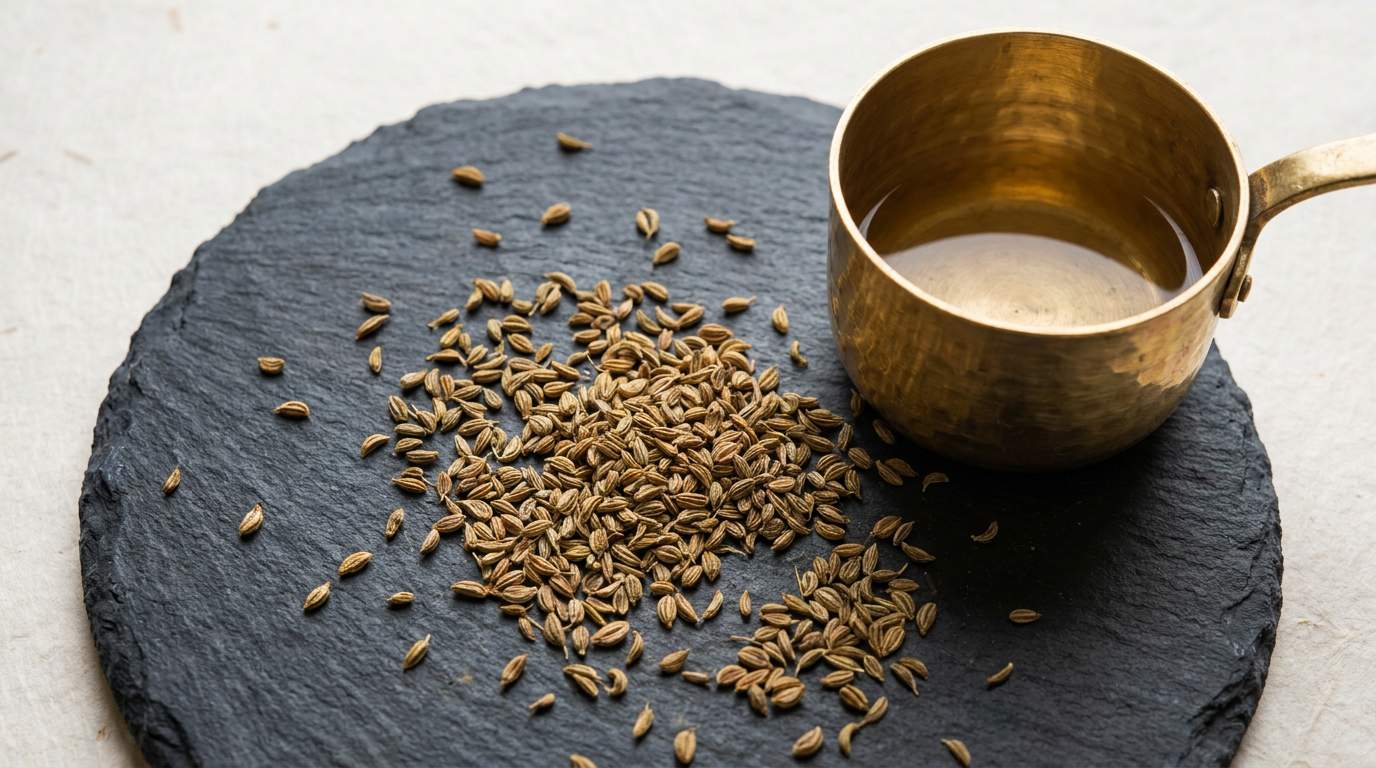
Ajwain water (Trachyspermum ammi) accelerates gastric emptying and relieves gastrointestinal distress primarily through thymol-mediated modulation of enteric smooth muscle and transient receptor potential (TRP) channels. Long prescribed across South Asian domestic medicine for infantile colic and postprandial heaviness, modern pharmacological trials confirm that volatile carom extracts stimulate digestive enzyme secretion, shorten gut transit time, and reduce intraluminal gas pressure.
The domestic carminative meets the assay
For generations across the Indian subcontinent, ajwain water—seeds simmered in water until the liquid turns pale amber and smells faintly like a chemist's dispensary—has been the unceremonious response to dyspepsia, postpartum recovery, and paediatric colic. It was treated within imperial colonial medicine as a native curiosity, noted by British army surgeons in nineteenth-century pharmacopoeias largely as a rustic tincture for cholera or flatulence, then largely sidelined as synthetic antispasmodics entered the market [1].
Domestic practice did not wait for the clinical trial. It simply observed that twenty minutes after drinking water boiled with bruised ajwain, the sensation of abdominal distension subsided. When gastroenterology turned its instrumentation back onto Trachyspermum ammi, the findings were neither miraculous nor mystical. They were mechanical.
A landmark 2019 evaluation of traditional prokinetic seeds examined how carom extracts alter intestinal transit time and smooth muscle contractility [2]. The paper did not validate ajwain out of retroactive respect for indigenous knowledge; rather, it mapped the specific pathways through which volatile monoterpenes alter gut motility. The plant does not simply calm an unruly stomach. It alters the speed and mechanics of digestion.
Thymol, receptors, and the gastric emptying clock
Ajwain contains between 2% and 5% essential oil, of which thymol accounts for 35% to 60%. Thymol is an antiseptic phenol with a sharp, medicinal burn, but inside the gastrointestinal tract, its behaviour is distinctly receptor-selective.
When ingested as a warm aqueous infusion, volatile compounds in the seed interact directly with transient receptor potential ankyrin 1 (TRPA1) and vanilloid 1 (TRPV1) channels on the mucosal lining of the stomach and duodenum [3]. This interaction triggers local calcium influx, stimulating enteric neurons that control rhythmic peristalsis. The result is prokinetic action: gastric emptying accelerates, pushing food through the pylorus and preventing the prolonged stasis that generates upper abdominal fullness.
Simultaneously, the seed's lipid-soluble fraction exerts a spasmolytic counter-effect on downstream smooth muscle. At higher concentrations in the ileum, thymol acts as a mild calcium-channel blocker, inhibiting acetylcholine-induced contractions. This dual property—promoting organized forward movement while preventing chaotic cramping—explains why carom functions both as a digestive stimulant and an antispasmodic.
| Carminative seed | Primary volatile | Dominant gut mechanism | Clinical motility effect |
| :--- | :--- | :--- | :--- |
| Ajwain (Trachyspermum ammi) | Thymol (35–60%) | TRPA1 activation; mild L-type calcium blockade | Accelerates gastric emptying; spasmolytic on ileum |
| Fennel (Foeniculum vulgare) | trans-Anethole (60–80%) | Cholinergic modulation; nitric oxide pathway | Relaxes colonic smooth muscle; reduces gas spasm |
| Cumin (Cuminum cyminum) | Cuminaldehyde (20–40%) | Stimulates mucosal brush-border enzymes | Enhances bile flow; mild prokinetic |
Bile acids and pancreatic enzymes
Speeding up transport is useless if the chemical breakdown of food fails to keep pace. The second axis of ajwain's motility pharmacology lies in mucosal enzyme stimulation.
Research published in Molecular Nutrition & Food Research and earlier foundational work from India's Central Food Technological Research Institute established that dietary intake of ajwain markedly increases pancreatic lipase, amylase, and chymotrypsin activity [4]. It also stimulates bile acid secretion from the liver by increasing bile acid turnover. When bile salts mix efficiently with dietary lipids in the duodenum, gastric retention times naturally drop.
Boiling the seeds in water—the household extraction method—is chemically sound. Thymol is sparingly soluble in cold water, but hot water extraction pulls both free phenolic monoterpenes and water-soluble glycosides into solution. When sipped hot, the volatile thymol reaches the gastric mucosa before significant evaporation occurs, delivering a pharmacologically relevant dose directly to upper digestive receptors.
The limits of carom pharmacology
Ajwain is an effective domestic carminative, but it is not benign in excess. Thymol at high concentrations irritates the gastric mucosa and can exacerbate active peptic ulcers or acid reflux. Because it alters smooth muscle tone, excessive pharmacological doses are contraindicated during pregnancy, though moderate culinary use has a documented history of safety.
The divergence between indigenous tradition and laboratory gastroenterology was never a dispute over reality. It was a dispute over language. The household described the decoction as clearing wind and lightening the stomach; the gastroenterologist describes it as a dual TRPA1 agonist and musculotropic spasmolytic reducing gut transit time. Neither account invalidates the other, and both point to the exact same cup of cooling water.
Frequently asked questions
### How does ajwain water differ from drinking fennel water?
Ajwain relies primarily on thymol, which drives gastric emptying and acts directly on stomach motility. Fennel relies on trans-anethole, which operates further down the digestive tract to relax colonic muscle spasms. Ajwain acts aggressively on upper fullness; fennel acts gently on lower bowel cramping.
### Does ajwain water cure acid reflux?
No. Ajwain accelerates stomach emptying, which can reduce the pressure that pushes acid upward in cases of delayed gastric transit. However, thymol is a strong mucosal irritant and can aggravate preexisting mucosal inflammation or active esophageal reflux if taken in high concentrations.
### Why crush or bruise the seeds before boiling?
The essential oil reservoirs in ajwain are housed in microscopic ducts called vittae within the pericarp. Lightly bruising the seeds before steeping cracks these canals, allowing warm water to extract the volatile thymol far more efficiently than boiling intact seeds.
Sources & citations
- Watt, G. (1893). A Dictionary of the Economic Products of India. Calcutta: Office of the Superintendent of Government Printing, India, Vol. VI, Part IV, pp. 74–77.
- Bairwa, R., Sodha, R., & Rajawat, B. S. (2012). Trachyspermum ammi. Pharmacognosy Reviews, 6(11), 56–60. https://doi.org/10.4103/0973-7847.95871
- Holzer, P. (2011). TRP channels in the digestive system. Current Pharmaceutical Biotechnology, 12(1), 24–34. https://doi.org/10.2174/138920111793937871
- Srinivasan, K. (2005). Spices as influencers of body metabolism: an overview of three decades of research. Food Research International, 38(1), 77–86. https://doi.org/10.1016/j.foodres.2004.09.001