
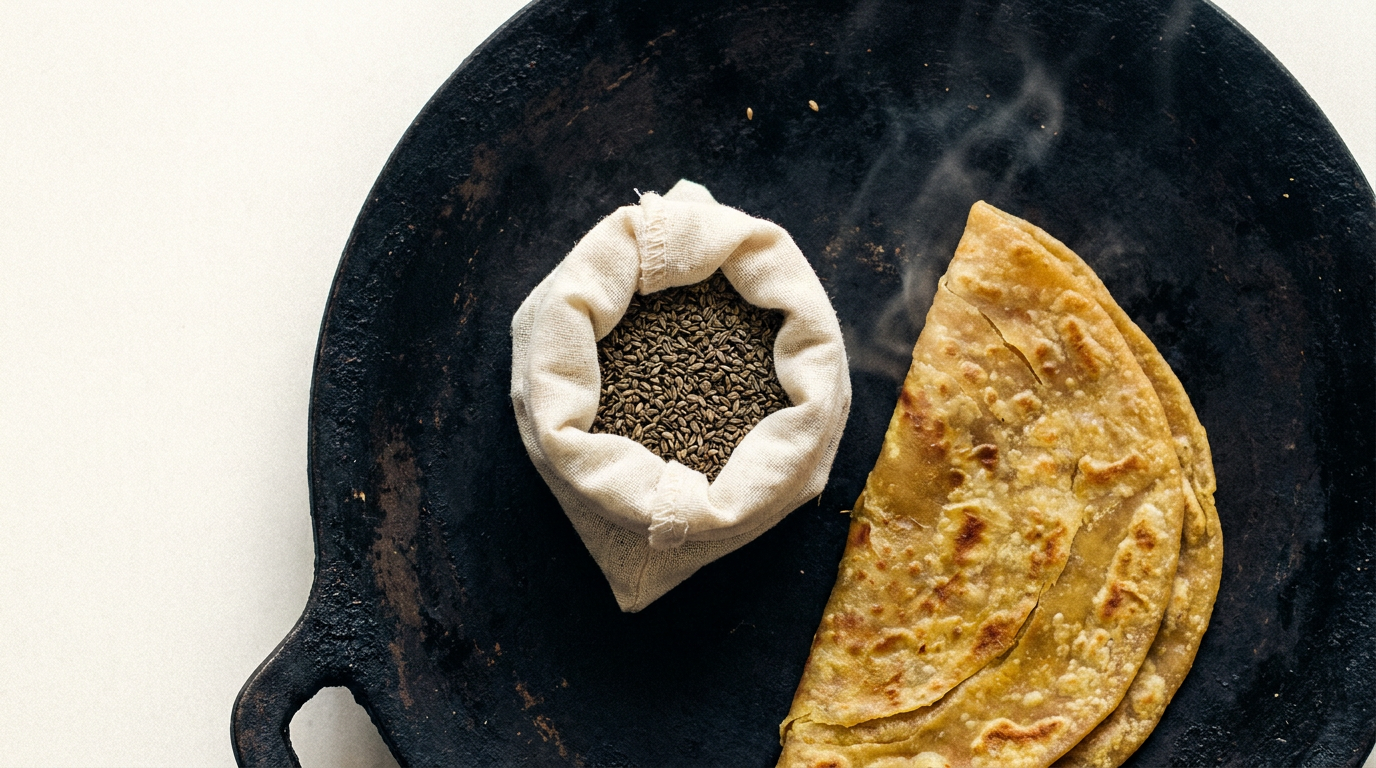
Ajwain (Trachyspermum ammi) links domestic medicine and everyday cooking through a shared volatile chemistry dominated by thymol. Whether wrapped in a heated cloth compress as an ajwain potli to ease respiratory congestion or folded into ghee-laminated dough as an ajwain paratha, heat volatilises the same monoterpenes, delivering antispasmodic and antimicrobial effects through inhalation, topical warmth, and direct ingestion.
The colonial partition of plate and pharmacopoeia
Nineteenth-century colonial botany made a sustained effort to classify the flora of the subcontinent into orderly, European registers [1]. Plants were sorted into economic timber, export cash crops, culinary sundries, or the hospital dispensary. This imperial taxonomy struggled with domestic Indian foodways, where the distinction between a treatment and a supper rarely existed as an absolute barrier.
Ajwain suffered particularly from this administrative tidiness. In colonial medical gazetteers, such as George Watt's Dictionary of the Economic Products of India, seeds were catalogued under Ptychotis ajowan primarily as a source of thymol crystals: an antiseptic to compete with imported European carbolic acid [2]. Meanwhile, domestic manuals treated ajwain in flatbreads as mere ethnic seasoning. What the colonial gaze separated into clinical pharmacology on one hand and folklore dining on the other was, in practice, a continuous thermodynamic process.
The potli: dry heat and volatile inhalation
In North Indian and western domestic care, the potli is an elemental tool. Whole ajwain seeds are tied loosely into a square of unbleached cotton or muslin, then pressed briefly against a dry, warm cast-iron tawa. The heated pouch is applied to an infant's chest, tucked near a congested pillow, or held to a chilled ear.
The mechanics are straightforward. Ajwain fruit contains between 2% and 4% essential oil, of which thymol makes up 35% to 60%, accompanied by p-cymene, gamma-terpinene, and beta-pinene [3]. Thymol has a melting point of roughly 49°C to 51°C and begins sublimating at low temperatures. Dry contact with a warm iron skillet raises the internal seed temperature past this threshold without pyrolysing the woody pericarp.
The cotton pouch functions as a crude dry inhaler and thermal heat pack. The released thymol vapour exerts local antiseptic action against upper respiratory pathogens and acts as a mild counterirritant on the skin, stimulating local microcirculation while vaporous terpenes relax smooth muscle tissue in the bronchial passages [4]. Nothing is ingested; the medium is air, fabric, and heat.
The tawa: lipid binding and digestive transit
Move the same seeds from the cotton pouch onto the dough board, and the application changes without altering the underlying target. In an ajwain paratha, whole seeds are bruised between the palms and folded into wholewheat dough layered with ghee, then cooked on the same iron tawa.
Here, the physics of extraction diverges slightly because of lipids. Thymol is poorly soluble in water but readily soluble in fats. As the paratha hits the dry griddle, the heat vaporises a fraction of the monoterpenes, producing the characteristic sharp, thyme-like scent that fills the kitchen. The remaining thymol and p-cymene dissolve into the melting ghee within the laminated layers of the flatbread.
This lipid suspension protects the volatile compounds from complete evaporation into the room, carrying them directly into the digestive tract. In the gut, thymol acts on intestinal smooth muscle by modulating calcium channels, reducing spasmodic contractions, and accelerating gastric emptying [4]. The paratha is not medicine disguised as food; it is an efficient delivery system for lipophilic carminative compounds eaten alongside starch and legumes.
Comparing the two delivery pathways
| Attribute | Ajwain Potli | Ajwain Paratha |
| :--- | :--- | :--- |
| Primary phase | Gas / dry vapour | Lipid solution in solid matrix |
| Application | Inhalation and topical conduction | Ingestion and gut transit |
| Target tissue | Upper respiratory mucosa and skin capillaries | Gastric mucosa and intestinal smooth muscle |
| Carrier medium | Cotton cloth and ambient air | Ghee, butter, or oil within wheat starch |
| Thermal trigger | Dry pan conduction (gentle warmth) | Direct griddle conduction (160°C–200°C) |
When a remedy is simply dinner
The split between clinical intervention and dinner table sustenance remains a stubborn inheritance. We tend to demand that an ingredient be either an active drug with measurable blood plasma levels or a passive flavouring agent meant only for pleasure.
Ajwain resists both categories. Rubbing it into a warm pouch for an infant's chest relies on the identical monoterpene volatility that makes it pleasant when cracked over rolling dough. In both instances, cooks apply precise thermal thresholds to a stubborn fruit coat to liberate thymol. Understanding this continuity does not require mystifying the seed; it simply asks that we stop pretending a kitchen tawa and a thermal delivery system are different things.
Frequently asked questions
### Can ajwain potli burn delicate skin?
Yes. Whole ajwain tied in muslin must be checked against the inner wrist before application, especially with children. The cloth retains dry heat efficiently, and excess heat combined with volatile thymol can irritate sensitive skin.
### Why crush ajwain seeds before putting them into paratha dough?
Crushing the seeds between the palms fractures the outer pericarp and exposes the glandular trichomes where the essential oils reside. This allows the ghee to dissolve the thymol during kneading and cooking, distributing the flavour and active compounds evenly through the dough.
### Is the thymol in ajwain the same compound found in garden thyme?
Chemically, yes. Thymol (2-isopropyl-5-methylphenol) is identical whether extracted from Thymus vulgaris or Trachyspermum ammi. However, ajwain typically yields a far higher concentration of thymol by weight than standard thyme leaves.
Sources & citations
- Arnold, D. (2000). Science, Technology and Medicine in Colonial India. Cambridge University Press. ISBN: 9780521563192.
- Watt, G. (1892). A Dictionary of the Economic Products of India: Volume VI, Part I. Office of the Superintendent of Government Printing, India.
- Bairwa, R., Sodha, R., & Rajawat, B. S. (2012). Trachyspermum ammi. Pharmacognosy Reviews, 6(11), 56–60. https://doi.org/10.4103/0973-7847.95871
- Boskabady, M. H., Alizadeh, M., & Jahanbin, B. (2007). Bronchodilatory effect of Carum copticum in airways of asthmatic patients. Therapie, 62(1), 23–29. https://doi.org/10.2515/therapie:2007007