
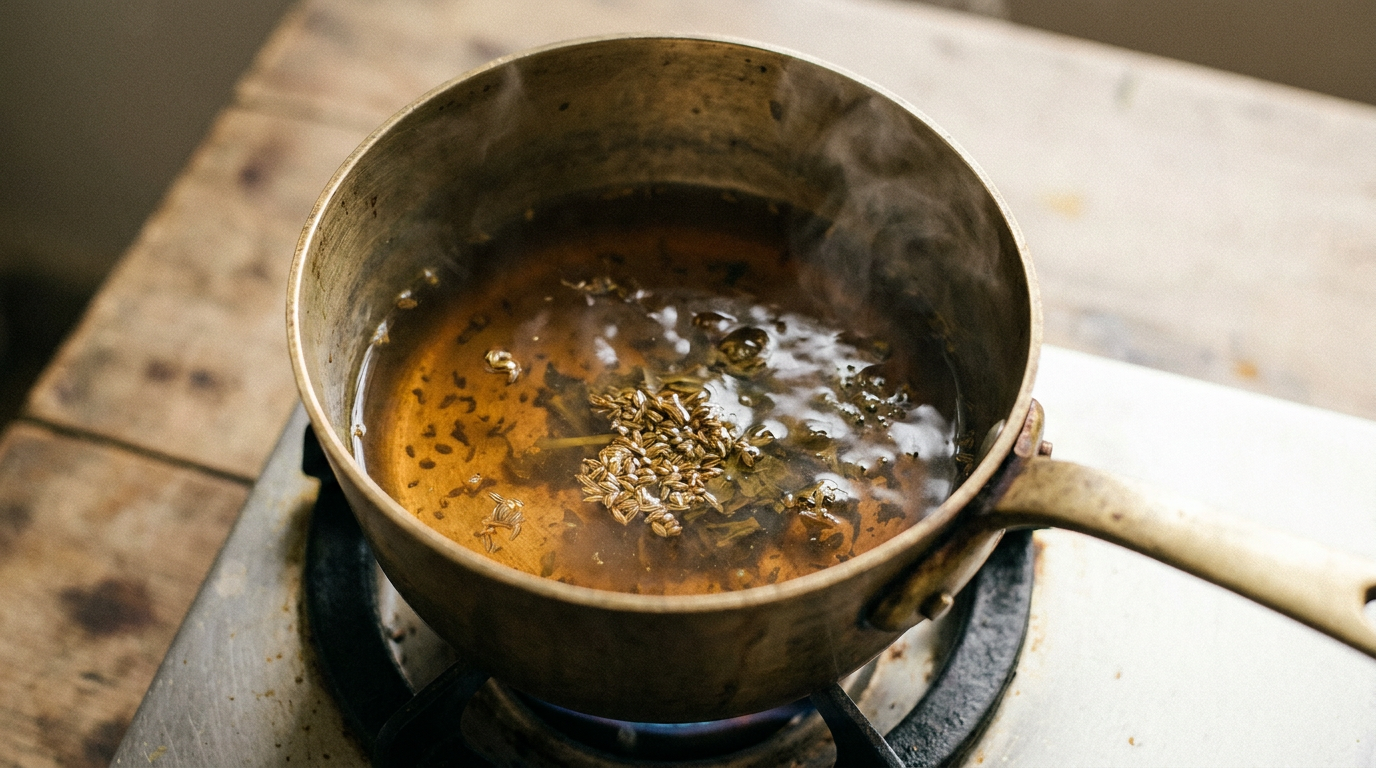
Ajwain kwath is a traditional Ayurvedic herbal decoction prepared by boiling crushed ajwain seeds (Trachyspermum ammi) in water until the liquid reduces, traditionally to one-quarter or one-half its original volume. Primarily consumed for acute gastrointestinal distress and respiratory congestion, the preparation pulls volatile thymol and polar polyphenols into a concentrated aqueous liquid without requiring alcohol, oil or industrial solvents.
Boiling an aromatic seed in an open pot looks, on paper, like an exercise in waste. Volatile organic compounds evaporate when heated. If you simmer fresh mint or basil for twenty minutes, the bright top notes leave the pot and perfume the ceiling, leaving behind a dull, bitter tea. Ajwain ought to suffer the same fate. Its signature molecule, thymol, boils at 232°C, but like many terpenes it readily co-distils with water vapour [1]. Simmering crushed ajwain drives a substantial fraction of its pungent aroma directly into the kitchen air.
Yet classical pharmacopoeias insist on decoction—kwath or kashayam—rather than a gentle infusion. As catalogued in our guide to Ajwain Kwath, the preparation is treated as a distinct therapeutic medium rather than a casual tea. Understanding why requires looking at what water does to the dense cellular architecture of a caraway-like schizocarp.
The mechanics of the reduction
In classical Ayurvedic pharmacy (Bhaishajya Kalpana), liquid preparations follow strict ratios of heat, water, and plant mass. An infusion made with hot water poured over seeds is called a phanta. A cold maceration is a hima. A kwath, by contrast, requires sustained thermal reduction: typically one part crushed herb to sixteen parts water, boiled down over mild heat until one-fourth of the liquid remains [2].
Ajwain seeds are rigid. The essential oil sits sequestered in narrow channels called vittae running lengthwise through the pericarp. Crushing the seeds cracks these channels, but simple hot-water steeping extracts only the superficial layer of oil. It also fails to dissolve the deeper matrix of glycosides, tannins, and non-volatile flavonoids like luteolin and apigenin that reside within the seed tissue [3].
| Extraction Method | Heat Application | Target Compounds | Resulting Profile |
| :--- | :--- | :--- | :--- |
| Phanta (Infusion) | Boiling water poured over seeds; steeped covered | Surface essential oils, light water-soluble acids | Mild, aromatic, volatile-dominant |
| Kwath (Decoction) | Active simmer until reduced by 50–75% | Phenolic acids, glycosides, dispersed thymol, tannins | Astringent, sharp, chemically dense |
| Hima (Cold Infusion) | Soaked overnight at ambient temperature | Highly delicate polars, mucilage | Very mild, low thymol yield |
During sustained boiling, two things happen simultaneously. The volatile fractions—chiefly thymol, γ-terpinene, and p-cymene—are partly stripped by steam. However, the residual thymol does not vanish entirely. At boiling temperatures, water's polarity decreases, slightly improving its capacity to dissolve sparingly soluble phenols (thymol has an ambient water solubility of roughly 0.98 g/L at 20°C, but this rises as temperature climbs). As the volume reduces, the liquid forms a cloudy, concentrated hydrosol-like suspension where micro-droplets of oil emulsify with water-soluble mucilage and saponins released from the boiled seed walls.
Smooth muscle and bronchial responses
The resulting liquor is significantly more astringent and bitter than a brief steep. This astringency is not an aesthetic flaw; it represents the concentration of water-soluble polyphenols alongside the remaining thymol.
Pharmacologically, ajwain extracts demonstrate direct spasmolytic activity on intestinal smooth muscle. Research suggests this relaxation occurs partly through calcium channel blockade and anticholinergic pathways, providing a biological rationale for its traditional use against abdominal cramping and flatulence [4]. In the respiratory tree, thymol exerts a modest local secretolytic effect, thinning mucus secretions, while its antibacterial properties act against oral and upper respiratory pathogens in transit [5].
Boiling down the liquid does sacrifice the high, medicinal bite that hits the nasal passages when you crack open raw seeds. What it provides in exchange is systemic density. The astringency dries excess secretions, while the emulsified thymol reaches the gastric lining in a diluted, non-caustic form that raw oil cannot duplicate.
Making it with precision
Kitchen preparations rarely require a strict 16:1 reduction unless following a physician's formula, but the physics remains consistent. A workable domestic standard:
- Lightly bruise 5 grams (roughly one teaspoon) of whole ajwain in a mortar. Cracking the seed coat is mandatory; pulverising into fine dust merely creates sludge.
- Add to 250 ml of cold water in a small saucepan.
- Bring to a gentle boil, then lower the flame so the surface bubbles quietly rather than rolling violently.
- Reduce until roughly 120 ml remains—about eight to ten minutes. Strain immediately.
The resulting liquid will be pale amber to light bronze, carrying a sharp, medicinal scent and a peppery, drying finish. Drink it warm. Letting it sit until cold allows the suspended oils to separate and cling to the sides of the mug, defeating the purpose of the boil.
Frequently asked questions
### Why not just swallow whole ajwain seeds with warm water?
Swallowing whole seeds relies on chewing to break the pericarp. Unchewed seeds pass largely intact through the gut, releasing minimal thymol. Decoction mechanically extracts both polar and non-polar fractions into a bioavailable liquid before ingestion.
### Does boiling destroy the active thymol?
Boiling evaporates a measurable percentage of thymol via steam distillation, but it does not chemically degrade the molecule itself. The remaining fraction dissolves into the heated water or forms a stable suspension with seed mucilage, creating an effective, non-irritating concentration.
### How does ajwain kwath differ from ajwain ark?
Kwath is a non-distilled decoction containing both water-soluble plant solids and dispersed oils. Ark is a clear distillate (an essential water or hydrosol) collected by condensing the steam evaporated from boiled ajwain, leaving all bitter solids and tannins behind.
Sources & citations
- Bhasin, S. et al. (2020). 'Extraction of essential oil from Trachyspermum ammi and evaluation of its composition.' Journal of Essential Oil Bearing Plants, 23(4), pp. 812–823.
- Central Council for Research in Ayurvedic Sciences. (2007). The Ayurvedic Formulary of India, Part I. Ministry of Health and Family Welfare, Government of India.
- Chatterjee, S. et al. (2012). 'Comprehensive analysis of the chemical composition and antioxidant activities of ajwain (Trachyspermum ammi) seed extract.' Industrial Crops and Products, 36(1), pp. 499–506.
- Gilani, A. H. et al. (2005). 'Antispasmodic and bronchodilator activities of Trachyspermum ammi are mediated through calcium channel blockade.' Fundamental & Clinical Pharmacology, 19(5), pp. 521–529.
- Salehi, B. et al. (2018). 'Thymol, thymoquinone, and thymoquinol against human pathogens.' Phytotherapy Research, 32(9), pp. 1675–1687.