
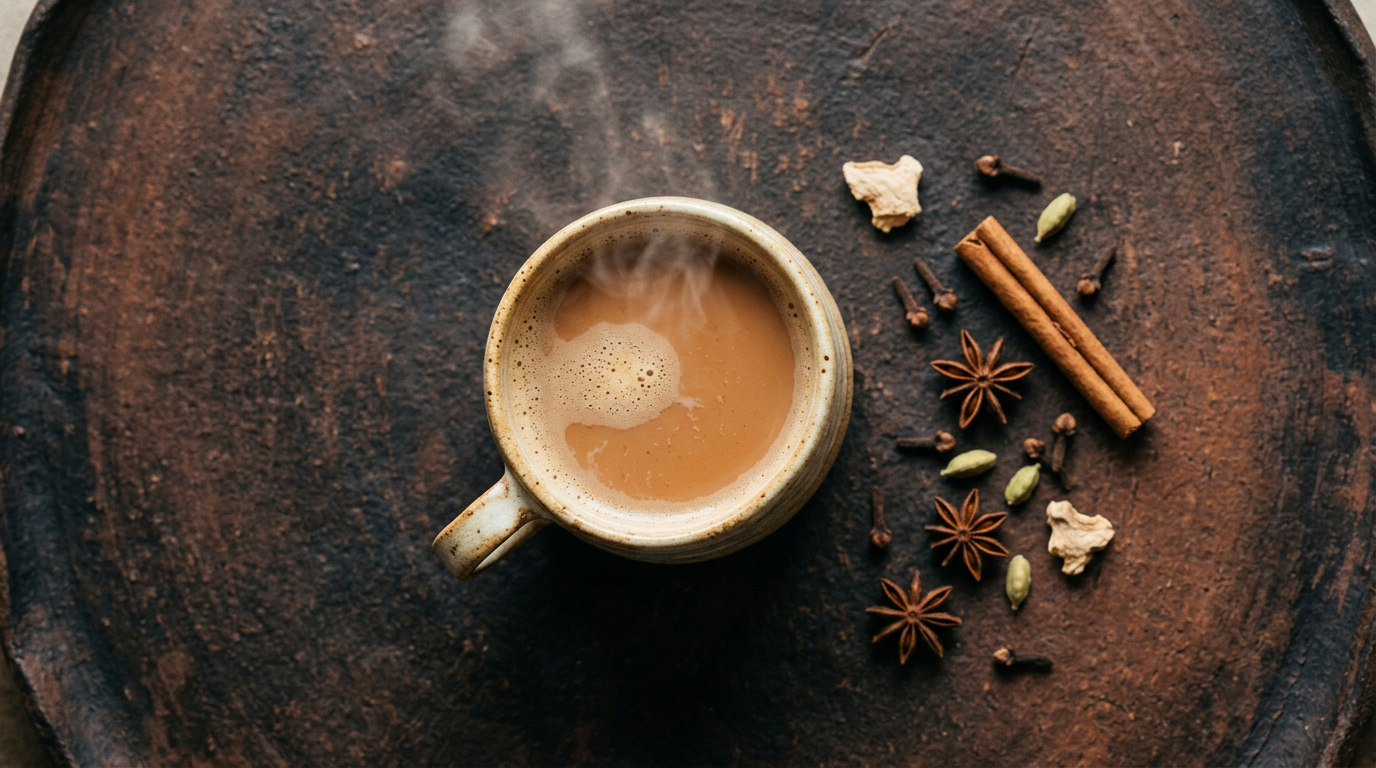
Some of the most meaningful gifts aren't objects, but rituals. The quiet, deliberate act of making something for someone you love is a language of its own. It’s a way of saying, 'You are worthy of my time and my full attention.'
For Father's Day, we’re setting aside grand gestures for a small, repeatable act of precision: a perfect cup of masala chai. But we're approaching it not just as a recipe, but as a laboratory procedure. Think of this as a chemist's note, a protocol for reliably brilliant results every single time. Because the difference between a good cup of chai and a great one lies in understanding the reactions you're trying to catalyze.
Great chai is an exercise in controlled extraction. You are a chemist, your pot is a reaction vessel, and your spices are complex botanical reagents. Your goal is to selectively pull specific molecules—the warm, sweet, and pungent ones—into a solution of water and milk, while leaving the bitter, astringent ones behind. It’s a balancing act of temperature, time, and surface area.
This protocol is designed for two generous servings. Adjust your volumes accordingly.
PROTOCOL: Masala Chai (Aqueous & Emulsion Phase Extraction)
### I. Apparatus & Reagents
- Reaction Vessel: 1x saucepan (1-quart capacity or larger)
- Filtration Device: 1x fine-mesh sieve
- Measurement Instruments: Measuring cups & spoons
- Primary Solvent: 350ml (≈1.5 cups) filtered water
- Emulsifying Agent: 240ml (≈1 cup) whole milk (the higher fat content is crucial for a creamy mouthfeel and emulsification)
- Substrate 1 (Aromatics):
1x 3-inch cinnamon stick (Cinnamomum verum*), broken into pieces
5-6x whole cloves (Syzygium aromaticum*)
* 3x green cardamom pods, gently crushed (see our deep-dive on [/spice/cardamom](/spice/cardamom))
* 1x star anise
* 3-4 thin slices of fresh ginger root
- Substrate 2 (Tannins & Color): 2 tbsp loose-leaf Assam black tea
- Catalyst (Sweetness): 2-3 tsp sugar, jaggery, or maple syrup (to taste)
### II. Procedure
Step 1: Aqueous Phase Extraction of Volatiles (Time: 5-7 minutes)
Combine the Primary Solvent (water) and Substrate 1 (all spices) in the Reaction Vessel. Apply medium heat.
The initial goal is to solubilize the primary aromatic compounds from the spices. Breaking the cinnamon and crushing the cardamom increases the surface area available for extraction. As the temperature rises to just below boiling (~90-95°C or 195-205°F), you’ll begin to extract key molecules: cinnamaldehyde from the cinnamon, which provides that classic warm sweetness, and eugenol from the cloves, contributing a pungent, almost medicinal note [1]. Holding the solution at a simmer, rather than a rolling boil, prevents the more delicate floral notes from flashing off too quickly.
Observation: The water will turn a pale amber, and the air will fill with a complex aroma. This is a successful primary extraction.
Step 2: Tannin Infusion & Maillard Reaction Initiation (Time: 3-4 minutes)
Reduce heat to low and add Substrate 2 (black tea). Stir once and let it steep. Timing is critical here. Black tea leaves contain tannins, which provide the brisk, structural backbone of the chai. But steep them for too long or at too high a temperature, and you’ll extract an excess of these polyphenols, resulting in an unpleasant astringency or bitterness [2]. Three minutes is typically sufficient for a strong but balanced foundation.
Next, pour in the Emulsifying Agent (milk) and the Catalyst (sugar). Increase heat back to medium. As the milk proteins and sugar heat up, they undergo a series of complex chemical changes, including the Maillard reaction and caramelization [3]. This isn't just about sweetening; it's about creating new, deeper flavor compounds—notes of toffee, cream, and malt that give the chai its comforting richness and opaque, café au lait color.
Step 3: Emulsification & Final Homogenization (Time: 1-2 minutes)
Bring the mixture to a frothy, rolling boil, watching carefully to prevent it from boiling over. This final boil is not for flavor extraction; it's a physical process. The vigorous churning helps to create a stable emulsion, dispersing the butterfat from the milk throughout the aqueous solution. This is what produces a smooth, homogenous texture, preventing the chai from feeling thin or watery. One or two boils is all you need. The moment it rises, pull it off the heat.
### III. Analysis & Conclusion
Immediately pour the final solution through the Filtration Device (sieve) into your mugs. Take a moment to observe the results. The color should be a rich, warm brown. The aroma should be a layered harmony of sweet spice from the aqueous extraction and creamy, cooked notes from the Maillard reaction.
The final product is a testament to controlled chemistry. It's a liquid expression of precision and care. By managing each phase of the reaction, you've built a flavor profile that is balanced, complex, and deeply satisfying. You haven't just followed a recipe; you've executed a successful experiment.
And that, we think, is a pretty wonderful way to start a day. Happy Father's Day.
(Find our complete recipe schema [here](/recipe).)
Sources & citations
- Srinivasan, K. (2017). "Cinnamon and Clove as Functional Foods." Traditional and Complementary Medicine in Diabetes, CRC Press. https://www.crcpress.com/
- "Tea Tannins." Penn State Extension, 2017. https://extension.psu.edu/
- "The Maillard Reaction: What’s that delicious smell?" European Food Information Council (EUFIC), 2020. https://www.eufic.org/
- Harold McGee. On Food and Cooking: The Science and Lore of the Kitchen. Scribner, 2004. https://www.simonandschuster.com/