
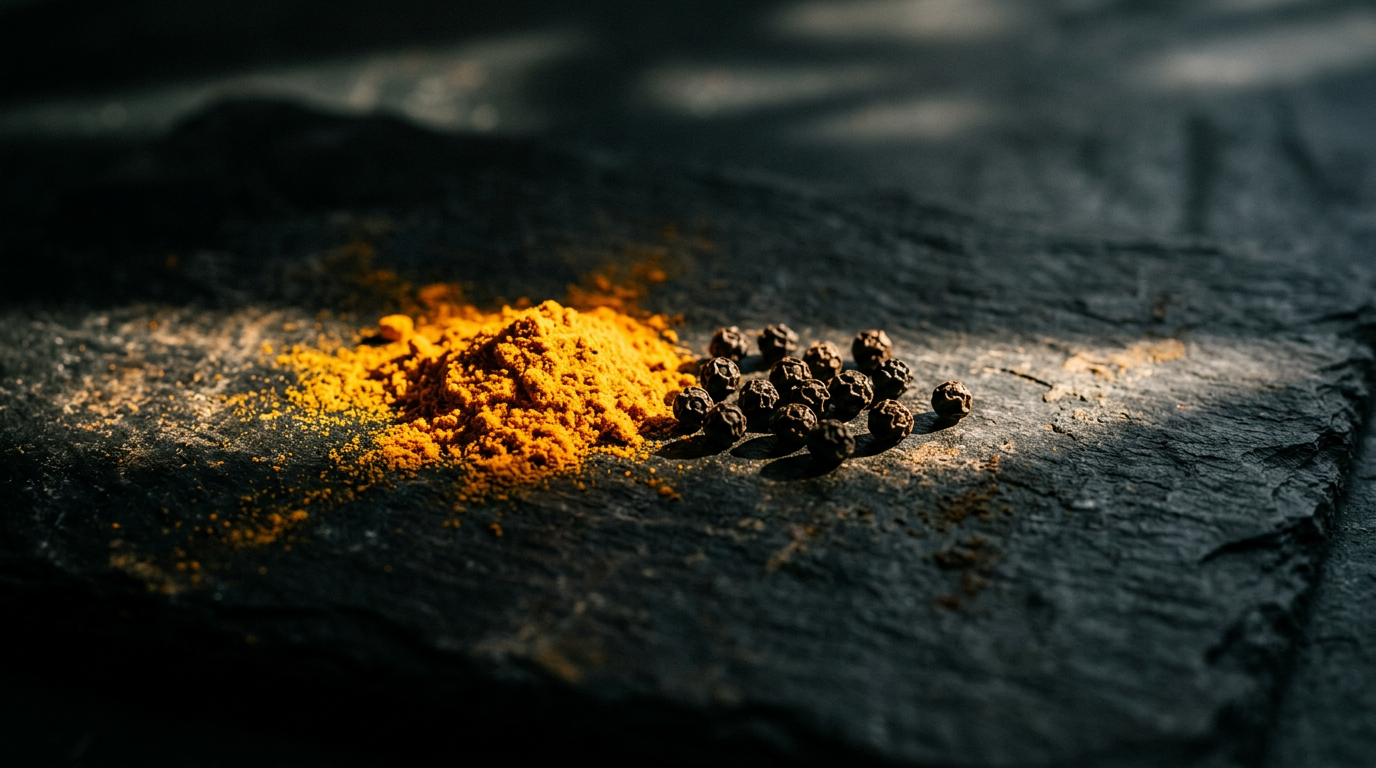
Turmeric is having a moment—a moment that’s lasted about 5,000 years. From the golden glow of a curry to the foam of a turmeric latte, this rhizome has colored our plates and captured our imaginations. Its acclaimed anti-inflammatory properties, largely attributed to a group of compounds called curcuminoids (of which curcumin is the star), have made it a darling of the wellness world [1].
But a quiet truth shadows turmeric’s golden reputation: on its own, it doesn’t do very much. If you’ve been dutifully sprinkling raw turmeric powder into your morning smoothie hoping for a physiological transformation, you’ve likely been experiencing little more than a placebo effect. The problem isn’t the turmeric; it’s a biological bottleneck called bioavailability.
The Bioavailability Trap
Bioavailability is the measure of how much of a substance—be it a nutrient or a drug—actually enters your bloodstream and has an active effect. For curcumin, the numbers are dismally low. When you ingest it by itself, it faces a gauntlet of challenges. First, it has very poor solubility in water, making it difficult to absorb in the gut. Second, what little is absorbed is often rapidly metabolized by the liver and intestinal wall, a process called "first-pass metabolism." Your body essentially sees it, flags it as a foreign substance, and efficiently clears it out before it has a chance to circulate and work its magic [2].
The result? Studies show that even with very high doses of raw curcumin, the levels detected in the blood are often negligible or even undetectable. It’s like sending a critical message that never gets delivered—the messenger is intercepted at every turn.
Wisdom in the Aromatic Matrix
This is where modern science catches up to ancient culinary wisdom. In traditional Ayurvedic practice and Southeast Asian cuisine, turmeric was never treated as a solo act. It was always a team player, integrated into a complex matrix of other spices, herbs, and, crucially, fats.
Think about a traditional Indian curry. Turmeric is bloomed in hot ghee or oil (a fat), often alongside black peppercorns and other spices. Or consider haldi doodh, the original golden milk, which involves simmering turmeric in full-fat milk—a far cry from a dash of powder in hot water. These weren’t just flavor choices; they were brilliant, time-tested delivery systems.
This traditional knowledge implicitly understood what we can now explain with clinical evidence: curcumin needs friends to help it get past the body’s gatekeepers.
The Pepper Partnership
The most famous of curcumin's allies is black pepper. The magic here lies in a compound called piperine, which gives pepper its characteristic pungency. Piperine is a potent bio-enhancer. It works by inhibiting the very enzymes in your liver and intestinal wall that are responsible for ejecting curcumin from your system [3].
It’s like piperine provides curcumin with a disguise, allowing it to slip past the guards. The effect is not trivial. One of the foundational human studies on this synergy found that when taken with just a small amount of piperine, curcumin’s bioavailability was boosted by a staggering 2,000% [3]. That’s the difference between a message that’s ignored and one that’s delivered with a megaphone.
The Lipid Carrier
The other piece of the puzzle is fat. Curcumin is lipophilic, which means it’s “fat-loving” and dissolves in oils rather than water. Consuming turmeric with a healthy fat—like the coconut milk in a Thai curry, the ghee in a dal, or the olive oil in a modern dressing—leverages this property.
When curcumin is dissolved in a fat, it can be absorbed through the lymphatic system, a network that transports fatty acids around the body. This route conveniently bypasses the liver's first-pass metabolic hit, allowing more of the active compound to make it into general circulation [4].
Beyond the Sprinkle
This insight—that the matrix is as important as the molecule—calls into question much of the modern, reductionist approach to wellness. We’ve been conditioned to isolate compounds, concentrate them into pills, and chase high dosages, assuming more is always better. But in the case of turmeric, the intelligence isn’t in the dose but in the delivery. A high-potency curcumin extract without a delivery system is an expensive waste. A sprinkle of turmeric in a non-fat latte is mostly for color.
The real power lies in formulation—in recreating the synergy that traditional foodways discovered centuries ago. It’s a compelling reminder that food is complex chemistry. The most profound effects often come not from a single hero ingredient, but from the intelligent, delicious conversation between them. It’s a shift from seeing food as a collection of parts to appreciating the wholeness of a recipe, where culture and science are perfectly spiced and served together.
Sources & citations
- Prasad, S., & Aggarwal, B. B. (2011). Turmeric, the Golden Spice. In Herbal Medicine: Biomolecular and Clinical Aspects. (2nd ed.). CRC Press/Taylor & Francis. Available from: https://www.ncbi.nlm.nih.gov/books/NBK92752/
- Anand, P., Kunnumakkara, A. B., Newman, R. A., & Aggarwal, B. B. (2007). Bioavailability of curcumin: problems and promises. Molecular pharmaceutics, 4(6), 807–818. https://doi.org/10.1021/mp700113r
- Shoba, G., Joy, D., Joseph, T., Majeed, M., Rajendran, R., & Srinivas, P. S. (1998). Influence of piperine on the pharmacokinetics of curcumin in animals and human volunteers. Planta medica, 64(4), 353–356. https://doi.org/10.1055/s-2006-957450
- Hewlings, S. J., & Kalman, D. S. (2017). Curcumin: A Review of Its Effects on Human Health. Foods, 6(10), 92. https://doi.org/10.3390/foods6100092