
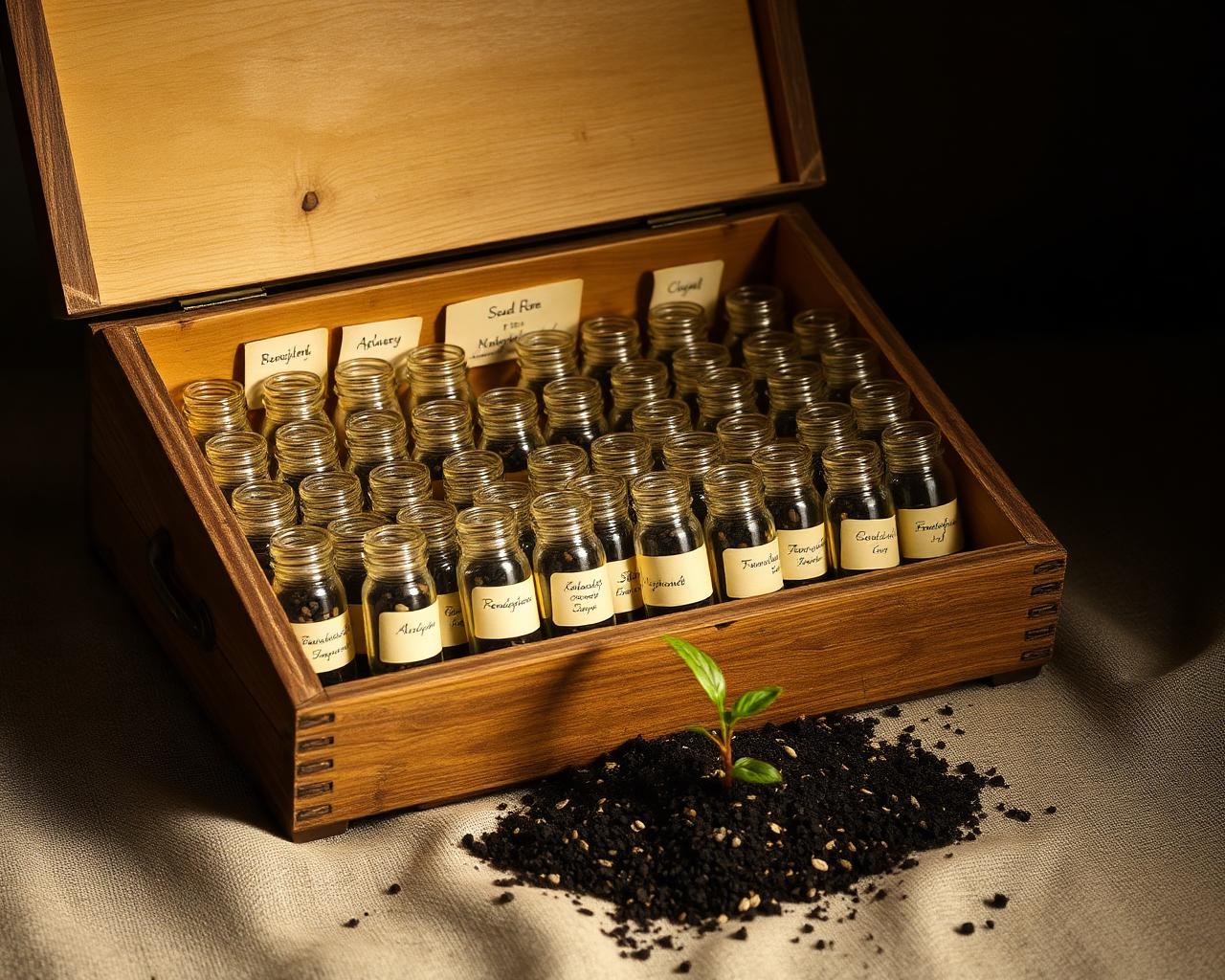
Carved into a Norwegian mountain, 800 miles from the North Pole, the Svalbard Global Seed Vault has a flair for the dramatic. Its entrance, a stark concrete wedge jutting from the permafrost, glows with a turquoise light installation, looking like a portal to another world. The media loves to call it the “Doomsday Vault,” a last-ditch effort to reboot agriculture after an asteroid or nuclear winter.
That makes for a great headline, but it misses the entire point. The vault isn't about some distant, cinematic apocalypse. It’s about the slow-motion crises happening right now: the wars, climate shifts, and economic pressures that quietly erase our planet’s agricultural biodiversity every single day. It’s an insurance policy, and like any policy, the crucial details are in the fine print. So who really owns and controls this global resource? Who can make a withdrawal? And what crucial parts of our food system are missing from the plan?
A Three-Key System
First, let’s be clear: no single country or corporation has control. The vault's governance is a deliberate, three-part partnership designed for neutrality and long-term stability [1]. Think of it as a system requiring three separate keys to operate.
- The Landlord: Norway. The Norwegian Ministry of Agriculture and Food owns the facility itself. They financed and built the vault and are responsible for its physical security and maintenance. By housing it on sovereign Norwegian territory under specific laws, the vault is protected from the political whims of other nations.
- The Manager: The Crop Trust. The Crop Trust is an independent international organization with a single mandate: to conserve and make available crop diversity for food security worldwide. They provide the long-term funding for the vault’s operations, working with governments, foundations, and private donors to build an endowment. Their involvement ensures the vault has a stable financial future, independent of any single government’s annual budget.
- The Operator: NordGen. The Nordic Genetic Resource Center (NordGen) is responsible for the day-to-day operations. They manage the deposits, maintain the database of what’s inside, and coordinate with gene banks around the world.
This structure creates a series of checks and balances. Norway provides the secure location, the Crop Trust provides the permanent funding, and NordGen provides the technical expertise. No one party can change the mission or access the seeds without the cooperation of the others.
It’s a Safety Deposit Box, Not a Bank
The most critical point about control is this: Svalbard operates like a safety deposit box at a bank, not a checking account. The vault’s operators do not own the seeds inside. The seeds remain the sole property of the institution that deposited them [2].
When a gene bank—say, from Brazil or India or the United States—sends seeds to Svalbard, they are placing them in a sealed, anonymous black box. The vault staff catalogs the box, not its contents. They cannot open it, test the seeds, or give them to anyone else. Only the original depositor can request a withdrawal.
This “black box” system is a deliberate answer to the fraught politics of genetic resources. It prevents biopiracy and ensures that countries, particularly developing nations, don't fear losing control of their native crops by backing them up. The vault isn't a central bank of seeds for the world to use; it's a secure backup facility for hundreds of individual gene banks around the globe.
The First and Only Withdrawal
The vault’s purpose was put to the test not by a global doomsday, but by a regional catastrophe: the Syrian civil war. The International Center for Agricultural Research in the Dry Areas (ICARDA) had one of the world's most important gene banks, located in Aleppo, Syria. It held priceless collections of heat- and drought-tolerant varieties of wheat, barley, and lentils—crucial for arid regions. The war made the facility inaccessible [3].
Fortunately, ICARDA had been a diligent depositor, sending duplicates of its collection to Svalbard. Starting in 2015, they made the first-ever withdrawal from the vault. They used the seeds not to feed people directly, but to painstakingly regenerate their entire collection at new facilities in Morocco and Lebanon. Once they had regrown the seeds and rebuilt their supply, they began re-depositing new seeds back into Svalbard to replenish their backup copy [4].
This story is the perfect illustration of the vault’s true mission. It worked exactly as designed, providing a failsafe that allowed a vital scientific collection to survive the chaos of war.
What's Not in the Vault
For all its importance, Svalbard isn’t—and can’t be—a complete collection of our food heritage. Its purpose has specific limitations.
First, it only backs up other gene banks. If a rare heirloom tomato variety only exists in a single village in Italy and isn't in a national gene bank, it's not in Svalbard. The vault is a safeguard for institutional collections, not a replacement for the on-farm, in-situ conservation done by farmers for millennia.
Second, freezer storage doesn't work for all plants. Many of our most beloved foods, like avocados, mangoes, coconuts, and cacao, produce what are known as “recalcitrant seeds.” These seeds are physiologically unable to survive the drying and deep-freezing process [5]. They must be preserved in living collections—essentially curated orchards and fields. The same is true for crops that are propagated by cuttings, not seeds, like bananas, yams, and potatoes. These are saved as living plants or in high-tech tissue culture labs.
Svalbard is a brilliant, necessary piece of the global food security puzzle. But it's just one piece. The real work of protecting biodiversity happens in a distributed network: in the national gene banks it backs up, in the botanical gardens that conserve recalcitrant species, and most importantly, in the fields of farmers who are the original stewards of crop diversity. The vault is our insurance policy, but the real wealth is the living, breathing agricultural system it’s designed to protect.
Sources & citations
- The Crop Trust. (n.d.). Svalbard Global Seed Vault. Retrieved from https://www.croptrust.org/our-work/svalbard-global-seed-vault/
- Norwegian Ministry of Agriculture and Food. (n.d.). Svalbard Global Seed Vault - FAQs. Retrieved from https://www.regjeringen.no/en/topics/food-fisheries-and-agriculture/svalbard-global-seed-vault/faq-svalbard-global-seed-vault/id2002226/
- Fowler, C. (2016, September 19). How the Syrian Civil War Led to the First Withdrawal From the Global Seed Vault. National Geographic. Retrieved from https://www.nationalgeographic.com/environment/article/food-ark-syria-seed-vault
- United Nations. (2022, February 14). Feature: Global seed vault in the Arctic marks 10 years of saving world’s food supply. UN News. Retrieved from https://news.un.org/en/
- Food and Agriculture Organization of the United Nations (FAO). (2010). The Second Report on the State of the World's Plant Genetic Resources for Food and Agriculture. Retrieved from https://www.fao.org/home/en/