
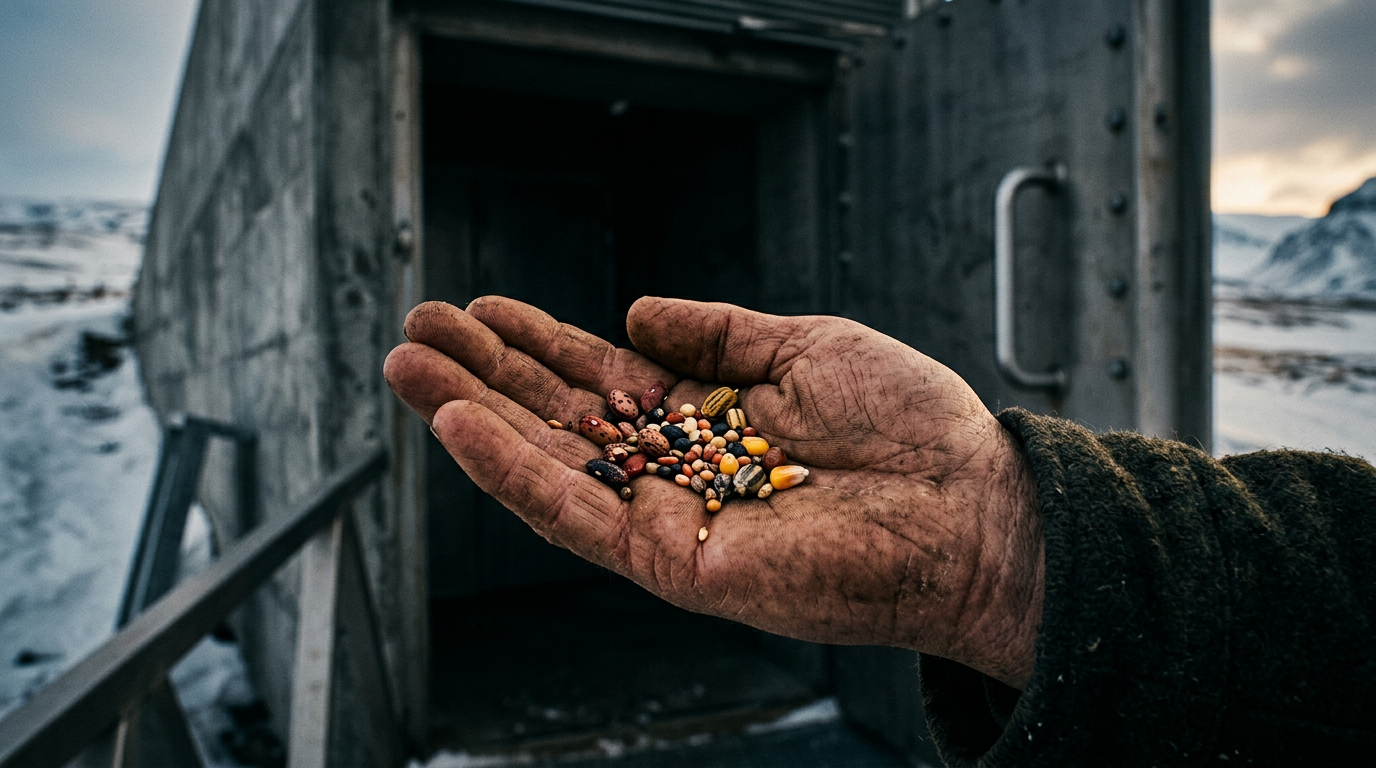
A seed is a story. It’s a promise. For millennia, it has been the source code of human survival, passed down through generations of farmers who selected for flavor, resilience, and local adaptation. Today, this precious inheritance is being safeguarded in a high-tech fortress buried in Arctic permafrost: the Svalbard Global Seed Vault.
Often called the “doomsday vault,” Svalbard is humanity’s agricultural insurance policy, designed to protect duplicates of the world’s crop diversity from war, climate change, and disaster. It’s a compelling idea, operated by the Norwegian government and the international organization Crop Trust. But who holds the keys? And more importantly, who controls the seeds we actually plant and eat today?
The answer should concern every one of us.
The Vault in the Ice: A Flawed Ark?
Svalbard doesn’t own the seeds it holds. It’s a planetary-scale safe deposit box. Over 1,700 genebanks from around the world deposit backup copies of their collections, and they retain ownership. The vault’s operational costs are covered by an endowment managed by the Crop Trust, which receives funding from governments, foundations, and private corporations.
As reported by news outlets like The Guardian, donors to the Crop Trust have included major agricultural corporations like Syngenta and Bayer [1]. This presents a staggering paradox. The very companies whose business models—based on patented, proprietary seeds and chemical-intensive monocultures—are considered a primary driver of crop diversity loss are also helping fund the preservation of the seeds they’re helping to eliminate from our fields.
While the vault provides a critical backstop, it can’t stop the erosion of biodiversity happening right now. It preserves seeds in a frozen stasis, divorced from the farmers and ecosystems where they co-evolved. The real power lies not in who manages the backup, but in who owns the active, living system.
Meet the Big Four
Welcome to the modern seed market. It’s an oligopoly. According to reporting on industry consolidation, just four interlocking chemical and seed conglomerates now control over 60% of the world's proprietary seed sales [2].
- Bayer: The German pharmaceutical and life sciences giant that acquired Monsanto in 2018.
- Corteva Agriscience: The agricultural spin-off from the merger of Dow and DuPont.
- ChemChina: A Chinese state-owned chemical enterprise that acquired Swiss giant Syngenta.
- BASF: Another German chemical company that acquired a significant portion of Bayer's seed and herbicide businesses as a condition of the Monsanto merger.
Their strategy is brilliantly simple and deeply effective: sell farmers a closed-loop system. The seeds are often patented—either as hybrids that don’t produce reliable offspring or as genetically modified organisms (GMOs)—and are frequently designed to work with the company's proprietary herbicides and pesticides. This package deal can lock farmers into a dependency cycle, forcing them to buy new seed and accompanying chemicals every year. It marginalizes alternative approaches and makes it more difficult for smaller, independent seed breeders to compete.
The Patent Problem: Owning Life Itself
For most of agricultural history, the idea of “owning” a seed variety would have been absurd. Seeds were a common heritage, freely saved, exchanged, and improved upon by farming communities. This changed dramatically in the late 20th century, particularly after a 1980 U.S. Supreme Court decision, Diamond v. Chakrabarty, allowed for utility patents on living organisms.
Today, a corporation can patent not just a genetically engineered plant, but a specific genetic trait found in nature. This has led to sprawling legal battles. In a famous case documented by international agricultural bodies, a U.S. company was granted a patent on a yellow bean variety functionally identical to beans cultivated by Mexican farmers for generations. It took nearly a decade of costly legal challenges for the patent to finally be revoked [3].
For farmers, this legal landscape is a minefield. Saving seeds from a patented crop, a practice as old as civilization, is now widely considered patent infringement. Every year, many farmers must repurchase seeds, surrendering their autonomy and a crucial tool for adapting crops to their local environment.
Why This Matters on Your Plate
This concentration of power isn’t an abstract issue for economists and activists. It fundamentally shapes the food available to us.
A Loss of Diversity and Flavor: The Food and Agriculture Organization of the United Nations (FAO) has estimated that 75% of crop genetic diversity was lost during the 20th century [4]. The corporate focus on a few dozen globally traded commodity crops—bred for uniformity, durability in shipping, and compatibility with chemical inputs—has pushed thousands of flavorful, nutrient-dense, and locally-adapted heirloom varieties toward the brink of extinction.
A Brittle Food System: Genetic uniformity is a massive liability. When millions of acres are planted with a single, genetically identical variety, our food supply becomes dangerously vulnerable to a new pest, disease, or the stresses of a changing climate. The Irish Potato Famine of the 1840s stands as the starkest historical lesson in the perils of relying on a single genetic stock.
Less Control for Everyone: When a handful of executives in a few boardrooms can influence what is grown on a global scale, we all lose. Their primary fiduciary duty is to their shareholders, not necessarily to public health, ecological resilience, or the culinary richness that biodiversity provides.
Seed sovereignty is the simple, radical idea that people—not corporations—should have the right to save, use, exchange, and sell seeds. It’s not just a farmer’s issue; it’s an eater’s issue. By supporting small-scale farmers who save their own seeds, buying from heirloom seed companies, and choosing brands that value biodiversity, we can help reclaim the story of food. Because the more people who hold a piece of our food system's source code, the more resilient and delicious our future will be.
Sources & citations
- The Guardian. (2018). "‘Doomsday’ seed vault grants draw fire for big-business links." `https://www.theguardian.com/environment/2018/jun/10/doomsday-seed-vault-draws-fire-for-big-business-links`
- The Guardian. (2019). "How a handful of corporations came to control our food." `https://www.theguardian.com/environment/2019/may/28/how-a-handful-of-corporations-came-to-control-our-food`
- Food and Agriculture Organization of the United Nations (FAO). (2006). "The Enola Bean Dispute: Biopiracy in the Spotlight." `https://www.fao.org/legal/databases/faolex/case-studies/detail/en/c/165971/`
- Food and Agriculture Organization of the United Nations (FAO). (2004). "The State of Food and Agriculture 2003-2004, Part I: Agricultural Biotechnology." `https://www.fao.org/docrep/006/Y5050E/y5050e05.htm`