
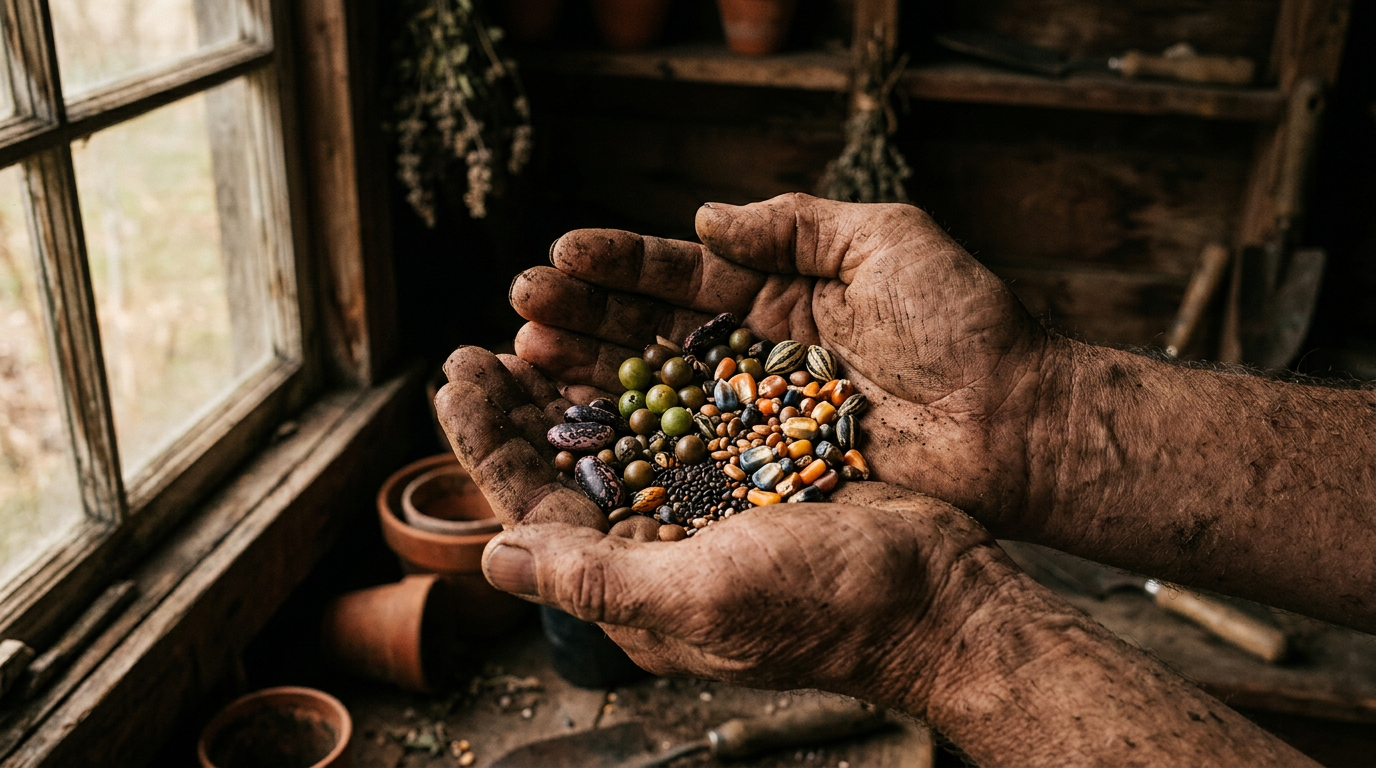
A seed is a promise. It’s the promise of a harvest, the promise of nourishment, and the promise of another season. For nearly 10,000 years of agriculture, that promise was a shared one—a common heritage passed between farmers, communities, and generations. But what happens when that promise comes with a patent, a licensing agreement, and a legal team?
Welcome to the sharp end of the food system, where the DNA of life itself has become intellectual property. This isn't just a distant legal squabble. It’s a battle for control over the first link in our food chain, and its frontline is moving faster and getting closer to home than ever before.
The Ghost of Monsanto
To understand the future, we have to look at the recent past. The 'Monsanto Playbook,' now carried on by its parent company Bayer, was brutally effective. First, genetically modify a seed, often for resistance to a proprietary herbicide (like Roundup). Second, patent that new seed as an invention. Third, create a contract that forbids farmers from doing what they have done for millennia: saving seeds from their own harvest for the next planting. Finally, prosecute—aggressively.
The most infamous example is that of Percy Schmeiser, a Canadian canola farmer. In the late 1990s, Monsanto’s patented Roundup-Ready canola was found growing on his fields. Schmeiser maintained he never planted it; the seeds had blown over from a neighboring farm or fallen off a passing truck. It didn’t matter. After a decade of legal battles that went to Canada’s Supreme Court, the ruling essentially established that the presence of a patented gene in a farmer's crop, regardless of how it got there, constituted infringement [1]. The farmer was no longer sovereign over his own fields.
This strategy, combined with aggressive mergers and acquisitions, has led to staggering market consolidation. Today, just three corporations—Bayer (Monsanto), Corteva (DowDuPont), and Syngenta Group (ChemChina)—control over 60% of the global proprietary seed market [2]. This concentration of power limits choice, stifles innovation, and creates a dependency that leaves farmers and our food system vulnerable.
2026: The New Playbook is Subtler, Sharper
If the first wave of GMOs was about introducing foreign genes, the next wave is about editing native ones. Technologies like CRISPR-Cas9 act like a biological find-and-replace tool, allowing scientists to make tiny, precise tweaks to a plant’s own DNA. They can 'silence' a gene that causes browning in apples or 'enhance' one that affects yield in corn. Because this process doesn't necessarily introduce DNA from another species, corporations argue it's just an accelerated form of conventional breeding.
Here’s where it gets insidious. A company can now take a cherished heirloom tomato—one cultivated for generations by an Indigenous community in the Andes for its unique flavor and drought resistance—and use CRISPR to alter a single gene for slightly longer shelf life. They can then file a patent on that “new” variety, effectively claiming ownership over a piece of shared biological and cultural heritage.
This is biopiracy 2.0. It's subtler than the old GMO model but far more sweeping in its implications. It allows for the privatization of traits that nature and centuries of careful stewardship created. The 'invention' is minimal, but the claim of ownership is total. By 2026, we are seeing a rush to patent the very characteristics of heirloom varieties that make them so valuable, cloaked in the language of minor genetic edition.
The Human Cost of a Handful of Seeds
For farmers in the Global North, the playbook means lawsuits and licensing fees. For farmers in the Global South, it can be a matter of life and death. The push for patented, high-input seeds has created devastating cycles of debt in countries like India. Farmers are often compelled to buy expensive corporate seeds—along with the specific fertilizers and pesticides they require—from one season to the next. The age-old practice of saving seed is prohibited.
When a harvest fails due to drought, or market prices collapse, farmers are left with crushing debt and no seeds for the following year. This unbearable pressure is a widely cited factor in the tragic epidemic of farmer suicides that has plagued India for decades [3]. When we decouple farmers from their seeds, we sever a lifeline of both economic and cultural survival.
Planting Resistance: The Rise of Seed Sovereignty
But a powerful counter-movement is growing from the ground up. It’s called seed sovereignty: the right of farmers and communities to breed, use, exchange, and save their own seeds. It is a declaration that seeds are not a commodity, but a commons.
All over the world, this resistance takes the form of community seed banks and exchanges. Unlike the well-known Svalbard Global Seed Vault, which is a “doomsday” backup frozen in the Arctic, these are living libraries. They are active, decentralized networks where farmers can access, trade, and cultivate a diverse array of locally-adapted, open-pollinated seeds.
Groups like Navdanya, founded by Dr. Vandana Shiva in India, have created over 150 community seed banks across the country, preserving thousands of heirloom varieties and empowering farmers to exit the cycle of debt [4]. In the United States, the Seed Savers Exchange has been a bastion for preserving and sharing heirloom seeds for nearly 50 years. These initiatives aren't anti-science; they are pro-diversity. They recognize that the most advanced technology we have for building a resilient food system is the vast genetic library of biodiversity.
As eaters, founders, and investors, we are not passive observers in this story. The food we choose to buy, the supply chains we build, and the companies we support all have an impact. We can seek out producers who use heirloom varieties. We can support brands that champion biodiversity. And we can invest in a future where our food system’s resilience is measured not by the uniformity of its patents, but by the diversity of its seeds.
The most radical act in food today might just be saving a seed.
Sources & citations
- The Guardian staff and agencies. (2004, May 21). Monsanto wins case against farmer. The Guardian. https://www.theguardian.com/world/2004/may/21/foodanddrink.business
- FAO. (2019). The State of the World’s Biodiversity for Food and Agriculture. Food and Agriculture Organization of the United Nations. http://www.fao.org/state-of-biodiversity-for-food-and-agriculture/en/
- Kennedy, J., & King, L. (2014). The political economy of farmers’ suicides in India: indebted cash-crop farmers with marginal landholdings explain state-level variation in suicide rates. Globalization and Health, 10(1), 16. https://www.ncbi.nlm.nih.gov/pmc/articles/PMC3994356/
- Navdanya International. Our Story. (n.d.). https://navdanyainternational.org/who-we-are/our-story/
- Shukla-Jones, A., & Blais, H. (2022). Who Owns CRISPR? A Look at the CRISPR Patent Landscape. Berkeley Law, University of California. https://www.law.berkeley.edu/research/bclt/