
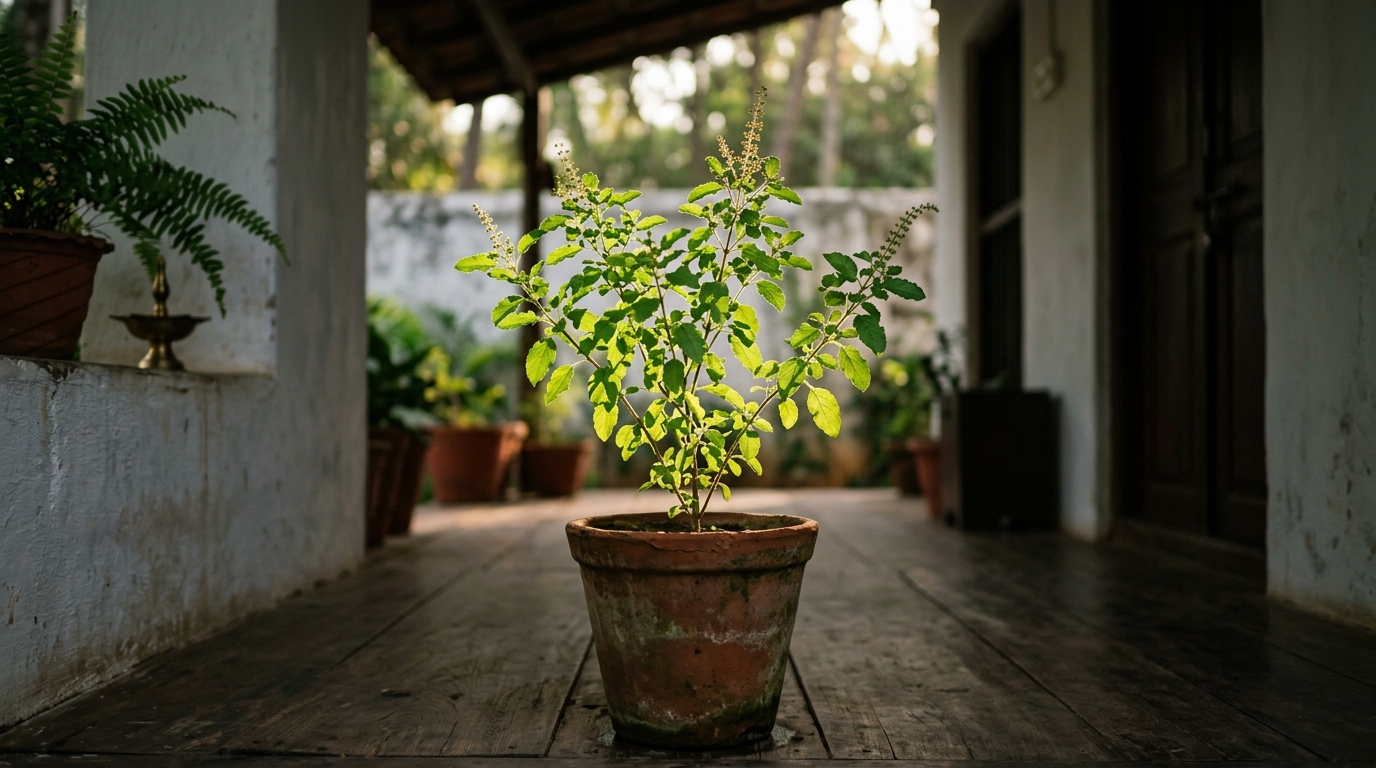
In the quiet of an Indian morning, before the day’s heat and hustle take hold, you’ll often find a moment of ritual. A small brass pot of water is poured into the soil of a plant that sits in a place of honor, often in a central courtyard or on a veranda. This plant is Tulsi, or holy basil (Ocimum tenuiflorum), and this daily act of watering and worship is more than simple gardening. It is a quiet acknowledgment of the plant known as the “Queen of Herbs,” a living embodiment of wellness woven into the fabric of domestic life for millennia.
For generations, this reverence was simply understood. Tulsi was a protector of the home, an aid for coughs and colds, a symbol of purity. But in our modern language of wellness, which demands data points and mechanisms of action, we ask a different question: what is it actually doing?
As the wellness industry has latched onto ancient botanicals, a new vocabulary has emerged. Words like “adaptogen”—a substance meant to help the body adapt to stress—are now commonplace. Tulsi is frequently crowned as a primary example. This has us wondering: Is this just a new marketing label for an old practice, or is there a measurable, physiological reason why millions of people have cultivated this plant as a guardian of their wellbeing for thousands of years? The answer appears to lie in our body's primary stress hormone: cortisol.
The Body's Alarm System
Cortisol is your body’s built-in alarm system. Produced by the adrenal glands, it’s the primary hormone released when you encounter a threat, real or perceived. It floods your body to make you more alert, raising blood sugar for quick energy and priming your muscles for a fight-or-flight response. This system is brilliant for acute, short-term threats, like swerving to avoid a car. But it was not designed for the chronic, low-grade stressors of modern life: the incessant phone notifications, the back-to-back video calls, the ambient hum of economic anxiety.
When the cortisol alarm is always on, the system begins to break down. Chronic elevation of cortisol is linked to a cascade of modern ailments, from metabolic issues and weight gain to impaired immune function and mental fog [1]. This is the landscape where an herb traditionally revered for bringing balance meets the quantifiable scrutiny of clinical science.
From Ritual to Research
Modern research offers a new lens through which to view Tulsi's ancient reputation. A growing body of evidence suggests that holy basil does, in fact, help the body manage its stress response. A systematic review of human studies published in 2017 found that Tulsi had favorable effects on psychological and immunological stress, as well as metabolism [2].
Rather than simply “blocking” or “lowering” cortisol, which would be a blunt and potentially unhelpful intervention, Tulsi appears to work as a true adaptogen. It helps modulate the hypothalamic-pituitary-adrenal (HPA) axis—the complex feedback loop that governs our stress response. Think of it less as an off-switch and more as a sophisticated thermostat, helping your body return to a state of balance, or homeostasis.
The plant’s power is not from a single “magic bullet” compound, but from a complex synergy of phytochemicals. Compounds like eugenol, rosmarinic acid, and ursolic acid have been shown to have antioxidant, anti-inflammatory, and neuroprotective properties [3]. They work in concert to buffer the physiological cascade that begins in the brain and ends with the adrenal glands pumping out cortisol.
It’s a fascinating case of modern science providing a new vocabulary for an ancient outcome. The calm that a cup of Tulsi tea brings is not just a feeling; it’s a biochemical event.
More Than a Molecule
But to reduce Tulsi to a set of active compounds is to miss the point, and perhaps to misunderstand the very nature of holistic wellness. The traditional practice was never about isolating a molecule. The ritual is part of the remedy.
The simple act of brewing and sipping Tulsi tea is an invitation to pause. It is a sensory experience—the warm, clove-like aroma, the gentle steam, the earthy flavor. This deliberate moment of calm is, in itself, an intervention against the relentless pace of modern life. The science validates the herb, but the ritual enacts the healing.
This is why provenance matters. The three main varieties of Tulsi—Rama, Krishna, and Vana—each have distinct aromatic profiles and slightly different phytochemical compositions, shaped by the soil and climate in which they are grown. Sourcing from growers who understand this plant not just as a crop, but as a sacred herb, ensures a level of quality and integrity that a commodity ingredient could never match. The plant’s vitality is inseparable from the health of the ecosystem and the respect of the community that cultivates it.
The woman on the veranda watering her Tulsi plant isn’t thinking about her HPA axis. Her practice is one of reverence, care, and connection. Yet, her actions are validated by the latest clinical research. It turns out that ancient wisdom and modern science are not in opposition; they are simply two different languages describing the same fundamental truth. The Queen of Herbs has earned her crown, both in the courtyard and in the lab.
Sources & citations
- Hannibal, K. E., & Bishop, M. D. (2014). Chronic stress, cortisol dysfunction, and pain: a psychoneuroendocrine rationale for stress management in pain rehabilitation. Physical therapy, 94(12), 1816–1825.
- Jamshidi, N., & Cohen, M. M. (2017). The Clinical Efficacy and Safety of Tulsi in Humans: A Systematic Review of the Literature. Evidence-based complementary and alternative medicine, eCAM, 2017, 9217567.
- Mondal, S., Varma, S., Bamola, V. D., Naik, G., Mirdha, B. R., Padhi, M. M., Mehta, N., & Mahapatra, S. C. (2011). Double-blinded randomized controlled trial for immunomodulatory effects of Tulsi (Ocimum sanctum Linn.) leaf extract on healthy volunteers. Journal of ethnopharmacology, 136(3), 452–456.
- Cohen, M. M. (2014). Tulsi - Ocimum sanctum: A herb for all reasons. Journal of Ayurveda and integrative medicine, 5(4), 251–259.
- "Holy basil". Encyclopædia Britannica. https://www.britannica.com/plant/holy-basil