
If your picture of the Indian pantry was formed by a supermarket aisle, you’d be forgiven for thinking it a tidy affair. Turmeric, cumin, coriander, chili. Perhaps a bottle of garam masala, a blend whose name promises warmth but whose contents are often a dusty compromise.
This isn't a critique; it's an observation of loss. The modern spice rack is a product of immense historical distillation. It’s what was left after colonial trade routes, industrial efficiency, and Western palates flattened a subcontinent’s worth of flavor into a few reliable commodities. The spices that were harder to harvest, more complex in flavor, or required a bit more knowledge to use were pushed to the margins.
But they never disappeared. They remained in regional kitchens, in Ayurvedic texts, and in the memory of the land. Now, as we collectively seek more nuance, more history, and more function from our food, it’s time to re-open the spice box. Let's meet three key characters who were written out of the mainstream story: long pepper, mace, and asafoetida.
Long Pepper: The Roman Empire's Favorite
Long before peppercorns (Piper nigrum) dominated the global table, Europe was captivated by its cousin, long pepper (Piper longum), or Pippali. It was the original pepper, documented in ancient Greek and Roman texts and prized for a complex heat that arrives with notes of ginger, cardamom, and cinnamon. So why did it vanish?
Because black pepper was easier. The round peppercorn was simpler to harvest and process in bulk, making it a more efficient commodity for the burgeoning global trade. Long pepper, with its delicate, cattail-like structure, fell out of favor.
In India, however, its importance was never just culinary. In Ayurveda, Pippali is a cornerstone ingredient, a key component of the famous digestive and respiratory tonic Trikatu (The Three Pungents) [1]. It was prized for its ability to increase agni, or digestive fire, and for its role as a bio-enhancer. The same active compound, piperine, that gives pepper its punch has been clinically shown to dramatically increase the absorption of other compounds, from curcumin in turmeric to vitamins and minerals [2]. Long pepper contains piperine, but also a unique alkaloid called piperlongumine, which is the subject of a compelling body of modern research for its own distinct properties. Its revival isn't just about recovering a lost taste; it’s about reconnecting with a more functional understanding of spice.
Mace: The Secret Other Half
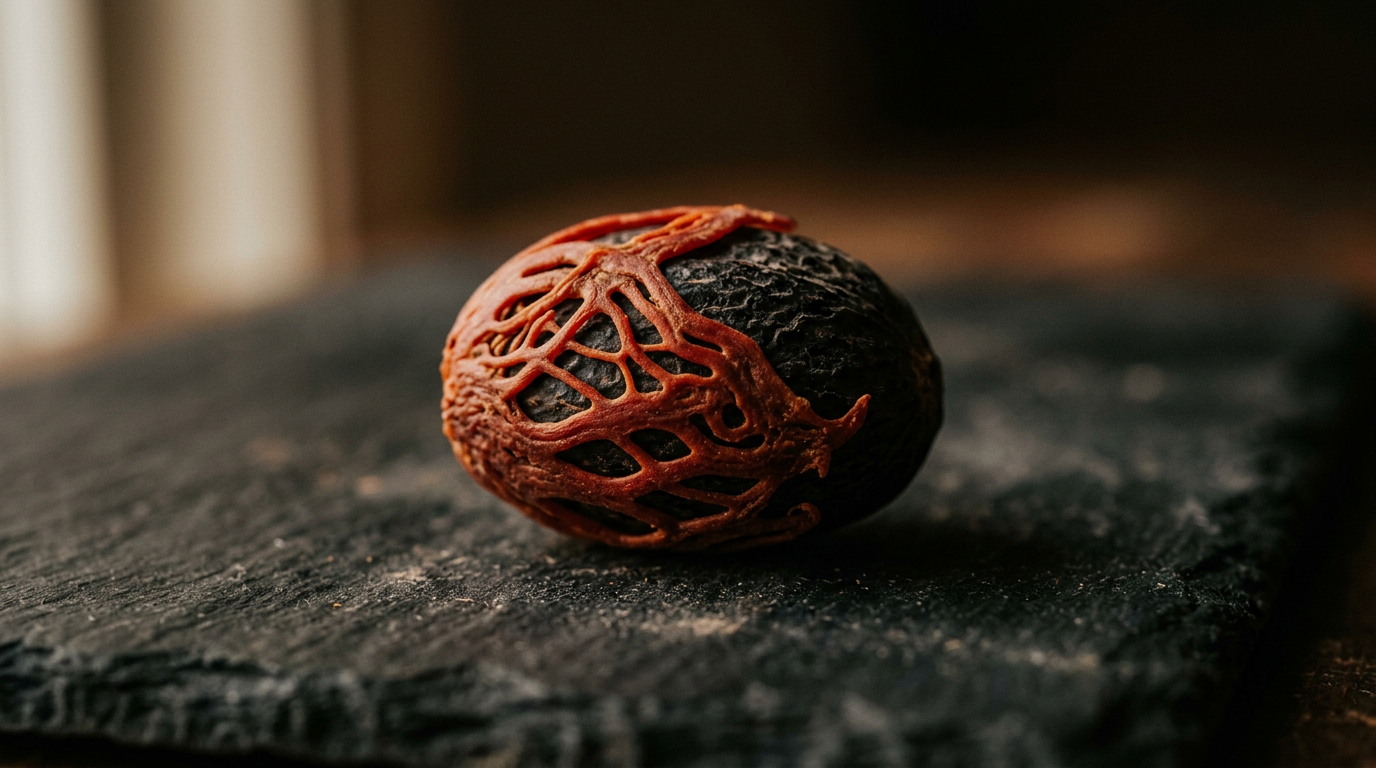
Walk through a spice plantation in Kerala or the Banda Islands of Indonesia, and you might miss the magic. A fruit, looking like a small apricot, hangs from a tree. This is the source of nutmeg. But when the fruit ripens and splits, it reveals something extraordinary: a seed (nutmeg) covered in a waxy, blood-red, lace-like webbing. This is mace.
Nutmeg and mace are two distinct spices from the same fruit. Yet where nutmeg is warm, woody, and sweet, mace is its ethereal counterpart: more delicate, with startling notes of citrus, clove, and black pepper. It’s the difference between a cello and a violin.
Its history is tied to one of the most brutal chapters of colonial expansion. The Dutch East India Company’s quest to monopolize nutmeg and mace led to the violent subjugation of the Banda Islands, the world’s only source for centuries [3]. The VOC's business model required simplifying the story, marketing the two spices separately and creating a supply chain that rewarded volume over nuance. In the process, the poetry of their shared origin was lost on the world. Yet in the royal kitchens of Mughal India, cooks understood its power, using mace to subtly perfume biryanis and kormas without the heaviness of other sweet spices. Modern analysis confirms what these cooks knew by taste: mace has a different balance of volatile oils than nutmeg, containing a higher concentration of compounds that contribute to its bright, floral aroma [4].
Asafoetida: The Alchemical Allium
Let’s be direct: in its raw, resinous form, asafoetida (Ferula asa-foetida) smells aggressively pungent. Its common name, hing, is friendlier than its old English moniker, “devil’s dung.” It is the dried latex tapped from the root of a giant fennel-like plant native to the deserts of Iran and the mountains of Afghanistan.
To judge it by its raw smell is to miss the point entirely. This is a spice of transformation. When a tiny pinch is bloomed in hot ghee or oil, a stunning alchemy occurs. The sulfuric pungency mellows and disappears, replaced by a deeply savory, onion-garlic flavor that undergirds countless Indian dishes. It is the invisible foundation.
Its function is particularly brilliant in culinary traditions, like those of Jains and certain Brahmin communities, that avoid onions and garlic. Hing is not a substitute; it’s a distinct tool that provides that satisfying umami allium base. For thousands of years, Ayurveda has revered it as one of the most powerful aids for digestive health, particularly for relieving gas and bloating [1]. This is no longer just folk wisdom. Modern science is beginning to investigate the sulfur compounds in asafoetida, which demonstrate a range of biological activities and may contribute to its legendary digestive benefits [5]. In a world newly obsessed with gut health, an ancient answer has been waiting on the shelf all along.
These three spices are more than ingredients. They are invitations—to taste with more attention, to look past the convenient narrative, and to understand that the future of our pantry may well be found in its forgotten past.
Sources & citations
- Tilgner, S. (2020). Ayurvedic Botany. Wise Acres LLC. (Summary available through various herbal medicine resources; for a peer-reviewed context, see Johns Hopkins Medicine's page on Ayurveda: https://www.hopkinsmedicine.org/health/wellness-and-prevention/ayurveda)
- Mhaske, S., et al. (2018). "Piperine: A review of its biological effects." International Journal of Pharmaceutical Sciences and Research. (General findings on piperine's bioavailability can be found in numerous articles on PubMed Central: https://www.ncbi.nlm.nih.gov/pmc/)
- "Spice trade." Encyclopædia Britannica. https://www.britannica.com/topic/spice-trade
- Leela, N. K. (2008). "Chemistry of Nutmeg and Mace." Nutmeg and Mace: Chemistry, Manufacturing, and Quality Management. (Overview available via food science journals like Foods on MDPI: https://www.mdpi.com/journal/foods)
- Amalraj, A., & Gopi, S. (2017). "Biological activities and medicinal properties of Asafoetida: A review." Journal of Traditional and Complementary Medicine, 7(3), 347–359. https://www.ncbi.nlm.nih.gov/pmc/articles/PMC5506628/