
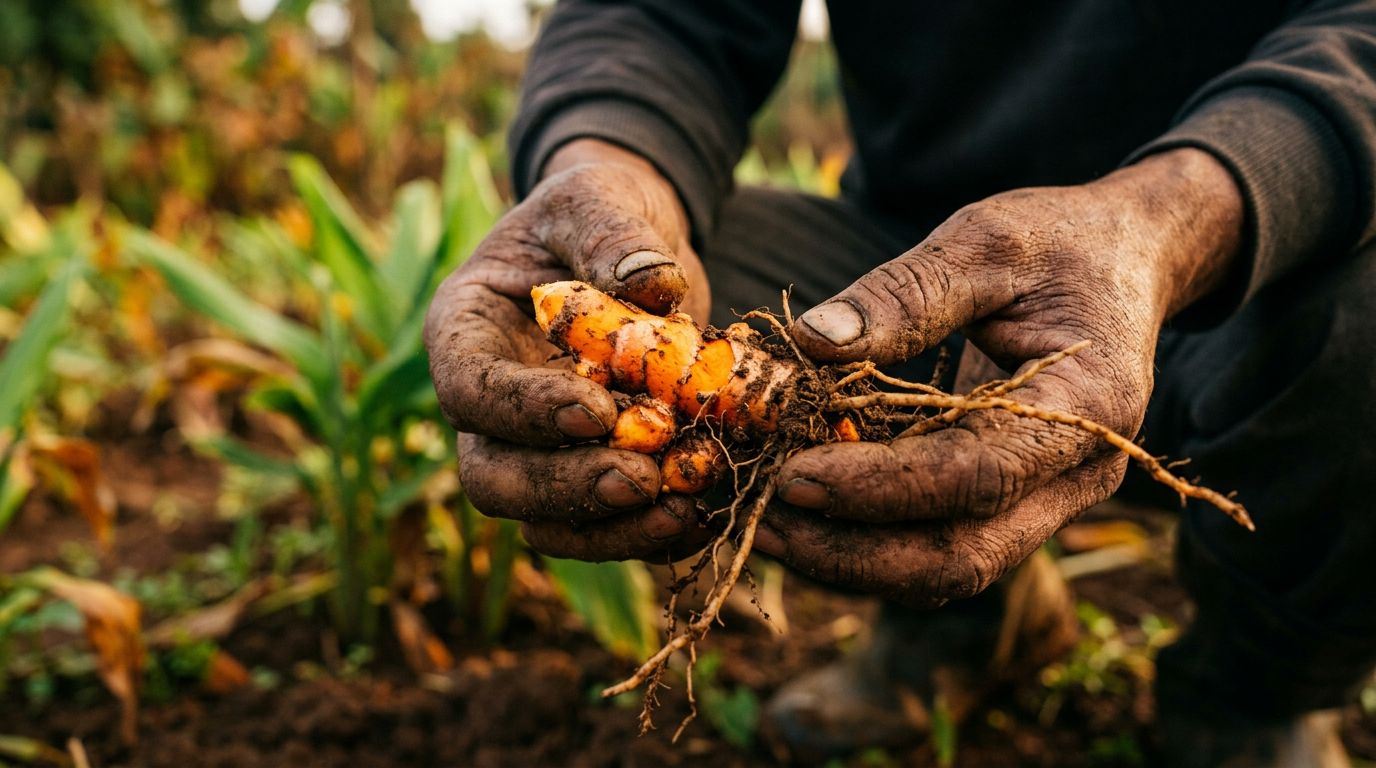
We tend to think of spices in their final form: a fragrant powder, a vibrant color blooming in hot oil. For turmeric, we think of curcumin, the potent bioactive compound at the heart of its healing reputation. We look for high percentages on a label, seeing it as a mark of quality.
But what if the most important ingredient in a truly powerful turmeric isn't the curcumin molecule itself, but the dark, fragrant, living earth it was grown in?
Modern industrial agriculture has taught us to see soil as an inert medium—a mere anchor for roots, to be flooded with synthetic fertilizers and pesticides. This approach has consequences. Decades of intensive monoculture have left vast tracts of farmland depleted and eroded, little more than dust [1]. For a crop like turmeric, this sterile environment is a disaster. A plant grown in weak soil is a weak plant. It struggles to produce the very compounds we value it for, resulting in a spice that is often more dusty than dynamic, with curcumin levels that barely register.
There is, however, a different way. High in the rain-soaked Khasi and Jaintia Hills of Meghalaya in Northeast India, a different story is unfolding. This is the home of Lakadong turmeric, a variety famed for its deep orange hue and exceptionally high curcumin content, which can range from 7% to over 12%—more than triple that of standard varieties [2].
Yet, the secret isn't just in the plant's genetics. It’s in the soil, and the centuries-old wisdom used to tend it.
The Wisdom of Living Soil
For generations, farmers in Meghalaya have practiced a form of regenerative farming rooted in deep ecological understanding. Practices like Jhum, a rotational system of shifting cultivation, allow the land to lie fallow and regenerate its native fertility. Instead of sterile monocultures, turmeric is intercropped with ginger, chilies, and other staples. This biodiversity creates a resilient ecosystem, attracting beneficial insects and discouraging pests without a single drop of chemical spray.
This isn't neglect; it's active, intelligent stewardship. The result is a soil that is profoundly, intensely alive.
A single teaspoon of this healthy soil contains billions of microbes—bacteria, fungi, and other microscopic life forms [3]. This is the soil microbiome, an underground network that acts as the plant's external digestive and immune system. Tiny threads of mycorrhizal fungi form a symbiotic relationship with the turmeric's roots, vastly expanding their reach. These fungi trade sugars from the plant for crucial minerals like phosphorus, which are essential for developing the dense, nutrient-packed rhizomes where curcumin is synthesized and stored.
Other microbes act as bodyguards, producing compounds that ward off harmful pathogens, while the complex structure created by all this life turns the soil into a sponge. This is the quiet, critical climate adaptation happening at the root level.
Resilience in a Changing Climate
The ability of healthy soil to retain water is not a trivial detail. As weather patterns become more erratic, the sponge-like quality of this living earth offers profound resilience. It absorbs the intense rainfall of the monsoons, preventing topsoil erosion, and then slowly releases that moisture during dry spells. A conventionally farmed plot might wash away or dry out, but here, the crop remains stable and nourished.
This is how you get quality not just for one season, but consistently. Farmers we partner with in Meghalaya, like those in the Mulum-based cooperative society, think in terms of decades and generations, not just single harvests. They understand that by feeding the soil with compost and biomass, they are ensuring the vitality of the land for their children. It’s a level of long-term thinking that is systematically ignored by a food system chasing short-term yield above all else.
Ultimately, this ancient wisdom, now validated by modern microbiology, creates a spice that is fundamentally different. The rich, floral, and earthy notes in true Lakadong turmeric are the taste of a thriving ecosystem. This complexity—the terroir of the spice—is a direct expression of the soil's biological richness. It’s a vitality you can’t replicate with chemical inputs or engineer in a lab.
When we source our turmeric, we aren't just looking for a high curcumin number on a lab report. We are seeking out the source of that potency: the living, breathing soil of Meghalaya. Because what's good for the soil is good for the spice. And what's good for the spice is, ultimately, good for us.
Sources & citations
- Food and Agriculture Organization of the United Nations. "Soil Erosion: The Greatest Challenge to Sustainable Soil Management." https://www.fao.org/
- Directorate of Horticulture, Government of Meghalaya. "Lakadong Turmeric." https://megagriculture.gov.in/
- Fierer, N. "Embracing the unknown: disentangling the complexities of the soil microbiome." Nature Reviews Microbiology, 2017. https://www.nature.com/nrmicro/
- University of California, Davis. "Soil Health and Regenerative Agriculture." https://www.ucdavis.edu/
- Zarena, A.S., & Gopal, S. "A review on the pharmacological and allied aspects of 'Lakadong' turmeric." Journal of Spices and Aromatic Crops, 2021. https://updatepublishing.com/journal/index.php/jsac