
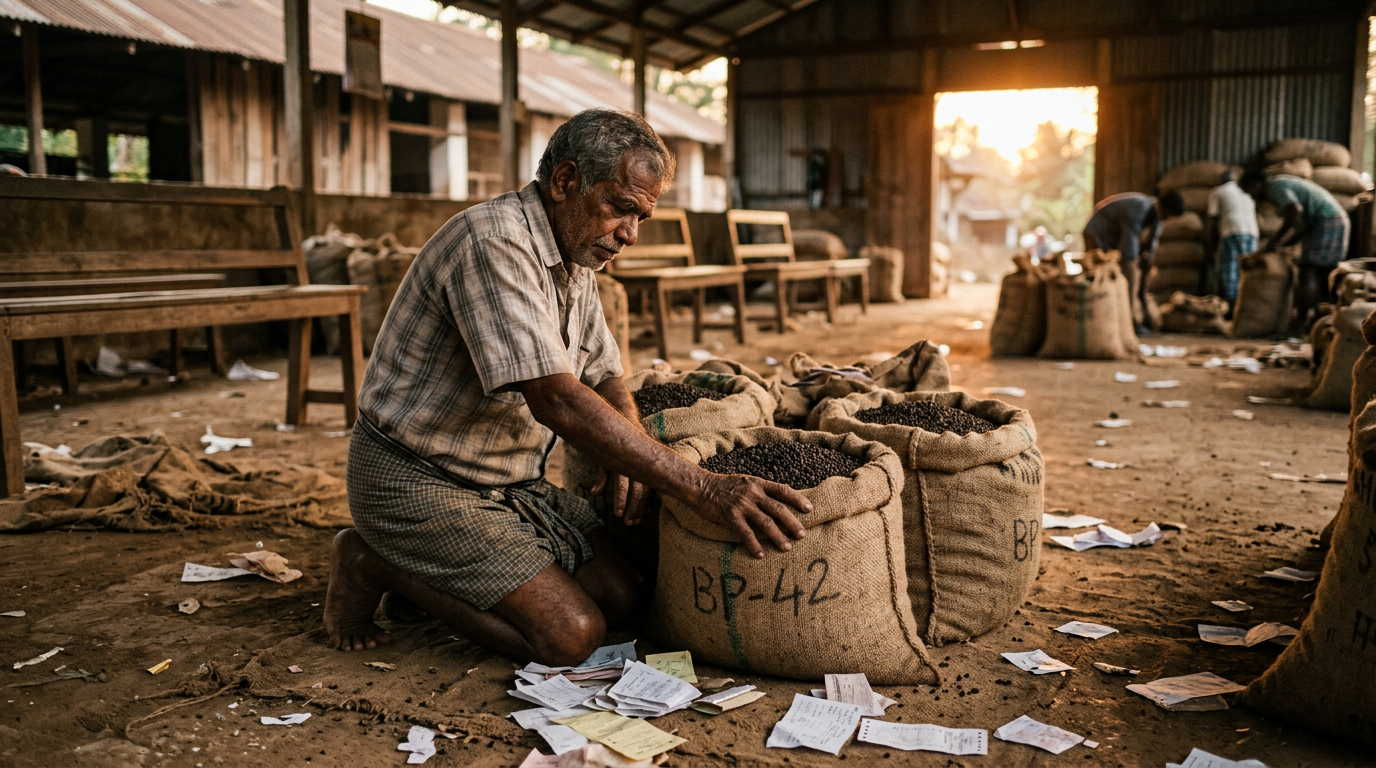
We’ve all been there: standing in the grocery aisle, comparing two bottles of turmeric. One is $7, from a brand that talks about its supply chain. The other is $2. It’s a no-brainer, right? Grab the bargain and move on.
But that simple economic choice has a profound and often devastating human cost. The global spice trade is a multi-billion dollar industry built on the backs of millions of smallholder farmers, most of whom manage less than two hectares of land. For them, the price on that bottle isn’t a bargain; it's a disaster. The story of cheap spice is a story of debt, vulnerability, and systems that value low prices over human dignity.
The Vanilla Chimaera: A Boom-Bust Nightmare
Nowhere is the volatility of the spice market more apparent than in the vanilla fields of Madagascar. The island nation produces the vast majority of the world's vanilla, with some reports noting it supplies up to 80% of the global market [1]. For a few years, it was like black gold. Around 2018, prices for top-grade vanilla soared to over $600 per kilogram, at times exceeding the price of silver [2]. This boom was driven by crop damage from a cyclone, combined with a surge in demand for natural flavorings.
For a moment, it seemed like a windfall for Madagascar's estimated 80,000 vanilla farmers. But booms in commodity markets are almost always followed by busts. As new plantings matured and international food giants sought alternatives, the market became flooded. By 2023, reporting indicated prices had crashed, with some grades fetching less than a tenth of their peak value [3].
Farmers who had invested everything in planting more vanilla—often at the expense of food crops for their own families—were left with a devalued harvest. They were trapped. Buyers, aware of farmers' desperation, could offer rock-bottom prices. This isn’t a free market; it’s a hostage negotiation. The boom created a brief illusion of prosperity, but the bust threatens to entrench poverty and food insecurity for a generation of farmers.
India's Golden and Black Heartbreak
This isn't just a story about exotic vanilla. It's happening in the fields that grow our everyday staples. In India, which produces the lion's share of the world’s turmeric and black pepper, farmers are locked in a similar struggle [1].
Take turmeric. In major trading hubs, farmers report that market prices often languish far below the break-even cost of cultivation [3]. Imagine going to work every day knowing you are guaranteed to lose money. This is the reality for countless farmers. They may sell their harvest at a loss, take on debt to replant for the next season, and pray the market turns. It rarely does for long.
It's a similar story for black pepper, where prices have fallen significantly from highs seen a decade ago, while the costs of labor, fertilizer, and pest management have only climbed [3].
This is where the insidious nature of some contract farming comes in. On the surface, it sounds stable: a company guarantees it will buy a farmer's crop at a pre-agreed price. But these contracts can be set at prices that barely cover costs, stripping the farmer of any potential upside if the market price rises. The company gets a predictable, cheap supply. The farmer gets a predictable, meager income, bearing all the risk of crop failure, pests, or drought. It's a system that privatizes profit and socializes risk, right onto the farmer's shoulders.
Cinnamon's Crossroads
Even spices with a protected heritage, like Sri Lankan "true" cinnamon (Cinnamomum verum), are not immune. This botanical species is distinct from the cheaper, more common cassia varieties that constitute most of the 'cinnamon' sold in mass-market products [4]. But in a global market obsessed with the lowest possible price, this distinction can get lost. Buyers for mass-market foods often favor the harsher, cheaper cassia, putting constant downward pressure on the price of the more delicate, traditionally farmed Ceylon cinnamon [1].
The Sri Lankan farmers who peel cinnamon bark by hand, a skill passed down through generations, are forced to compete with industrial-scale cassia production. The result is a slow erosion of prices, tradition, and the biodiversity of the agroforestry systems where true cinnamon thrives.
The Real Price in Our Pantry
When we celebrate a cheap spice, we are often celebrating a system that is fundamentally strained. We are celebrating a price that may have been artificially lowered because a farmer somewhere is absorbing the loss. It’s a price that doesn’t account for the cost of their children’s education, their family’s healthcare, or their ability to withstand the next drought or flood.
Change doesn't come from shaming shoppers. It comes from curiosity and demand. It comes from food founders and investors who build—and fund—radically transparent supply chains. It comes from asking brands, "Who grew this?" and "Were they paid fairly?" It involves supporting companies that can answer those questions with pride.
That $2 bottle of turmeric isn't a bargain. It's an invoice for a debt we’re asking someone else to pay.
Sources & citations
- Food and Agriculture Organization of the United Nations. (2019). An overview of the market for cinnamon and cassia. https://www.fao.org/documents/card/en/c/ca5861en
- The New York Times. (2018). In Madagascar, the Lure of a Vanilla Boom Has a Dark Side. https://www.nytimes.com/2018/07/21/world/africa/madagascar-vanilla.html
- Reuters. See reporting on global spice markets, such as 'Vanilla prices plunge, leaving Madagascar's farmers destitute' (Oct 10, 2023) and reporting on Indian agricultural markets. https://www.reuters.com/world/india/
- Britannica. cinnamon. https://www.britannica.com/plant/cinnamon