
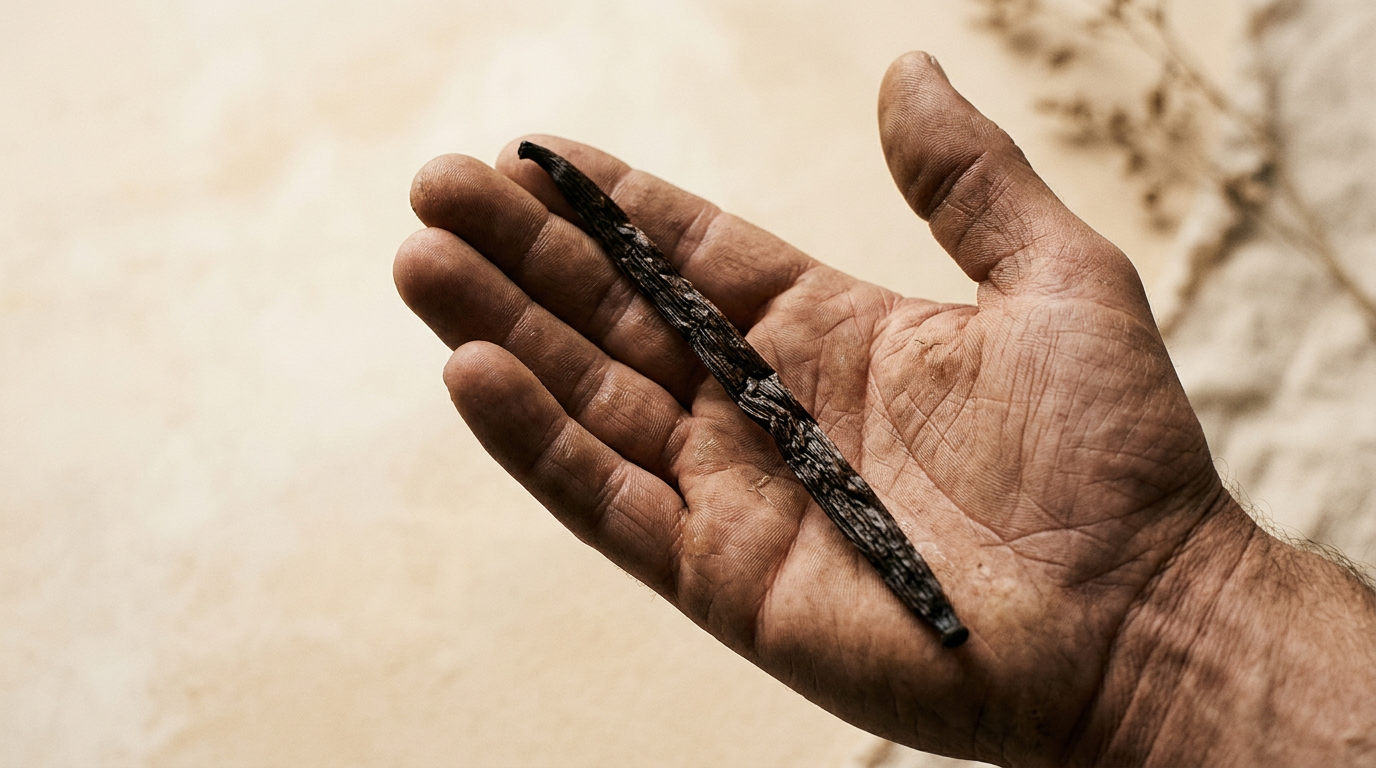
That comforting swirl of vanilla in your morning latte is a quiet luxury. It’s the world’s most popular flavor, a byword for plainness, yet its journey from flower to foam is anything but. Real vanilla is the second most expensive spice on Earth, after saffron, and its price is measured not just in dollars, but in human cost.
To understand vanilla’s dark side, you first have to understand the flower itself. Vanilla is the fruit of an orchid, a fussy, high-maintenance vine that demands a tropical climate and, for centuries, refused to fruit anywhere outside its native Mexico. The reason was a specific bee, the Melipona, which was the only creature that knew how to navigate the flower's complex anatomy to pollinate it.
That all changed in 1841 on the French island of Réunion. The breakthrough came not from a celebrated botanist, but from a 12-year-old enslaved boy named Edmond Albius. He discovered a simple, ingenious method to pollinate the orchid by hand using a thin sliver of wood and a flick of the thumb. This technique, still used today, unlocked vanilla’s global potential. It also set a precedent: the world’s most luxurious flavor would forever be tied to cheap, manual, and often un-credited labor [1].
The Madagascar Problem
Today, about 80% of the world's vanilla comes from the Sava region of Madagascar [2]. What was once a botanical curiosity has become the engine of an entire national economy and, too often, a trap for its people. The global demand for natural vanilla has sent prices soaring and crashing in a dizzying boom-bust cycle. When prices are high, farmers can earn a windfall. But high prices also bring crime, with vanilla-laden vines guarded by armed patrols against nighttime thieves.
When prices inevitably crash, farmers who took out loans to expand their crop are left with crippling debt. It is in this climate of poverty and precarity that the most troubling practices take root. An estimated 20,000 children work in Madagascar's vanilla industry, with many carrying out the arduous and repetitive pollination work that Albius pioneered [3]. Some are exposed to long hours, harassment, and hazardous conditions. This isn't an ancient practice; it's a modern reality driven by a system that demands cheap vanilla but is unwilling to look its true cost in the eye.
This system is built on opacity. A long and convoluted supply chain with multiple intermediaries—collectors, curers, exporters—means that by the time a vanilla bean reaches a port, its origin story is often erased. There is no way for a buyer in New York or Paris to know if the bean was pollinated by a child, stolen from a farmer, or purchased for a fair price. The very complexity that makes the supply chain “efficient” also makes it excellent at hiding the truth.
Beyond the Label
Many well-intentioned brands turn to certifications like “Fair Trade” to solve this. And while these programs can offer a floor for pricing and standards, they are not a panacea. When an entire region is dependent on a single volatile crop, the problems are systemic, running deeper than a label can reach. The real work involves shrinking the distance between the person growing the spice and the person enjoying it.
It means building long-term relationships with specific farmers and cooperatives, not just buying off the spot market. It means paying a stable, premium price that allows families to invest in their futures, send their children to school, and weather the inevitable price swings [4]. It means having a presence on the ground, understanding the local context, and treating farmers as partners, not just suppliers. This kind of traceability is hard work. It takes years to build the trust and infrastructure required. It’s not as simple as slapping a logo on a package.
But it creates a fundamentally different kind of product. It results in a spice that is not just higher quality, but is imbued with a story you can be proud to tell. The next time you order a vanilla latte, ask where the vanilla comes from. Not the country, but the community. The answer—or the lack of one—will tell you everything you need to know about the real cost of that flavor.
Sources & citations
- Britannica. "Edmond Albius." https://www.britannica.com/biography/Edmond-Albius
- Food and Agriculture Organization of the United Nations (FAO). "Vanilla: A Spice in Need of a Sustainable Future." https://www.fao.org
- International Labour Organization (ILO). "Child labour in the vanilla sector of Madagascar." (2020). https://www.ilo.org
- The Guardian. "Madagascar's vanilla farmers condemned to poverty by price crash." (2021). https://www.theguardian.com