
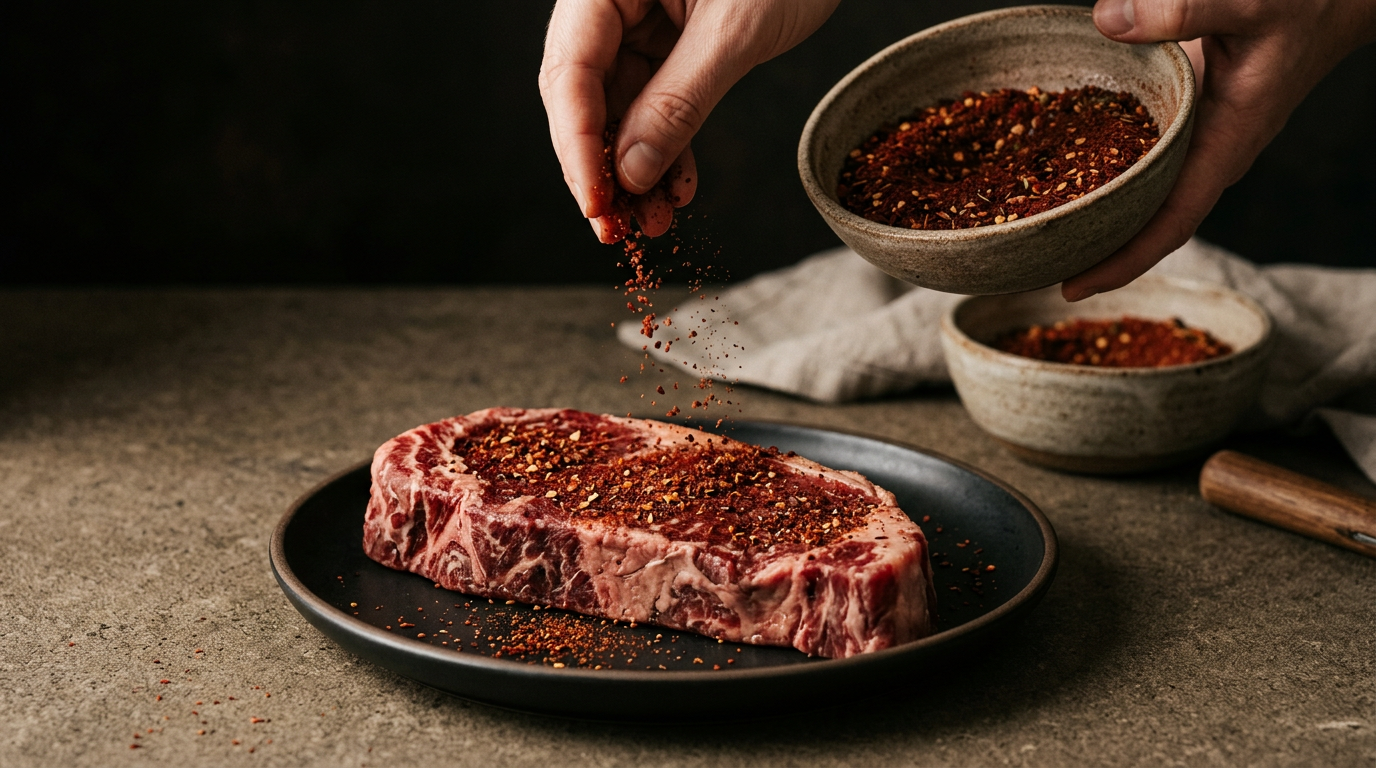
The smell of a backyard grill is a powerful piece of American scripture. It’s the scent of long weekends, community, and celebration—especially around the Fourth of July. In that ritual, the spice rub is the invocation. It’s the first layer of flavor, the promise of the meal to come. And in the last decade, as we’ve all grown more curious about what’s in our food, supermarket aisles have filled with rubs boasting ‘clean’ and ‘all-natural’ labels.
But pick up one of these bottles. Turn it over. The label that promises simplicity often tells a far more complicated story.
Beyond salt, sugar, and paprika, you’ll likely find a list of ingredients that have more to do with industrial efficiency than with flavor. You’ll see “anti-caking agents” like silicon dioxide—a chemical compound also used to make cement and glass—to keep the blend flowing smoothly [1]. You might find maltodextrin, a highly processed powder derived from corn or wheat, added as a filler to add bulk and prevent clumping. You will almost certainly see the catch-all term “spices,” a black box the FDA allows manufacturers to use to hide their precise formula. And then there's “natural smoke flavor,” an ingredient created by capturing smoke in a liquid, which bears little resemblance to the complex aromatics imparted by actual wood-smoking.
This isn’t a celebration of flavor. It’s a feat of chemical engineering designed for shelf stability and low costs.
The Paprika Problem
Let’s look at just one common ingredient: paprika. In a typical BBQ blend, it’s the star player, providing color and a mild, sweet heat. But the paprika in that shaker jar is usually a commodity product of unknown origin. To a large-scale manufacturer, its primary job is to provide a specific shade of red at the lowest possible price.
This creates a huge incentive for fraud. Low-grade paprika is frequently “enhanced” with things you do not want anywhere near your grill. The European Commission has identified it as one of the spices most vulnerable to adulteration, with common frauds including the addition of brick powder, salt, and illegal Sudan dyes, which are known carcinogens [2]. Even when it isn’t fraudulent, commodity paprika is often old, having lost the volatile oils that give it its characteristic flavor. It’s functionally red dust.
Contrast this with a high-integrity smoked paprika, like Pimentón de la Vera from Spain. There, farmers follow a centuries-old tradition of drying peppers for weeks over smoldering oak wood fires. This slow, patient process infuses the peppers with a deep, complex smokiness that cannot be faked with a laboratory-derived “natural flavor.” The result is a spice so potent and fragrant that it transforms a dish. This is what a single ingredient can do when it’s treated with respect. It’s a standard we apply across our entire collection, a difference you can see when you begin to compare an ingredient’s provenance.
The Flavor That's Missing
Fixing a BBQ rub isn't just about removing the bad stuff; it's about what you choose to put in its place. While American BBQ tradition has its canon—paprika, cayenne, black pepper, garlic—other culinary traditions offer a much wider palette for cooking over fire.
Consider fenugreek. In the United States, it’s a bit of a mystery, mostly known for its use in imitation maple syrup. But in India, North Africa, and the Middle East, its toasted seeds are a cornerstone of savory cooking. Fenugreek carries a deep, savory, slightly bitter note—think burnt sugar and celery—that adds incredible depth to grilled meats. Its secret lies in a compound called sotolon, which at low concentrations creates a rich, mapley, almost meaty aroma [3].
Beyond its complex flavor, fenugreek has been a staple of Ayurvedic and traditional Chinese medicine for millennia. Modern science is now catching up, studying its potential to help regulate blood sugar metabolism and improve cholesterol profiles, largely thanks to its high concentration of soluble fiber and compounds called saponins [4].
This is the kind of thinking that gets lost in a commodity supply chain. You won’t find fenugreek in a mainstream BBQ rub because it’s not a familiar flavor, and its inclusion would require explaining. It’s easier to fall back on sugar and artificial smoke. But by ignoring it, we’re missing out on a world of flavor and function—a philosophy we're exploring as we build out our pantry for the American palate.
A better BBQ rub isn't about a longer ingredient list. It's about a shorter, more powerful one. It’s about starting with spices that are so vibrant and potent on their own that they don’t need fillers, anti-caking agents, or fake flavors. It’s about making something for your family and friends this Fourth of July that is as honest and celebratory as the day itself.
Sources & citations
- Food and Drug Administration (FDA). "Sec. 172.480 Silicon dioxide." Code of Federal Regulations Title 21. https://www.accessdata.fda.gov/scripts/cdrh/cfdocs/cfcfr/CFRSearch.cfm?fr=172.480
- Directorate-General for Health and Food Safety (European Commission). "EU-wide survey on the authenticity of herbs and spices." 2021. https://food.ec.europa.eu/safety/eu-agri-food-fraud-network/eu-coordinated-actions/herbs-and-spices_en
- Blank, I., Lin, J., Devaud, S., Fumeaux, R., & Fay, L. B. "The analysis of sotolon in foods." In Flavor Chemistry: 30 Years of Progress. 1997. Springer, Boston, MA.
- Wani, S. A., & Kumar, P. "Fenugreek: A review on its nutraceutical properties and utilization in various food products." Journal of the Saudi Society of Agricultural Sciences, vol. 17, no. 2, 2018, pp. 167-176. https://www.sciencedirect.com/