
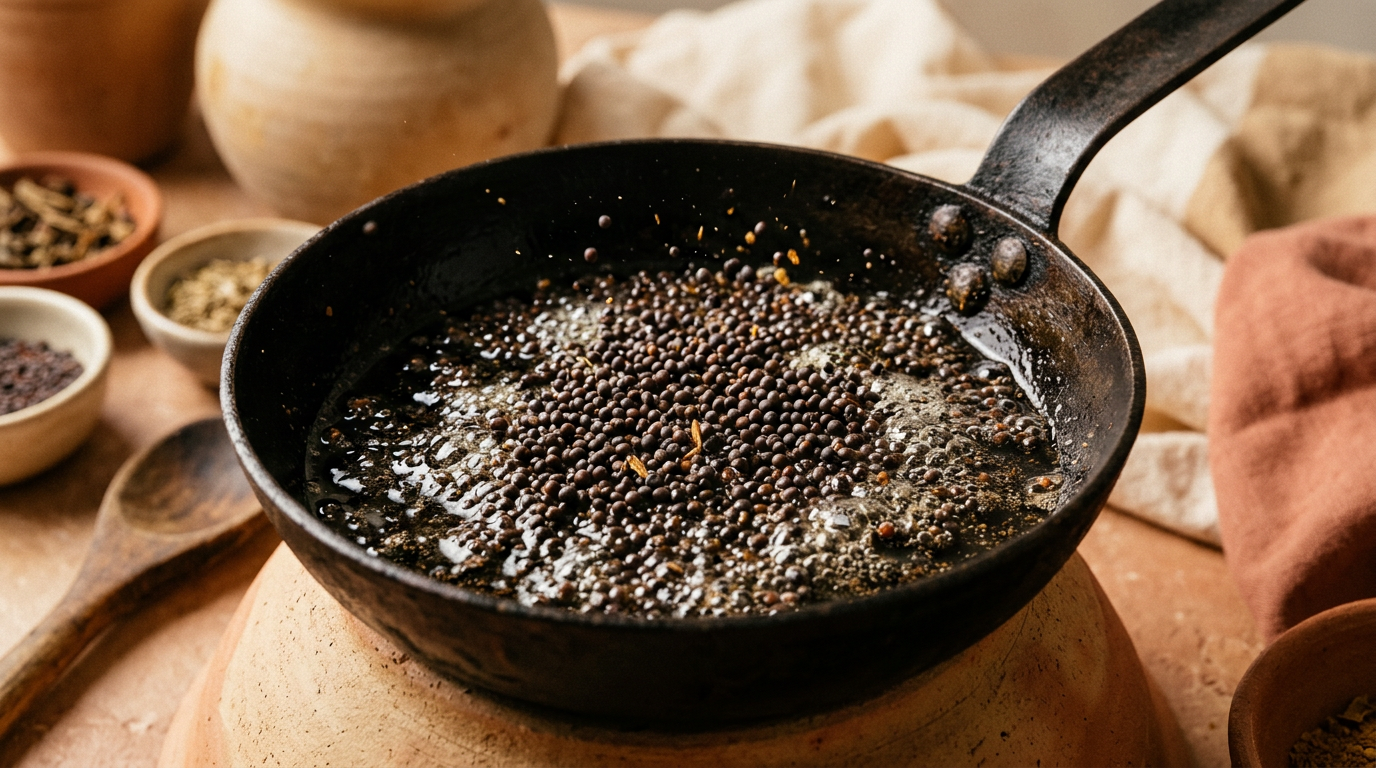
It’s one of the most arresting sounds in an Indian kitchen: a sharp, percussive crackle that cuts through the air, followed instantly by a pungent, almost peppery aroma that clears your sinuses and awakens your appetite. This is the sound of mustard seeds hitting hot oil—the foundational step of a tadka, the flavor-infusing technique known variously as chhonk, vaghar, or tempering.
For centuries, cooks have known that this moment of violent popping is the key to unlocking the mustard seed’s soul. But what they were mastering through sensory intuition, we can now understand as a brilliant act of applied chemistry. The humble tadka is not merely a cooking step; it is a form of rapid, in-situ chemical synthesis that creates and captures a flavor that cannot be bought in a jar.
The Silence Before the Storm
A dry mustard seed is a vessel of latent potential. Inside its tiny, perfect sphere, two key components are held in separate cellular compartments, waiting for a catalyst. The first is a class of compounds called glucosinolates. In brown and black mustard seeds, the dominant glucosinolate is sinigrin; in the milder yellow/white seeds, it is sinalbin. The second is a heat-sensitive enzyme called myrosinase [1].
As long as the seed remains whole and dry, these two components live separate lives. The seed has no sharp, pungent aroma. You can grind it into a powder, and it will smell dusty and faintly nutty. You can add that powder to oil, and nothing much will happen. The magic requires a specific sequence of events, one that cooks in the Indian subcontinent, from Sindh to Bengal, perfected long before the advent of chemistry labs.
An Enzyme Awakens
To unlock the seed’s fierce heart, you need two things: heat and fat. The fat—often ghee or a neutral oil—acts as a heat-transfer medium, enveloping the seeds and raising their temperature evenly. As the oil shimmers, the seeds begin to dance. The heat starts to break down the seed's tough outer coat and, crucially, its internal cell walls.
This is the moment of activation. Myrosinase, the enzyme, is finally introduced to its partner, the glucosinolate. Like a key meeting its lock, the enzyme immediately begins to break down the sinigrin. This enzymatic reaction produces a new, highly volatile, and famously pungent compound: allyl isothiocyanate, or AITC [2].
This is the very same molecule responsible for the sharp bite of wasabi and horseradish. The entire process—from inert seed to a pop of flavor creation—happens in seconds. The ‘pop’ is the audible signal that the reaction is occurring. The pressure from the water content vaporizing inside the seed, combined with the chemical transformation, causes it to burst. This isn't just kitchen theater; it's the sound of chemistry in action.
Mastering a tadka is a lesson in managing this reaction. Too low a temperature, and the enzyme won’t activate effectively, resulting in a bland, gritty texture. Too high, and the enzyme is denatured before it can do its work, while the seeds simply scorch and turn bitter. The perfect tadka happens in that precise window where the enzyme works at peak efficiency just before the seed burns. It is a fleeting, high-stakes moment that rewards focus.
Pungency with a Purpose
The brilliance of blooming mustard seeds in fat is that the oil immediately captures the newly formed AITC. Because AITC is volatile, this quick capture is essential. The infused oil then becomes the vehicle for distributing this bright, pungent flavor throughout an entire pot of lentils, vegetables, or yogurt. It’s a flavor layer that must be created fresh, on the spot, for peak expression.
This ancient technique also seems to have deep, intuitive wisdom. The compounds created are not just for flavor. AITC, the signature molecule of black and brown mustard, is a potent antimicrobial agent, and research has shown it can inhibit the growth of various foodborne pathogens [3]. In warm climates, before refrigeration was an option, was this technique partly a method of preservation? It’s a compelling thought. Modern science is also investigating isothiocyanates for their potential in disease prevention, showing them to have powerful antioxidant and anti-inflammatory properties [4]. The flavor our ancestors chased was intrinsically linked to compounds that protected and sustained them.
The Wisdom in the Method
Many brands can sell you a spice. They can grind it, package it, and put it on a shelf. But that static approach misses the point entirely when it comes to a spice like mustard. Its true character is not a fixed attribute but a dynamic potential, unlocked only through process.
Understanding the tadka isn't just culinary trivia; it’s a deeper appreciation for the wisdom embedded in traditional foodways. It reveals that the cook is a practicing chemist, orchestrating reactions to build flavor from the molecule up. It highlights that the most vibrant flavors are often the most fleeting, created in the moment rather than preserved. And it suggests that the line between ancient culinary arts and modern food science is blurrier than we think. They are two dialects describing the same delicious truth: that a simple seed, treated with knowledge and respect, can transform a meal.
Sources & citations
- U.S. National Library of Medicine, PubMed Central. (2019). The Glucosinolate-Myrosinase System: A Staple of Brassicaceae and a Potential Source of Bioactive Compounds. https://www.ncbi.nlm.nih.gov/pmc/articles/PMC6471902/
- Britannica, The Editors of Encyclopaedia. (2023). Mustard. Encyclopedia Britannica. https://www.britannica.com/plant/mustard
- Luciano, F. B., & Holley, R. A. (2009). Enzymatic and non-enzymatic reactions of mustard and their applications to food preservation. U.S. National Library of Medicine, PubMed. https://pubmed.ncbi.nlm.nih.gov/20302390/
- Zhang, Y. (2010). Allyl isothiocyanate as a cancer chemopreventive phytochemical. U.S. National Library of Medicine, PubMed. https://pubmed.ncbi.nlm.nih.gov/20116084/
- PennState Extension. (n.d.). Mustard. https://extension.psu.edu/mustard