
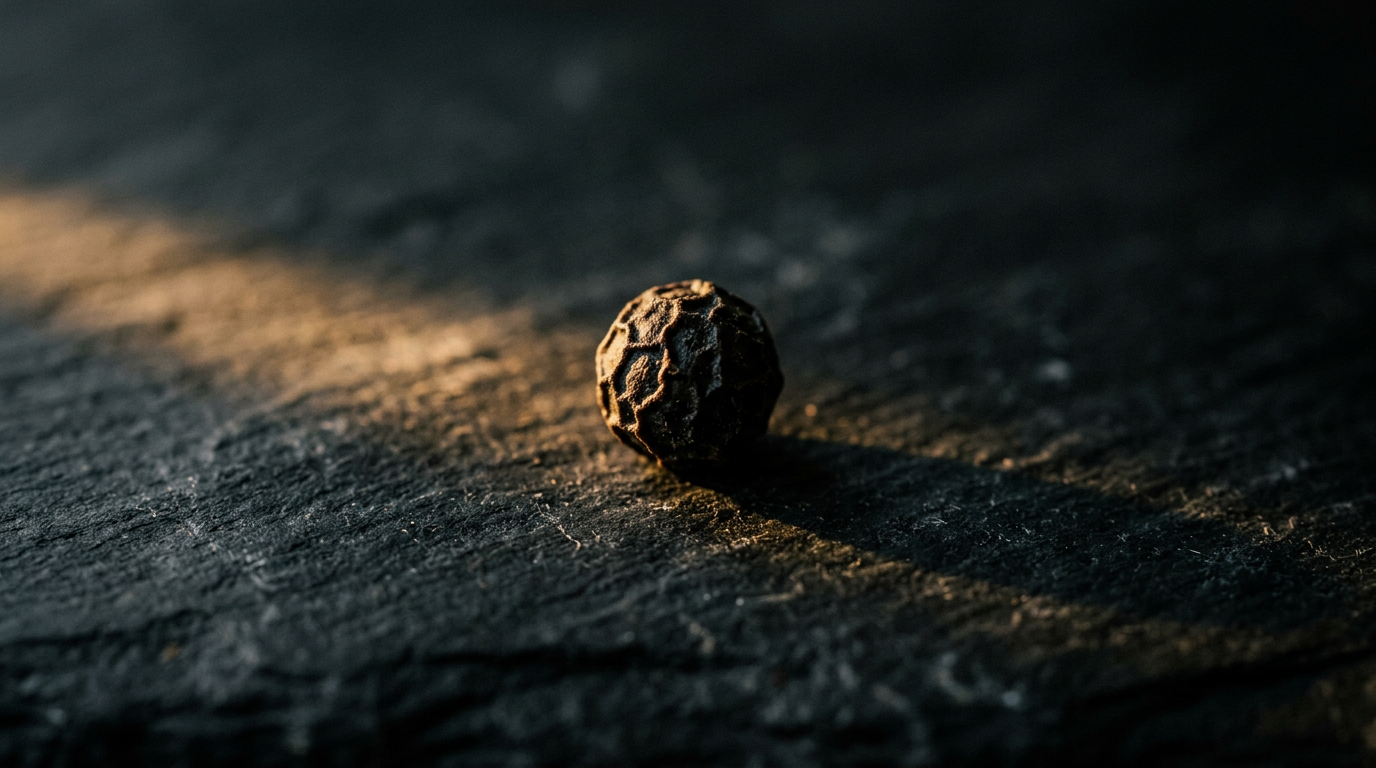
It sits on nearly every kitchen counter and restaurant table in the Western world, the loyal partner to salt. We reach for the pepper grinder out of habit, adding a few twists of dusty heat almost unconsciously. For centuries, Piper nigrum was hailed as the “King of Spices,” a precious commodity that launched voyages, built empires, and was worth its weight in gold. Today, it’s a staple so common we barely see it.
But what if we’ve been overlooking its most important function? The magic of black pepper isn’t just its pungent flavor. It’s a profound biological secret, hiding in plain sight. That familiar sharp bite comes from an active compound called piperine, and it does far more than just tingle your tongue. Piperine is one of nature’s most effective bioenhancers.
Your Body's Gatekeeper
Think of your digestive system as a tightly secured building. When you consume nutrients, they have a limited time to pass through the intestinal wall and enter the bloodstream before the body’s metabolic processes break them down and show them the exit. Many valuable compounds, from vitamins to the phytonutrients in plants, are notoriously difficult to absorb. Much of their benefit is lost before it ever reaches your cells.
This is where piperine steps in. It acts like a master key, or a skilled gatekeeper. It works in a few clever ways. First, it temporarily inhibits enzymes in your liver and intestinal wall—specifically, enzymes like CYP3A4—that are responsible for metabolizing foreign substances [1]. By slowing down this process, piperine gives valuable compounds a much wider window to be absorbed into the bloodstream. Second, it can stimulate amino acid transporters in the gut lining, essentially creating more open doorways for nutrients to pass through [2].
This isn’t a small effect. It's a fundamental shift in your body’s ability to use what you give it. This process even has a scientific name: bioenhancement.
More Than Turmeric's Sidekick
The most famous example of this partnership is piperine’s effect on curcumin, the bright yellow compound in turmeric. On its own, curcumin is famously difficult for the body to absorb. But when consumed with even a small amount of black pepper, its bioavailability—the amount that actually enters the bloodstream—can skyrocket by as much as 2,000% [3]. This is the scientific validation behind the age-old practice in South Asian cooking of combining turmeric and black pepper in curries and medicinal preparations.
But piperine’s power doesn’t stop there. This is what most articles miss. It’s not just a one-trick pony for turmeric.
Its bioenhancing effect extends to a wide array of other crucial nutrients. Studies show piperine can significantly increase the absorption of beta-carotene (a precursor to Vitamin A, found in carrots and leafy greens), selenium (a vital mineral for thyroid function), and several B vitamins [4]. It has also been shown to enhance the absorption of Coenzyme Q10 and resveratrol. Essentially, piperine is a team player that makes the entire nutritional ecosystem of your meal work harder and more efficiently.
This isn't a new discovery so much as a modern confirmation of ancient wisdom. In Ayurveda, the traditional medicine system of India, black pepper is a cornerstone of countless formulas. The classic digestive blend Trikatu—consisting of black pepper, long pepper, and ginger—has been used for thousands of years. The logic was clear to these early practitioners: certain spices made others more powerful. They observed the effect; we are just now mapping the mechanism.
The Pepper on Your Table
All of this leads to a simple, practical truth: the quality of your pepper matters. If piperine is the source of this remarkable power, then the piperine content of your pepper is paramount.
Most pre-ground black pepper sold in supermarkets is a ghost of what it once was. It’s often a blend of miscellaneous varieties, ground months or even years before it reaches you. The volatile oils that carry flavor and the piperine that carries function have long since degraded, leaving little more than bland, spicy dust. True black pepper, the kind cultivated for centuries on India’s Malabar Coast—the historical heartland of the spice—is a different thing entirely. Single-origin, high-piperine varietals, harvested at peak ripeness and freshly ground, deliver a complex aroma and a potent dose of the very compound that unlocks the rest of your food.
So the next time you reach for the pepper grinder, pause for a moment. See it not as salt’s dull companion, but as a key. A simple twist can transform your meal from just sustenance into something far more intelligent, elevating the nutrition already on your plate. It’s the smallest of actions, a daily ritual that connects our dinner tables to ancient insight and modern science, all at once.
Sources & citations
- Kesarwani, K., & Gupta, R. (2013). Bioavailability enhancers of herbal origin: an overview. Asian Pacific Journal of Tropical Biomedicine, 3(4), 253–266.
- Dudhatra, G. B., Mody, S. K., Awale, M. M., et al. (2012). A comprehensive review on pharmacotherapeutics of herbal bioenhancers. The Scientific World Journal.
- Shoba, G., Joy, D., Joseph, T., Majeed, M., Rajendran, R., & Srinivas, P. S. (1998). Influence of piperine on the pharmacokinetics of curcumin in animals and human volunteers. Planta Medica, 64(4), 353–356.
- Fernández-Lázaro, D., Mielgo-Ayuso, J., Córdova-Martínez, A., & Seco-Calvo, J. (2023). Iron and Physical Activity: Bioavailability Enhancers, Properties of Black Pepper (Bioperine®) and Potential Applications. Nutrients, 15(10), 2274.
- Britannica, The Editors of Encyclopaedia. "Spice trade". Encyclopedia Britannica, 21 Sep. 2023, https://www.britannica.com/topic/spice-trade.