
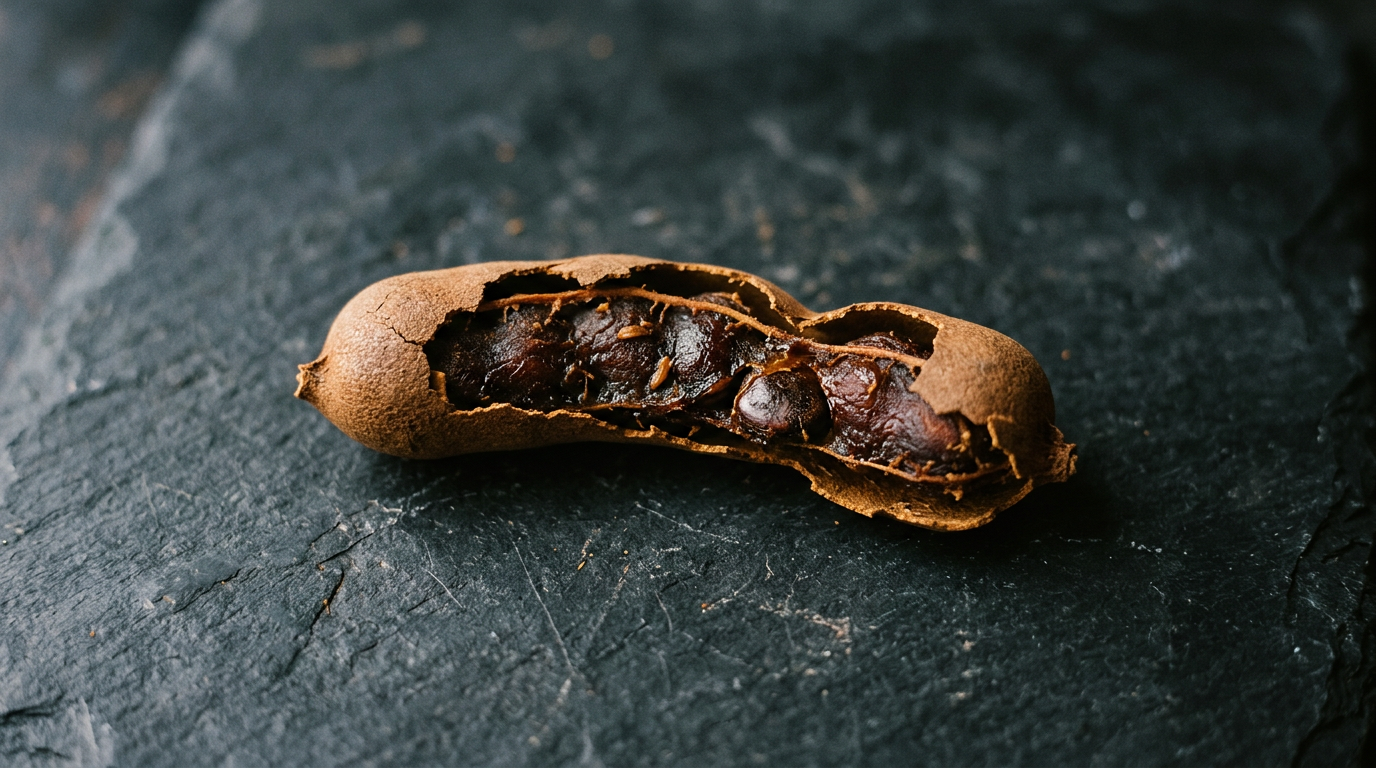
Tamarind (Tamarindus indica) is a tropical fruit prized for its distinct sweet-and-sour pulp. A cornerstone ingredient in cuisines across Asia, Africa, and Latin America, its pod contains a unique profile of polyphenols and nutrients. Traditional medicine has long utilized tamarind for digestive and inflammatory ailments, a practice now being validated by contemporary clinical research.
That sticky, dark brown paste you reach for when making Pad Thai or a South Indian rasam does more than just add a tangy brightness. Tamarind is one of the world's great culinary connectors. Native to tropical Africa, this leguminous tree was carried by human migration and trade thousands of years ago, taking root so deeply in Indian culture that its name derives from the Persian tamar-i-hind, meaning "date of India" [1]. From there, it traveled with Spanish and Portuguese colonists to the Americas, where it now stars in everything from Mexican aguas frescas to the iconic Worcestershire sauce.
This journey speaks to its incredible utility. Tamarind is a true pantry workhorse, providing a complex sourness that lemon juice or vinegar can't replicate. Its flavor isn't just sharp; it’s layered with notes of caramel, stone fruit, and a subtle smokiness. It’s sold as brittle, velvety pods; as dense, seed-filled blocks of pulp; and as smooth, ready-to-use concentrates. Each form offers a slightly different character, a nuance well understood by generations of home cooks.
The Pod with a Pharmacy Inside
For as long as tamarind has been used in the kitchen, it has also been used as medicine. This isn’t a coincidence. The very compounds that give it its unique flavor and preserve it from spoilage are also biologically active in the human body. Ancient systems of medicine in both Africa and Asia used tamarind pulp, leaves, and seeds to treat everything from fever and digestive trouble to wounds and sore throats [2].
Modern science is beginning to map the chemical landscape that explains this traditional wisdom. The pulp is exceptionally rich in polyphenols, particularly a class called procyanidins, which are potent antioxidants that help the body manage oxidative stress. It’s also a good source of tartaric acid, another antioxidant that contributes to its signature sourness.
Researchers are particularly interested in tamarind's potential role in metabolic and cardiovascular health. Several clinical studies have explored how tamarind pulp extract may influence lipid metabolism. A review of existing research highlighted its potential to help lower total and LDL ("bad") cholesterol, likely due to its high concentration of flavonoids and other polyphenols [2].
Beyond the pulp, even the seeds—often discarded—are a source of valuable compounds. Tamarind seed extract contains phytochemicals like lupeol and other triterpenoids, which have demonstrated significant antimicrobial and anti-inflammatory properties in laboratory settings [3]. This adds context to tamarind’s traditional use as a poultice for wounds; the compounds that fought off microbes in a petri dish may have been doing the same job on the skin.
More Than a Commodity
Unlike spices grown in vast monocultures, much of the world's tamarind is still harvested from trees growing semi-wild or in small family groves. This method of cultivation preserves biodiversity but also creates incredible variation. A tamarind from a dry region in Thailand might be intensely sour and sharp, perfect for a fiery curry, while one from a more humid part of India could be sweeter and fruitier, ideal for a chutney or candy.
Understanding this provenance is key. It’s the difference between a flat, one-dimensional sourness and a complex, layered flavor that makes a dish memorable. It’s also a reminder that this ancient fruit is not a uniform commodity. It is a product of its specific terroir, a living link between a place, its people, and a web of global culinary traditions.
Tamarind is a perfect example of how ancient foods are being re-examined through a modern lens. What was once simply a souring agent or a folk remedy is now being understood as a complex functional ingredient. It’s a workhorse, yes, but one with a quiet, powerful intelligence all its own.
Frequently Asked Questions
1. What's the difference between sweet and sour tamarind?
Sour tamarind (Tamarindus indica) is the most common variety, used globally for cooking. Sweet tamarind is a specific cultivar, often grown in Thailand, that has less tartaric acid and more sugar. It's typically eaten fresh as a snack, much like a date.
2. How do I use tamarind paste from a solid block?
It's simple. Cut off a small piece of the block and soak it in a few tablespoons of hot water for 10-15 minutes. Use your fingers or a spoon to mash the pulp, dissolving it into the water. Finally, strain the mixture through a fine-mesh sieve to remove seeds and fibers, leaving you with a smooth, ready-to-use tamarind liquid.
3. Is tamarind actually healthy?
In moderation, yes. Tamarind pulp is a good source of antioxidants like polyphenols and tartaric acid. It also contains minerals like magnesium and potassium. As discussed, scientific studies are actively exploring its benefits for cardiovascular health and its antimicrobial properties, which supports its long history in traditional medicine [2, 4].
Sources & citations
- Britannica, The Editors of Encyclopaedia. "Tamarind". Encyclopedia Britannica, 2023, https://www.britannica.com/plant/tamarind.
- Komakech, Richard, et al. "A Review on the Medicinal Properties of Tamarindus indica L." Asian Journal of Plant Sciences, vol. 16, no. 3, 2017, pp. 116-27, https://www.ncbi.nlm.nih.gov/pmc/articles/PMC6341221/.
- Razali, N., et al. "The Multifarious Medicinal Properties of Tamarindus indica: A Review." Boletín Latinoamericano y del Caribe de Plantas Medicinales y Aromáticas, vol. 14, no. 2, 2015, pp. 79-92.
- Morton, J. "Tamarind". Fruits of warm climates, 1987, pp. 115–121. Purdue University, https://www.hort.purdue.edu/newcrop/morton/tamarind.html.