
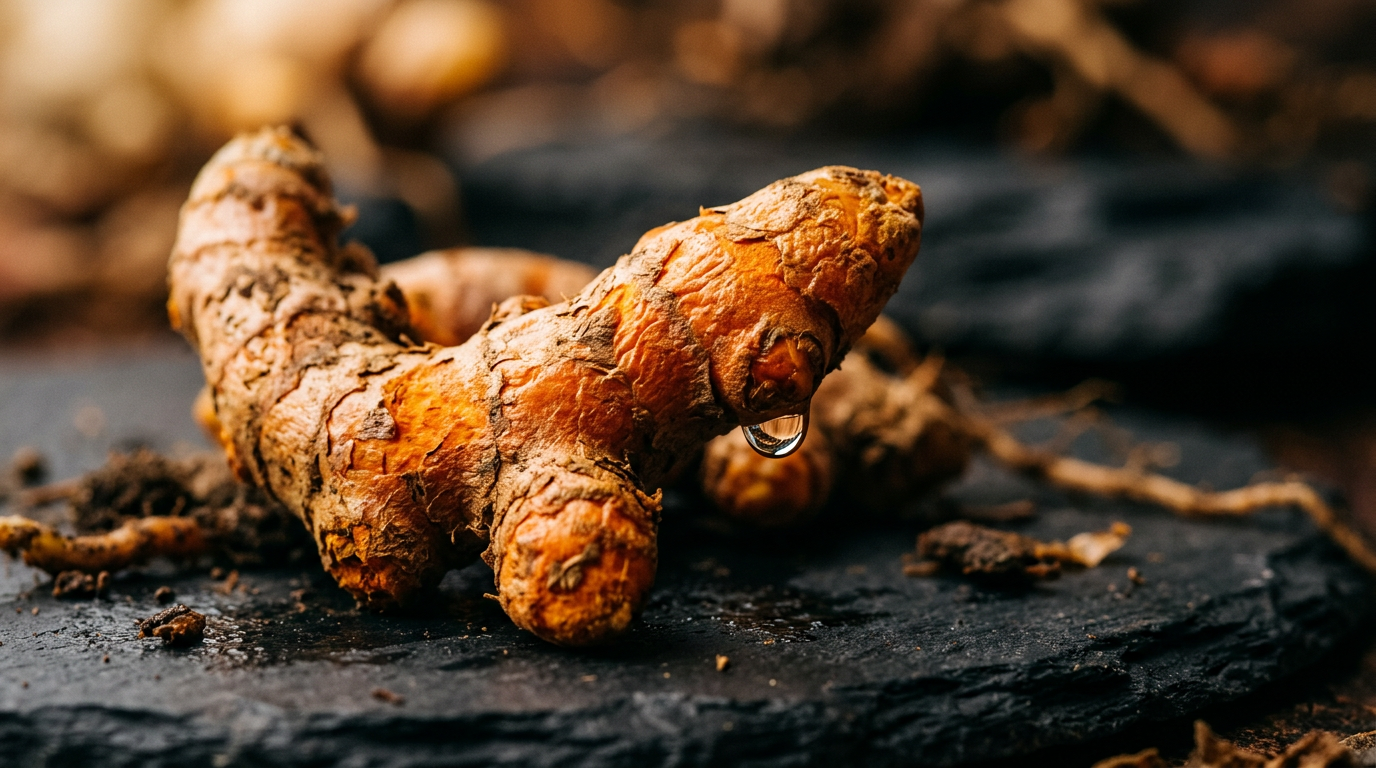
Gold has always been the color of what we value most: currency, divinity, the sun itself. For the past two years, our team has been captivated by a different kind of gold. One that grows in the humid earth of Southern India, stains your fingers a brilliant saffron, and holds a history as rich as its hue.
You’ve seen it everywhere, of course. The ‘golden latte’ is now a standard cafe offering, and wellness influencers pack turmeric into everything from face masks to smoothies. But behind this recent craze lies an inconvenient truth: most of us are missing the point entirely.
A 4,000-Year-Old Medicine Chest
Long before it became a trending topic, the knobby, vibrant rhizome of Curcuma longa was a pillar of daily life and medicine. In Ayurvedic traditions, it is known as Haridra, a name that appears in Sanskrit texts dating back thousands of years. It wasn’t just a flavorful culinary spice; it was regarded as a cleansing, healing powerhouse, used for everything from respiratory ailments and liver support to digestive health and topical pastes for skin radiance [1]. Ancient practitioners understood this spice’s power was systemic and profound. It wasn't a single-use tool, but a foundational element for maintaining balance in the body.
This deep-rooted wisdom is what first drew us in. How could one plant be so versatile? What did they know that we had forgotten?
The Science of the Golden Compound
Modern science provides a stunningly clear answer: a class of compounds called curcuminoids. The most famous of these, curcumin, is the main active ingredient in turmeric and the subject of thousands of peer-reviewed studies. It is, to put it simply, a biological multitool.
The most compelling research has focused on its role in modulating inflammation. Chronic, low-grade inflammation is now understood to be a key driver behind many of the health challenges of modern life. Curcumin appears to work at a fundamental level by blocking activation of NF-kB, a molecule that acts like a master switch, turning on genes related to inflammation throughout the body [2]. By quieting this switch, curcumin helps the body find its way back to equilibrium.
That sounds incredible, right? A golden key to unlock a healthier inflammatory response. But here’s the problem that most brands quietly ignore.
The Bioavailability Puzzle
That powerful curcumin compound makes up a mere 3-5% of the raw turmeric root. Worse, on its own, it’s notoriously difficult for the human body to absorb. When you consume plain turmeric powder, the vast majority of the curcumin is rapidly metabolized by your liver and intestinal wall before it ever reaches your bloodstream, where it needs to be to do its work [3].
Your body simply doesn’t get a meaningful dose. That turmeric-dusted latte might be comforting, but its physiological benefit is likely negligible. This is the central challenge, and for us, it became a fascinating obsession.
We looked back to the old ways. Traditional Ayurvedic preparations often combined turmeric not just with water, but with fats and other spices—most notably, black pepper. It turns out that piperine, the active compound in black pepper, naturally inhibits the metabolic enzymes that break down curcumin, increasing its bioavailability significantly. Indigenous wisdom contained a clue to solving the modern scientific puzzle.
Provenance is Everything
These insights are useless without an ingredient of uncompromising quality. Our search led us to a multigenerational organic farm cooperative in Kerala, India, where the terroir is legendary for producing the ‘Alleppey’ variety of turmeric. This cultivar is prized for its naturally high curcumin content—often two to three times that of generic turmeric.
We don't just trust the regional reputation; we test every single batch. We receive a Certificate of Analysis confirming the exact curcuminoid percentage, and we run our own third-party screens for heavy metals and other contaminants. The material must be potent, pure, and grown with respect for the soil. This is non-negotiable.
For the last eighteen months, we have been working to fuse this pristine ingredient with a deep understanding of formulation science. We asked ourselves: how can we honor the root's history, respect the clinical data, and deliver its promise in a way that is not only radically effective but a genuine pleasure to consume?
We didn’t want to just launch another turmeric product. We wanted to launch the right one.
Next month, we’ll show you what we mean.
Sources & citations
- National Center for Complementary and Integrative Health (NCCIH). "Turmeric." https://www.nccih.nih.gov/health/turmeric
- Hewlings, S. J., & Kalman, D. S. (2017). "Curcumin: A Review of Its Effects on Human Health." Foods, 6(10), 92. https://www.mdpi.com/2304-8158/6/10/92
- Anand, P., Kunnumakkara, A. B., Newman, R. A., & Aggarwal, B. B. (2007). "Bioavailability of curcumin: problems and promises." Molecular pharmaceutics, 4(6), 807–818. https://pubs.acs.org/doi/10.1021/mp700113r
- Prasad, S., & Aggarwal, B. B. (2011). "Turmeric, the golden spice: from traditional medicine to modern medicine." In Herbal Medicine: Biomolecular and Clinical Aspects (2nd ed.). CRC Press/Taylor & Francis. https://www.ncbi.nlm.nih.gov/books/NBK92752/
- Food and Agriculture Organization of the United Nations (FAO). "Spices and culinary herbs." https://www.fao.org/publications/card/en/c/CB4279EN/