
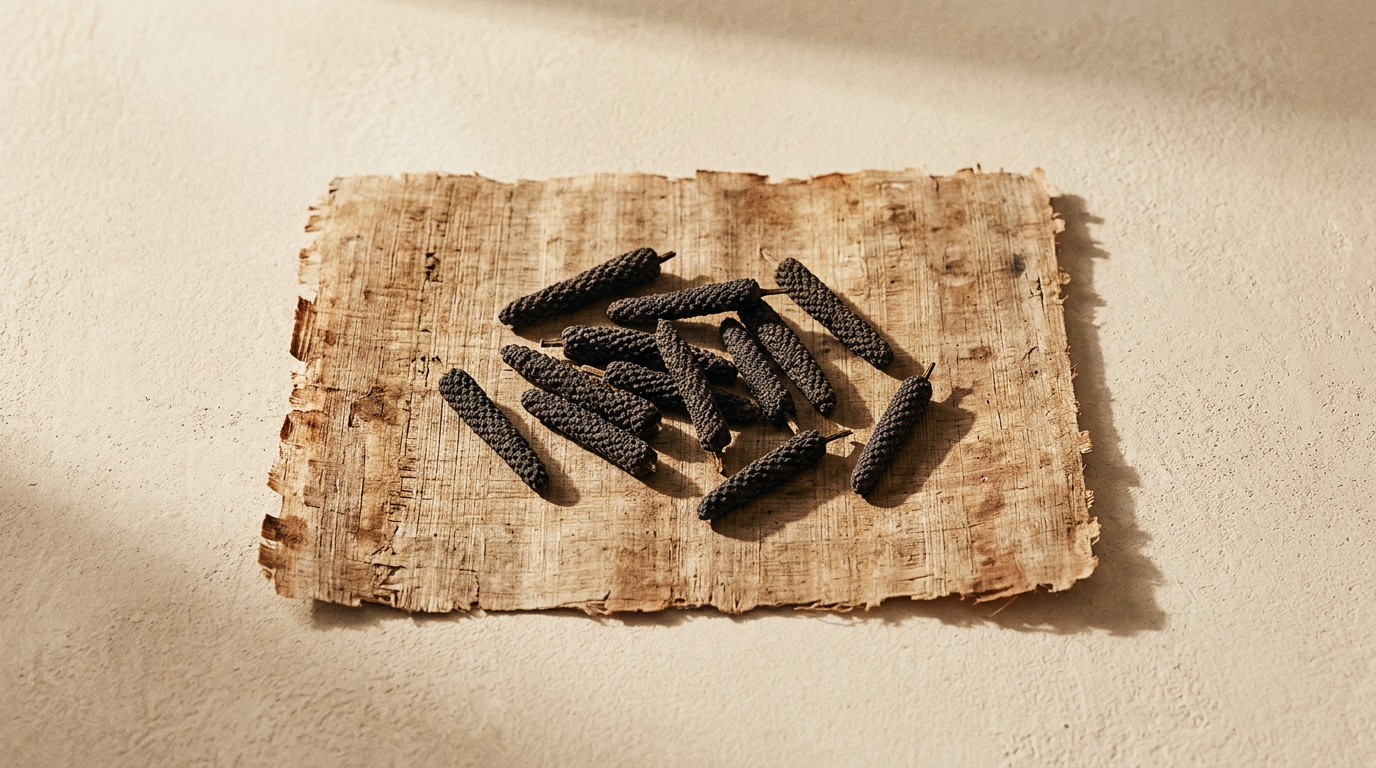
In the markets of Ancient Rome, it was the scent of power. Not gold, not silk, but a small, unassuming spice that looked like a dried, woody caterpillar. This was long pepper, Piper longum, and for centuries, it was the pepper of choice for the Caesars, gourmands, and physicians of the classical world. Pliny the Elder, never one to mince words, complained in his Natural History that long pepper was priced at 15 denarii per pound — more than double the price of its cousin, black pepper [1]. Rome was hemorrhaging money for spice, and long pepper was a primary culprit.
Then, it vanished. By the time the Renaissance dawned, long pepper had faded from European kitchens, so completely eclipsed by the round black peppercorn that most people today have never even heard of it. The story of what happened is more than a culinary footnote; it’s a lesson in how economics, logistics, and taste are deeply intertwined, and how easily we can lose something remarkable.
The Original Pepper
Long before the familiar black peppercorn (Piper nigrum) dominated global trade, there was long pepper. Native to the foothills of the Himalayas in Northern India, it is not a berry but a flower spike, harvested and dried just as it begins to ripen. Its appearance is striking—a one- to two-inch catkin-like structure, bumpy and grayish-brown. The flavor is where its true character lies. It possesses the familiar upfront heat of black pepper, thanks to the alkaloid piperine, but that’s just the opening act. The heat builds slowly and lingers, giving way to complex notes of cinnamon, nutmeg, and even a pine-like freshness. It’s a warmer, sweeter, more aromatic experience.
This complexity made it a star in Roman cuisine. The famous (and famously decadent) cookbook Apicius calls for it repeatedly in everything from spiced wine to roasted boar [2]. For the Romans, its value wasn't just in its taste, but in its Galenic medical properties. Following the principles of humoral medicine, long pepper was considered hot and dry, a powerful agent to balance the body's humors, aid digestion, and act as an aphrodisiac. Its price tag wasn't just for flavor; it was for status and wellness, a signifier that one had the wealth to command the best the world had to offer.
A Disappearance by a Thousand Cuts
So why did Europe forget its favorite spice? The answer isn’t about a sudden shift in taste, but a slow, grinding change in logistics. Long pepper’s journey to Rome was an arduous overland trek. It traveled from India through Persia and the Arabian peninsula, passing through countless middlemen, each adding their cut. The fall of Constantinople in 1453 made these routes even more perilous and expensive [3].
Meanwhile, its cousin, black pepper, had a distinct advantage. It grew abundantly and was easier to cultivate along India's Malabar Coast, a region more accessible to new maritime trade routes being forged by Portuguese explorers. Vasco da Gama and his successors found they could sail directly to the source, bypass the overland taxes, and load their ships with a pepper that was plentiful and therefore cheaper. Black pepper didn't win because it was better; it won because it was more efficient to scale.
As black pepper flooded the European market, the rarer, more expensive long pepper was pushed to the margins. By the 18th century, it was a ghost in the European pantry, a relic of a bygone era.
The Flavor of Resilience
But “vanished” is a Eurocentric term. Long pepper never left the kitchens and apothecaries of its homeland. In India, it is known as Pippali, a cornerstone of Ayurvedic medicine for millennia. It is a key ingredient in the classical formula Trikatu (“three pungents”), a blend of long pepper, black pepper, and ginger used to stoke digestive fire (agni) and, fascinatingly, to enhance the efficacy of other herbs—an ancient understanding of what modern science now calls bioavailability [4].
It also held its ground in regional cuisines across Asia and North Africa. You can still find it lending its unique warmth to certain Hyderabadi kebabs in India, in Indonesian herbal jamu drinks, and in the complex spice blends of Ethiopia and Morocco. While Europe was standardizing around a single pepper, other food cultures were preserving a vital piece of botanical diversity.
This quiet persistence is why long pepper can have a second act. As chefs and curious eaters look beyond standardized industrial spices for more complex and nuanced flavors, long pepper is being rediscovered. Its sweet heat is a revelation with slow-cooked meats, on roasted vegetables, and even grated over fruits like pineapple or a creamy cheese. It doesn't replace black pepper; it offers an entirely different dimension.
The story of long pepper is a reminder that the flavors on our shelves are not inevitable. They are the survivors of history, economics, and geography. Sometimes, the most exciting new flavors are the ones that were just waiting patiently to be remembered. Its return isn't just about novelty; it's about reclaiming a richer, more complex, and perhaps more interesting pantry than the one we inherited.
Sources & citations
- Dalby, A. (2000). Dangerous Tastes: The Story of Spices. University of California Press. Accessed via Google Books.
- Freedman, P. (2007). Spices and the Medieval Diet. In Food: The History of Taste. University of California Press. Pages 154–157.
- Turner, J. (2009). The History of a Temptation. Vintage Books. Published as Spice: The History of a Temptation.
- Dudhatra, G. B., Mody, S. K., Awale, M. M., Patel, H. B., Modi, C. M., Kumar, A., Kamani, D. R., & Chauhan, B. N. (2012). A comprehensive review on pharmacotherapeutics of herbal bioenhancers. The Scientific World Journal, 2012, 637953. https://doi.org/10.1100/2012/637953