
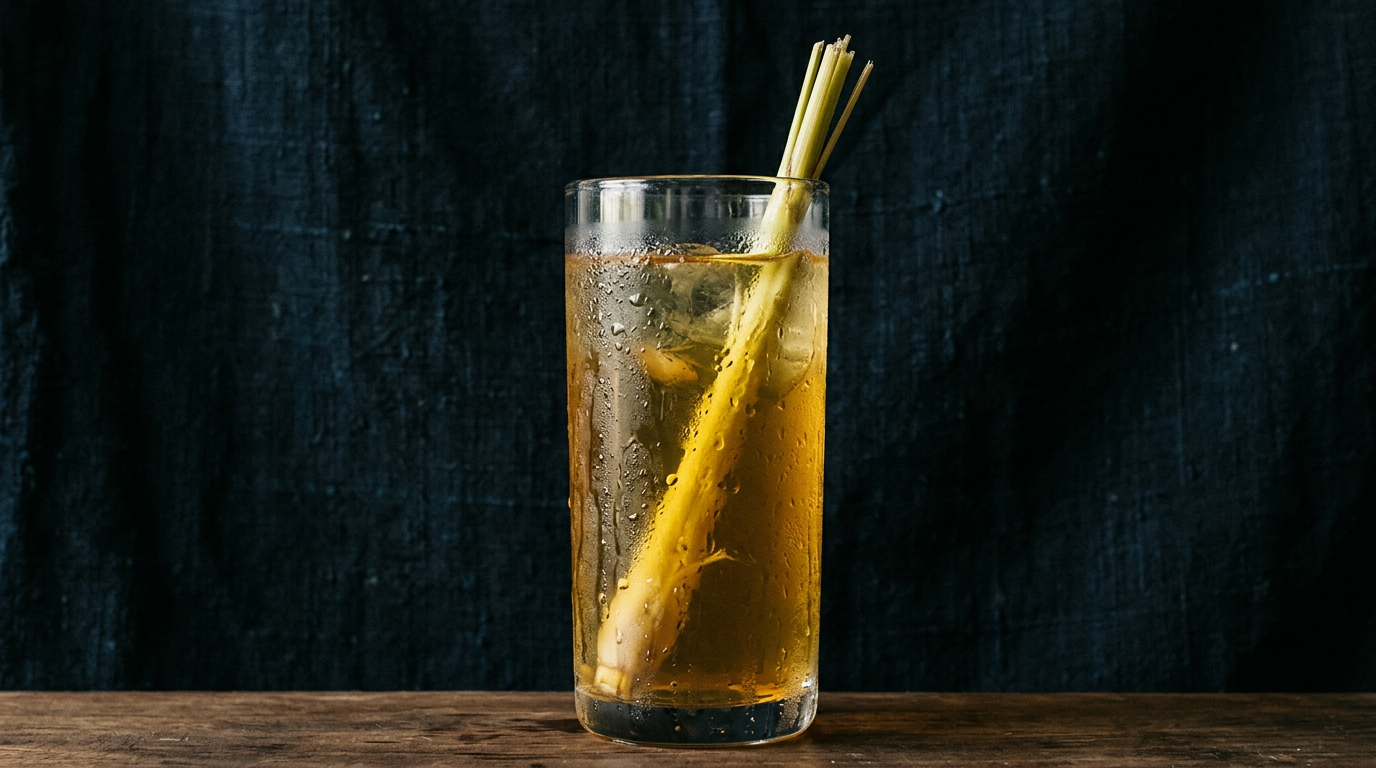
Lemongrass tea is a traditional Southeast Asian beverage known for its bright, citrusy aroma and calming properties. Made by steeping fresh or dried lemongrass in hot or cold water, this simple infusion is celebrated not only for its refreshing taste but also for its historical use in folk medicine to aid digestion, reduce anxiety, and provide antioxidant benefits [1].
The Kitchen Table Showdown
The other week, on a day thick with summer heat, our kitchen table became an impromptu tasting lab. On one side stood a pitcher of our house cooler: iced lemongrass tea, pale straw-gold, with a few bruised stalks lolling at the bottom. It’s a drink of profound simplicity, something my grandmother would make without a recipe or a second thought.
On the other side stood its challenger: a new, impressively marketed 'functional beverage.' It arrived in a sleek bottle, its label a tapestry of wellness buzzwords—nootropics, adaptogens, optimized hydration. It promised focus, calm, and vitality, all in one scientifically-formulated gulp. The color was an arresting, almost unnatural magenta.
We poured both into identical glasses for a blind tasting. The contestants were my family and a few friends, their only instruction to pick the one they’d want to finish on a hot day. Pitcher A vs. Pitcher B. The Lab vs. The Land.
Tale of the Tape
Before we get to the verdict, let's look at the contenders on paper. The difference isn't just in the ingredients; it's a difference in philosophy.
| Feature | The Challenger (Functional Beverage) | The Champion (Lemongrass Tea) |
| :--- | :--- | :--- |
| Ingredients | Filtered Water, Organic Cane Sugar, Natural Flavors, Citric Acid, Fruit & Vegetable Juice (for color), L-Theanine, Ashwagandha Extract, Lion's Mane Extract, Stevia... and 8 more. | Water, Lemongrass. |
| The Promise | 'Cognitive enhancement,' 'stress reduction,' 'peak performance.' | A refreshing drink. |
| Aroma & Flavor | A muddle of sweet berry, vague herbal notes, and a synthetic finish. | Clean, bright, citrus-forward with a hint of green grass and ginger. |
| Provenance | Formulated in a lab, ingredients sourced globally from industrial suppliers. | Lemongrass from a local farm we know by name. |
The Verdict
It wasn’t even close. Unanimously, every single person chose the lemongrass tea.
The comments for the functional drink were telling: "It tastes... loud." "I can’t tell what I’m supposed to be tasting." "It’s sweet in a way that makes me more thirsty." It wasn’t bad, but it was confusing. It was a beverage trying to be too many things at once.
The feedback for the lemongrass tea was simpler, more sensory: "Clean." "So refreshing." "It tastes like summer." "I could drink a whole pitcher of this." One friend held the glass to her nose for a full minute before sipping, lost in the aroma.
The lab-designed drink, for all its promises, failed the most basic test: the simple pleasure of a delicious, thirst-quenching drink. The ancient cooler won.
Why Simple Won
This isn't just a matter of taste; it’s a matter of elegant, time-tested chemistry. Lemongrass's power comes from its primary active compound, citral. This is what gives it that unmistakable lemony scent, and it's also a potent bioactive ingredient. Clinical studies show citral has significant antioxidant and anti-inflammatory properties, working at a cellular level to combat oxidative stress [2].
For generations, lemongrass was also served as a calming evening tea. Modern science is just catching up to this wisdom, with studies pointing to its anxiolytic (anxiety-reducing) effects, likely by influencing neurotransmitter receptors in the brain [3]. It calms without sedating.
Compare this focused, potent plant chemistry to the 'everything but the kitchen sink' approach of many modern wellness products. The functional drink boasted a dozen 'active' ingredients. But in such small, unstated quantities, it's fair to ask if they have any meaningful effect—a practice known in the industry as 'fairy dusting.' While adaptogens like Ashwagandha are powerful herbs in their own right, their inclusion often feels more like a marketing claim than a functional dose [4].
Our humble tea, with just one star ingredient, delivered a clear, singular, and effective experience. It did one thing, and it did it perfectly. It cooled the body, calmed the mind, and delighted the senses.
Reclaiming the Cooler
The story of food in the last century has often been one of complication—of processing, fortifying, and reformulating what was once simple. We were taught that innovation came from a lab and that a long ingredient list signaled value. Our little kitchen-table experiment suggests a shift is underway.
Perhaps the most potent innovations are actually rediscoveries. The future of feeling good might look less like a complex formula in a can and more like a stalk of grass in a glass of water. All it requires is that we trust the wisdom of our ancestors as much as we trust a label.
To make it yourself: Take 3-4 fresh lemongrass stalks. Trim the ends and peel away the tough outer layers. Bruise the stalks with the back of a knife to release their aromatic oils. Place them in a pitcher and cover with 4 cups of boiling water. Let it steep for 10-15 minutes, or until it tastes right to you. Strain, cool, and serve over ice. That’s it. No powders, no extracts, no fuss.
Frequently Asked Questions
1. Can I use dried lemongrass instead of fresh?
Yes, absolutely. Use about 1 tablespoon of dried, cut lemongrass for every fresh stalk. The flavor will be slightly more woody and less bright, but still lovely.
2. Is lemongrass tea caffeinated?
No. Lemongrass is a naturally caffeine-free herb, making it a wonderful drink for any time of day, especially in the evening when you're winding down.
3. What are the main proven benefits of lemongrass?
Scientific studies have focused on its anti-inflammatory, antioxidant, antimicrobial, and anxiolytic (anxiety-reducing) properties, primarily due to its high concentration of the compound citral [1, 2, 3].
4. Is it better hot or cold?
It's a matter of personal preference and tradition. Served hot, it's a soothing, aromatic digestif. Served cold, it's one of the world's most effective and elegant thirst-quenchers.
Sources & citations
- Shah, G., Shri, R., Panchal, V., Sharma, N., Singh, B., & Mann, A. S. (2011). "Scientific basis for the therapeutic use of Cymbopogon citratus, stapf (Lemon grass)." Journal of Advanced Pharmaceutical Technology & Research, 2(1), 3–8. https://www.ncbi.nlm.nih.gov/pmc/articles/PMC3217679/
- Ekpenyong, C. E., Akpan, E. E., & Daniel, N. E. (2014). "Phytochemical constituents, and antimicrobial and antioxidant activity of Cymbopogon citratus (DC.) Stapf. leaves." Journal of Medicinal Plants Research. https://academicjournals.org/journal/JMPR
- Blanco, M. M., Costa, C. A. R. A., Freire, A. O., Santos, J. G., Jr, & Costa, M. (2009). "Neurobehavioral effect of essential oil of Cymbopogon citratus in mice." Phytomedicine, 16(2-3), 265–270. https://pubmed.ncbi.nlm.nih.gov/18947879/
- Johns Hopkins Medicine. (n.d.). "What Are Adaptogens and Are They Healthy?" https://www.hopkinsmedicine.org/health/wellness-and-prevention/what-are-adaptogens-and-are-they-healthy