
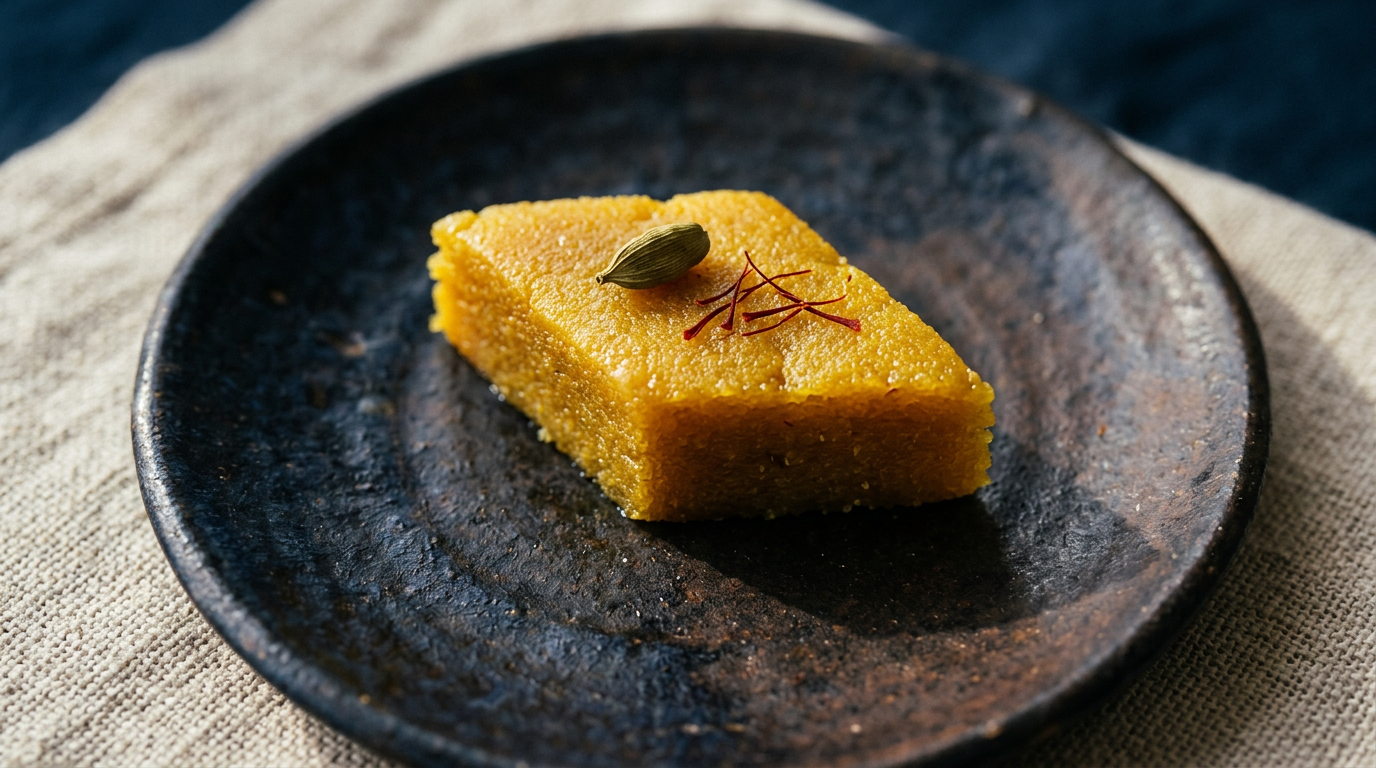
This Hijri new year recipe halwa is a sensory tribute to a tradition my grandmother perfected in her Jeddah kitchen. It's a simple alchemy of toasted semolina, fragrant ghee, and a syrup jeweled with saffron and cardamom. As we approach the [Islamic New Year (Hijri 1448)](/festival/islamic-new-year-1448) on July 16, 2026, this isn't just a dessert; it's a way to mark time with intention and flavor.
My grandmother’s kitchen in /region/ksa overlooked a small courtyard. The Hijri New Year wasn't marked by loud celebrations, but by quiet, deliberate acts of hope. The most potent of these was the making of halwa. The process began with toasting coarse semolina—known as `sooji` in India or `simid` in Egypt—in a generous amount of ghee, or `samneh` as it's often called in the Gulf. She’d stir patiently over a low flame, not stopping until the grains turned the color of pale sand and the kitchen filled with a scent so deeply nutty and comforting it felt like a prayer.
The Alchemy of Toasting
That unforgettable aroma isn't just nostalgia; it's chemistry. Gently heating semolina in fat initiates a cascade of browning reactions, including the Maillard reaction. This process creates hundreds of new aromatic compounds that give the halwa its foundational depth [3]. Rushing this step with high heat leads to a raw, pasty flavor. The goal is an even, golden toast that transforms the grain from a simple starch into a complex flavor base. My grandmother judged it not by time, but by the change in sound as she stirred and the specific fragrance that signaled it was ready.
Saffron's Golden Bloom
While the semolina toasted, she would prepare the saffron. A few precious threads, sourced from the old vendors in Jeddah's Souq Al Alawi, were crushed and steeped in a small bowl of warm water. This isn't just for color. Saffron's magic lies in three key molecules: `crocin` (the vibrant color), `picrocrocin` (the gentle bitterness), and `safranal` (the iconic aroma) [1]. Steeping, or “blooming,” coaxes these compounds out of the threads, ensuring every drop of the syrup is infused with saffron’s full character. Adding dry threads directly to the pan is a missed opportunity, a shortcut that sacrifices complexity for convenience. You can learn more about sourcing quality saffron in our deep dive, [/spice/saffron](/spice/saffron).
Cardamom's Cooling Counterpoint
Just before the sugar syrup was ready, she'd crack open a few green cardamom pods and bruise the seeds within. Cardamom’s primary aromatic compound, 1,8-cineole (also known as eucalyptol), provides a bright, slightly cooling, and camphoraceous note [2]. It’s the perfect counterpoint to the warm, earthy saffron and the rich ghee. It cuts through the sweetness, lifting the entire dish and preventing it from becoming cloying. This balance is the hallmark of a well-made halwa—it should feel both rich and refreshing.
A Recipe Schema for Semolina Halwa
This is less a rigid recipe and more a framework of ratios and sensory cues.
- Ingredients:
* 1 part coarse semolina
* 1 part ghee
* 1 part sugar
* 3 parts water
* A generous pinch of high-quality saffron, bloomed in a tablespoon of warm water
* 4-5 green cardamom pods, crushed
* A handful of slivered almonds or pistachios for garnish (optional)
- Method:
1. In a heavy-bottomed pan, melt the ghee over low-medium heat.
2. Add the semolina and toast, stirring constantly, for 10-15 minutes. Wait for the color change and the nutty aroma.
3. While the semolina toasts, combine the water, sugar, crushed cardamom, and bloomed saffron in a separate saucepan. Bring to a gentle boil, stirring until the sugar dissolves completely. Turn off the heat.
4. Once the semolina is toasted, carefully pour the hot syrup into the pan. It will sizzle and steam violently—this is normal. Stand back and stir continuously as the semolina absorbs the liquid and thickens.
5. Once the mixture pulls away from the sides of the pan, turn off the heat. Cover and let it rest for 10 minutes. This allows the grains to fully swell.
6. Fluff with a fork, transfer to a serving dish, garnish, and serve warm.
This basic formula is a canvas. In the UAE, you might find it enriched with a splash of rosewater. In Egypt, `halawet el simid` can be pressed into a mold and served in firm slices. What connects these variations is the shared understanding that a new year deserves a sweet, thoughtful beginning. Making this hijri new year recipe halwa is an act of creation, a fragrant welcome to the days ahead.
FAQ
1. Can I make this recipe vegan?
Yes, you can substitute ghee with high-quality coconut oil or a neutral-flavored vegan butter. The flavor profile will be different, lacking the distinct nutty taste of browned milk solids from ghee, but it will still be delicious.
2. What's the best type of saffron to use?
Look for saffron labeled as “sargol” or “negin” grade. These consist of deep red threads only (the stigmas) without the yellow style, indicating higher potency in color and aroma.
3. How do I store semolina halwa?
You can store it in an airtight container at room temperature for up to 3 days or in the refrigerator for about a week. It may firm up when chilled; you can gently warm it before serving.
4. Why did my halwa turn out gummy or sticky?
This usually happens for two reasons: the semolina wasn't toasted for long enough, or the sugar syrup was cooked for too long, reaching a candy stage. Ensure the semolina is properly roasted and only bring the syrup to a boil long enough to dissolve the sugar.
Sources & citations
- Moshiri, M., Vahabzadeh, M., & Hosseinzadeh, H. (2015). Clinical Applications of Saffron (Crocus sativus) and its Constituents: A Review. Drug research, 65(6), 287–295. `https://pubmed.ncbi.nlm.nih.gov/25497893/`
- Batiha, G. E., Al-Ghamdi, A. A., & Al-Zoghaibi, M. A. (2022). Elettaria cardamomum (L.) Maton: An Updated Review of Its Pharmacological and Toxicological Aspects. BioMed research international, 2022, 6023285. `https://www.ncbi.nlm.nih.gov/pmc/articles/PMC8909459/`
- Food and Agriculture Organization of the United Nations. (n.d.). Durum Wheat. `https://www.fao.org/durum-wheat/en/`
- The Editors of Encyclopaedia Britannica. (2023). Halvah. In Encyclopædia Britannica. `https://www.britannica.com/topic/halvah`