
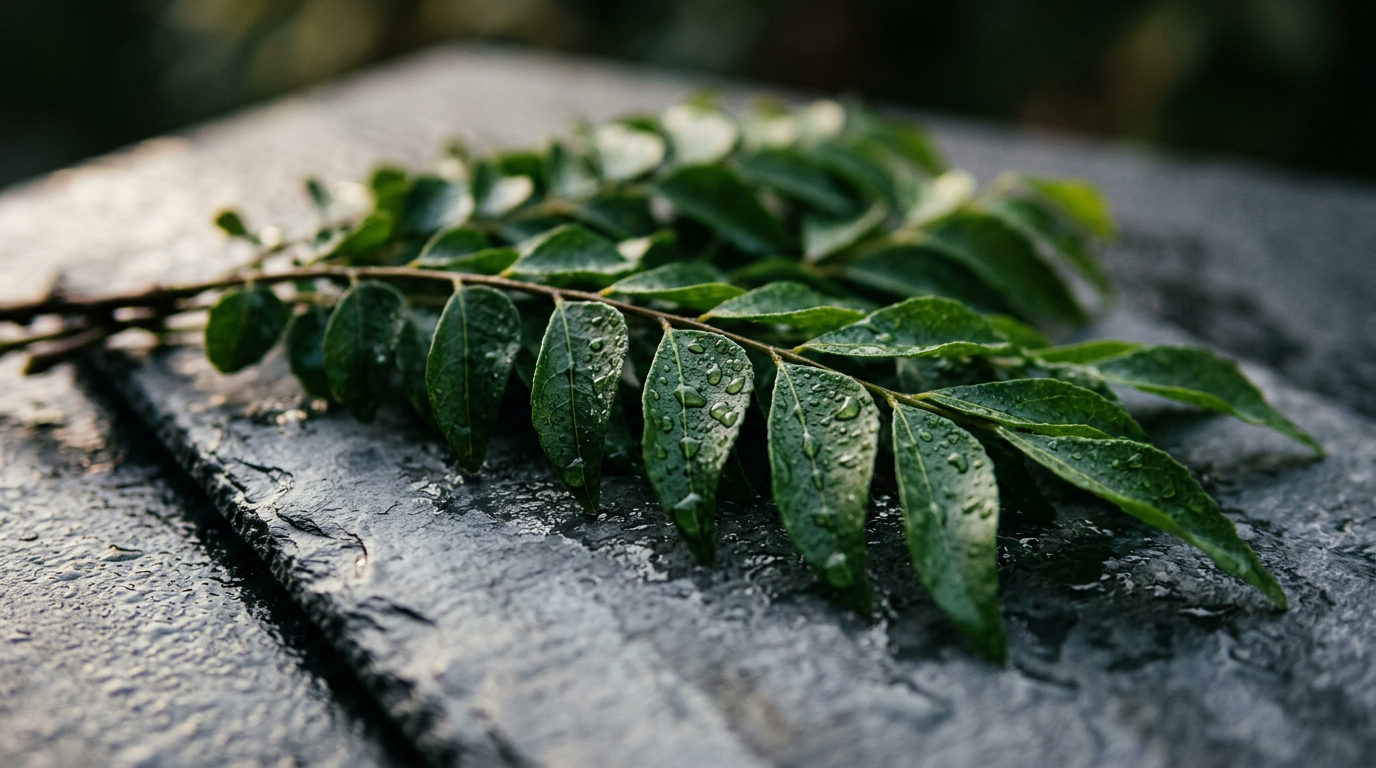
In many South Asian kitchens, it’s the sound that signals dinner is truly underway: a sharp, percussive crackle as a fistful of fresh curry leaves hits hot oil. The sound is fleeting, but the aroma that blooms in its wake—a complex, smoky-citrus fragrance—is the very foundation of countless dishes. For generations, Murraya koenigii, or kadi patta, has been an indispensable staple, its flavor woven into the fabric of daily life.
But what if this everyday herb is doing more than just adding flavor to our lentils? What if it’s quietly working to protect the very heart of the person at the stove? In recent years, a growing body of scientific evidence has begun to validate what Ayurvedic tradition has suggested for centuries: the curry leaf is a potent cardioprotective agent [1].
From 'Tadka' to Ticker
For those of us who grew up with it, the curry leaf is often the first thing pushed to the side of the plate. It has done its job, we think, infusing the oil with its essence. But modern science suggests we should be eating the leaves themselves. The same compounds that create their unique aroma are also powerful bioactive agents.
The primary interest for cardiologists and food scientists lies in a class of compounds called carbazole alkaloids. Curry leaves are a uniquely rich source of these, with names like mahanimbine, girinimbine, and koenimbine appearing frequently in research papers [2]. These alkaloids are powerful antioxidants. This is more than a wellness buzzword; in the context of heart health, it’s a critical function. Our arteries are under constant assault from oxidative stress—damage caused by unstable molecules called free radicals. This stress is a key driver of atherosclerosis, the process where plaque builds up in the arteries, leading to heart disease. The antioxidants in curry leaves help neutralize these free radicals, essentially acting as a cellular defense system for our circulatory plumbing [3].
Reading the Lipid Panel
The research goes beyond general antioxidant activity. Several studies have looked specifically at how curry leaves affect cholesterol and other blood lipids. While much of the foundational research has been in animal models, the results are consistently intriguing. A 2010 study published in the American Journal of Chinese Medicine, for example, found that extracts from curry leaves significantly lowered levels of “bad” LDL cholesterol and triglycerides in diabetic rats, while simultaneously increasing levels of “good” HDL cholesterol [4].
How? The mechanisms are still being fully mapped, but it appears the alkaloids interfere with the absorption of fat in the gut and boost the activity of enzymes that break down cholesterol. It’s a multi-pronged approach that mirrors the complexity of the plant itself. It's a reminder that a whole food often acts in a symphony of ways that a single, isolated compound cannot.
This is not a magic bullet, of course. No single ingredient can undo a diet of highly processed foods or a sedentary lifestyle. But the evidence points to a powerful role for curry leaves within a balanced, whole-foods diet. It’s a perfect example of food-as-medicine not being about a specific pill or powder, but about the consistent, daily inclusion of protective foods.
The Freshness Imperative
If you want to incorporate more of this humble leaf, sourcing matters. The dried curry leaves available in many supermarkets are a ghost of the real thing, having lost most of their aromatic oils and, with them, a significant portion of their bioactive compounds. Fresh or flash-frozen leaves are far superior. They are increasingly available at Indian grocers and farmers' markets as the diaspora and curious eaters alike create a new center of gravity for demand.
The science is simply catching up to the wisdom of the kitchen. The practice of starting a meal with a tadka or chaunk of spices in hot fat wasn’t just for flavor. It was an ingenious method for making the fat-soluble compounds in spices—like the carbazole alkaloids in curry leaves—more bioavailable. That crackle in the pan is the sound of an ancient health technology being activated.
The next time you find a curry leaf on your plate, you might think twice before setting it aside. It’s more than a garnish. It’s a small, edible testament to the idea that our most potent medicines might not come from a lab, but from a leaf we’ve known and loved all along [5].
Sources & citations
- Tiwari, R., & Dikshit, M. (2015). “Incredible Power of Curry Leaves: A Review.” Rasayan Journal of Chemistry. [https://rasayanjournal.co.in]
- Patel, J., et al. (2021). “A comprehensive review on the phytochemistry, pharmacology, and clinical-significance of Murraya koenigii.” Heliyon. [https://www.cell.com/heliyon/home]
- Ghasemzadeh, A., et al. (2014). “The effect of different extracts of Murraya koenigii (L.) Spreng leaves on antioxidant and antimicrobial activities.” International Journal of Food Properties. [https://www.tandfonline.com/journals/ljfp20]
- Xie, J. T., et al. (2006). “An aqueous extract of curry leaf (Murraya koenigii) protects against experimentally induced diabetes in neonatal streptozotocin rats.” The American Journal of Chinese Medicine. [https://www.worldscientific.com/worldscinet/ajcm]
- Food and Agriculture Organization of the United Nations (FAO). (2004). “Minor tropical fruits: Mainstreaming a neglected treasure.” [https://www.fao.org/home/en]