
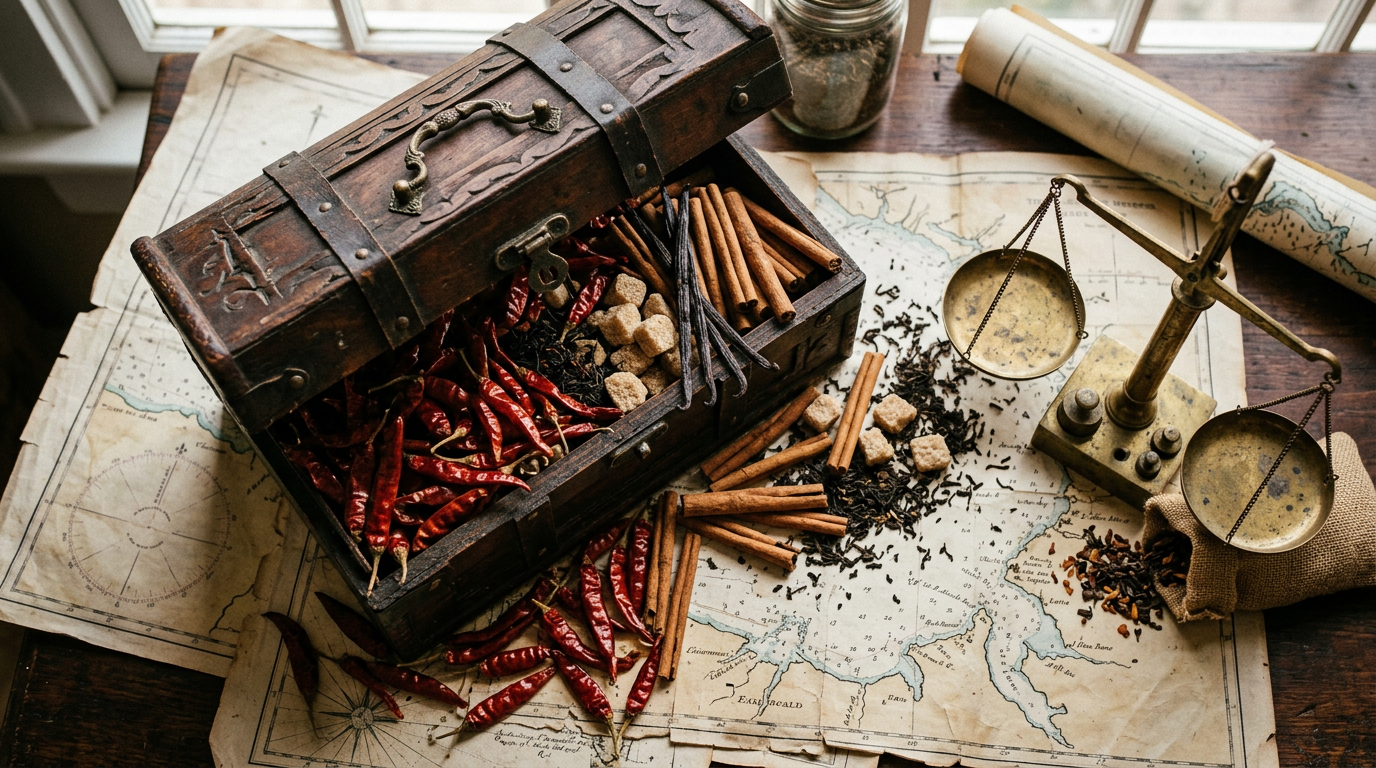
Walk down any supermarket aisle and you’ll see a story of global harmony—or so it seems. Italian tomatoes, Irish potatoes, Thai chilies, English tea. It looks like a potluck where every country brought its best dish. But this convenient narrative omits a crucial, often brutal, truth: our modern pantry was not assembled through polite exchange. It was forged in the fire of empire.
The shelves of our grocery stores are living artifacts of colonial history. The placement of ingredients, the flavors we consider 'staple' versus 'exotic,' and the very existence of certain food pairings are a direct legacy of conquest, displacement, and forced trade. To understand the food we eat is to understand how power has shaped our palates for centuries.
The Columbian Exchange's Decisive Shock
Let’s start with a foundational ingredient many of us mistake as native to Asia: the chili pepper. It’s impossible to imagine Indian vindaloo, Thai green curry, or Sichuan hot pot without its fiery kick. Yet, for thousands of years, these cuisines thrived without it. Their heat came from spices like black pepper and ginger.
The chili pepper is native to the Americas. It arrived in Asia and the rest of the world as part of the “Columbian Exchange,” the vast transfer of plants, animals, culture, and diseases that followed Christopher Columbus’s voyages in the 15th century [1]. Portuguese traders, establishing colonial outposts in India, introduced the chili in the 16th century. It was an immediate hit, not just for its flavor, but for its economics. Chilies were easy to grow in local climates, making them an accessible alternative to black pepper, a fiercely guarded and expensive spice whose trade routes Europeans were desperate to control [2].
This wasn't an isolated incident. The tomato, now the heart of Italian cuisine, also came from the Americas. So did the potato, which would tragically reshape Ireland’s fate. This was not a culinary fusion project; it was the biological consequence of one part of the world imposing its will on another, with permanent and unpredictable results.
Sweetness and Power: The Bitter Story of Sugar and Tea
Few pairings seem more civilized than a cup of sweet tea. Yet, this simple ritual is steeped in the violence of two colonial enterprises.
By the 18th century, Britain was consumed by a craze for tea from China. When China's government insisted on payment in silver, creating a trade imbalance, the British East India Company found a sinister solution: illegally trafficking opium, grown on its colonial plantations in India, into China in exchange for tea. This policy created widespread addiction, devastated Chinese society, and ultimately led to the Opium Wars [3].
Meanwhile, the national sweet tooth for tea had to be satisfied. The demand for sugar exploded, and it was met by one of the most brutal systems of labor imaginable: the transatlantic slave trade. Millions of Africans were kidnapped and forced to labor on sugarcane plantations in the Caribbean and Brazil under horrific conditions. The profits from sugar, produced by enslaved people, not only sweetened British tea but helped finance the Industrial Revolution [4]. As historian Sidney W. Mintz argued in his seminal work, Sweetness and Power, sugar was transformed from a luxury for the rich into a daily necessity for the working class, propping up an entire colonial economy built on human suffering.
What's 'Normal'? Your Supermarket's Colonial Aisle
This history directly informs the layout of your local grocery store. The foods normalized by powerful empires—wheat, sugar, tea, beef—form the core of the Western diet and occupy the most retail space. These are simply ‘food’.
Meanwhile, ingredients from other culinary traditions are often relegated to a token ‘ethnic’ or ‘international’ aisle. This division is a modern echo of the colonial mindset, which categorizes the world into the imperial center and the ‘exotic’ periphery.
This presents a critical challenge and an opportunity. For decades, the consumer goods industry has often operated on a colonial model: taking ingredients and recipes from other cultures, stripping them of context, and reformulating them for a mainstream palate. Think of ‘curry powder’—a British invention designed to simplify the complex spice blends of Indian cuisine for colonial kitchens.
But consumers are growing wiser. We now have a chance to build a more equitable food system. That means honoring provenance, promoting fair trade with origin communities, and telling the full, complex story of our ingredients—not just the marketable parts. It means seeing food not as a commodity to be extracted, but as a culture to be respected.
The story of our pantry is a story of adaptation and survival, but also one of profound injustice. Acknowledging this doesn't diminish our enjoyment of food; it deepens it. It allows us to cook and eat with greater awareness, honoring the true, complicated journey of the ingredients that feed us.
Sources & citations
- The Editors of Encyclopaedia Britannica. "Columbian exchange". Encyclopedia Britannica, 12 May 2024. https://www.britannica.com/event/Columbian-exchange
- See National Geographic reporting on the global history of the chili pepper. https://www.nationalgeographic.com/history/
- The Editors of Encyclopaedia Britannica. "Opium Wars". Encyclopedia Britannica, 12 May 2024. https://www.britannica.com/topic/Opium-Wars
- Daniels, J., & Glaun, D. "The Bitter History of Sugar in America". Smithsonian Magazine, 20 May 2024. https://www.smithsonianmag.com/history/the-bitter-history-of-sugar-in-america-180963333/