
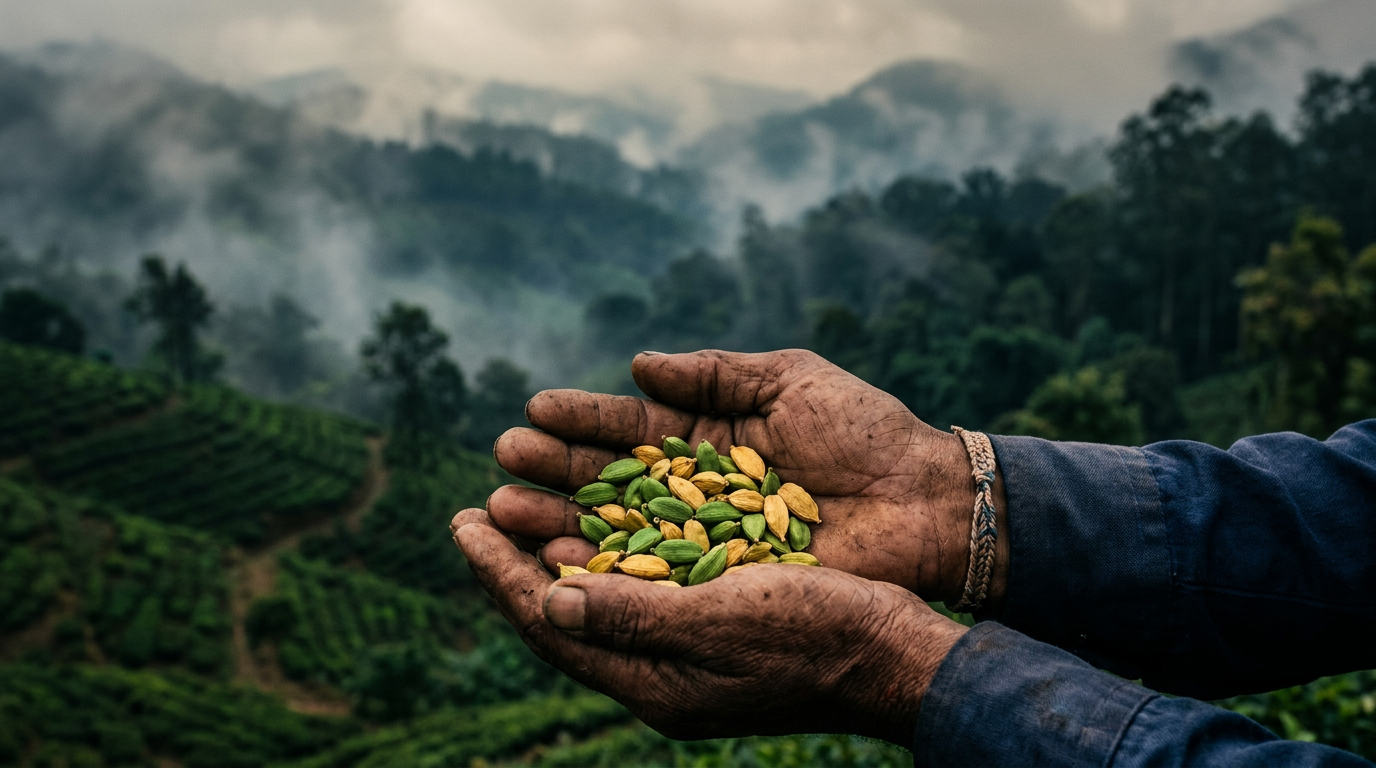
Crush a green cardamom pod between your fingers. First comes the crackle of the papery husk, then the release of its scent—a complex perfume of eucalyptus, mint, citrus, and flowers, all at once. This is the aroma of Elettaria cardamomum, the “Queen of Spices,” an ingredient that has scented everything from Vedic rituals and Bedouin coffee to Scandinavian breads for millennia.
But that scent is not a given. It is an expression of place, or what winemakers call terroir. The specific balance of volatile compounds that we recognize as true cardamom is a direct consequence of a precise microclimate: specific rainfall, humidity, temperature range, and soil composition. For centuries, the world’s most coveted cardamom has come from a particular place: the Idukki district in the Western Ghats of southern India, a region so suited to the plant it’s simply known as the Cardamom Hills.
Here, cardamom grows as an understory plant in a delicate dance with the monsoon. It needs the shade of a taller forest canopy, consistently moist but well-drained soil, and temperatures that hover reliably between 18°C and 23°C [1]. The farmers of Idukki have passed down the knowledge of cultivating this sensitive crop for generations. They know the exact moment to harvest the pods by hand to capture the peak concentration of its essential oils.
But that dance is becoming unsteady. The rhythm of the monsoons is growing erratic, with intense downpours leading to waterlogged roots and longer dry spells stressing the plants. Average temperatures in the region are climbing, pushing the ideal growing conditions to higher, cooler altitudes. These changes don't just reduce yield; they threaten the very character of the spice. A stressed plant may produce pods with a lower concentration of 1,8-cineole and α-terpinyl acetate, the two compounds primarily responsible for cardamom’s signature camphoraceous and sweet notes [2].
A Tale of Two Mountains
Half a world away, another cardamom story is unfolding in the cloud forests of Alta Verapaz, Guatemala. In a fascinating turn of history, Guatemala now produces more cardamom by volume than India. The spice arrived there in the early 20th century and thrived, creating an economic lifeline for hundreds of thousands of smallholder farmers, many of them from the indigenous Q’eqchi’ and Poqomchi’ communities.
For decades, this new origin provided a steady supply to the world market. But it is not immune to the same pressures. Guatemalan farmers are also witnessing a slow march uphill. As lowland temperatures rise, they are forced to clear new plots at higher elevations to find the cool, misty conditions cardamom requires [3]. This “uphill migration” has profound consequences. It creates a moving target for quality, as flavor profiles shift with the new soil and altitude. It also puts pressure on fragile, high-altitude ecosystems and the communities who depend on them.
This isn't merely a supply chain problem; it's a flavor problem. The spice in your chai or your curry is a snapshot of an ecosystem. When that ecosystem is disrupted, the snapshot blurs. The cardamom of tomorrow, grown at a different elevation by a farmer adapting to a new climate reality, may not taste quite like the one we know today.
The Future of Flavor
So, what does this mean for those of us who care about how our food tastes? It means we can no longer think of spices as static commodities. Their future depends on a dynamic and intelligent approach to sourcing.
The response isn't to abandon historic growing regions like Idukki or chase the latest productive frontier. The response is to deepen our engagement with the people and places at the heart of the story. It means supporting farmers who are implementing climate-resilient practices, like multilayered agroforestry that mimics the natural forest, improves water retention, and fosters biodiversity. It means investing in the scientific analysis of different cardamom cultivars to identify those with greater tolerance for heat or drought, without sacrificing the complex essential oil profile we cherish.
This is where ancestral wisdom and modern science must meet. The generational knowledge of a farmer in the Cardamom Hills—who can read the sky and the soil to predict a harvest—is invaluable. So is the work of a lab that can map the thirty-plus compounds that make up cardamom’s aroma and track how they change with the climate [4]. By pairing these two forms of knowledge, we can build a more resilient future for our spices.
When you taste a truly exceptional cardamom, you're not just tasting a spice. You're tasting the cool air of a high-altitude forest, the richness of its soil, a season of predictable rain, and the accumulated knowledge of a farming community. As the world warms, preserving that flavor has become an act of conscious cultivation.
Sources & citations
- K. P. Martin, S. K. A. Christy, and R. G. Madhusoodanan, "Climate change and its impact on the physiology of elite spices of the Western Ghats," Climate Change and Its Impact on Agriculture, 2023.
- "Cardamom: The Queen of Spices," Spices Board India, Ministry of Commerce & Industry, Government of India. [https://www.indianspices.com/spices-data/cardamom-large.html]
- Jeff Abbott, "The Changing Climate For Cardamom in Guatemala," The Progressive Magazine, August 20, 2019. [https://progressive.org/magazine/the-changing-climate-for-cardamom-in-guatemala-abbott/]
- L. K. M., G. K. H., and A. A. K., “A review on chemical constituents and medicinal properties of Elettaria cardamomum,” International Journal of Pharmacognosy and Phytochemical Research, 2017. [https://www.ijppr.com/]