
The familiar green and blue logo on a package of coffee, chocolate, or tea feels like a guarantee. We see it and trust that we’ve made a responsible choice—one that ensures a farmer somewhere was paid a decent wage for their hard work. And often, that’s true. The Fairtrade movement was a revolutionary step forward, creating a vital conversation about ethics in our global supply chains.
But it's just that: a step. After years spent building relationships in the spice trade, we’ve come to see that a sticker, however well-intentioned, can’t tell the whole story. For many small-scale farmers, the high cost of certification can be a barrier to entry. The system often sets a price floor, which is crucial for preventing exploitation, but it doesn't always account for the true cost of production in a specific region, nor does it inherently reward superior quality [1]. The result can be a flattening of a complex agricultural craft into a simple, certified commodity.
What if we could build something even more resilient and rewarding? What if we moved from a transactional system to a relational one?
The Direct Trade Difference
This is the principle behind direct trade. It’s a simple name for a profound shift in thinking. Instead of buying spices from a series of anonymous aggregators and exporters, we build direct, long-term partnerships with the people who grow them. This isn’t about just “cutting out the middleman” for better margins; it’s about shortening the distance between the farm and your kitchen to build trust and share knowledge.
When you have a direct relationship, the conversation changes. It’s no longer about haggling over the lowest possible commodity price. It becomes a discussion about the weather, about a new intercropping technique that improves soil health, about the premium we can pay for a harvest that is exceptionally aromatic because it was hand-picked at its peak. It’s a partnership where risk and reward are shared.
For many of the world's million-plus spice farmers, who cultivate less than two hectares of land, this shift is everything. It re-centers their expertise and treats them as the artisans they are.
Collective Strength in Cooperatives
A key part of making this model work is the farmer cooperative. By banding together, smallholder farmers gain the collective bargaining power they lack on their own. They can pool their harvests to fulfill larger orders, share the cost of organic certification, and invest in shared infrastructure like processing facilities or new drying equipment that improves the quality and consistency of their crop [2].
We’ve seen this firsthand with our partners at the Harishchandra Hilly Agri-Cooperative in Idukki, Kerala. By working together, they’ve been able to invest in better post-harvest handling for their black pepper, ensuring the peppercorns are dried carefully to preserve their volatile oils. This results in a more fragrant, potent spice. The cooperative structure provides financial and social resilience, creating a support system that benefits the entire community, not just the individual.
Traceability You Can Taste
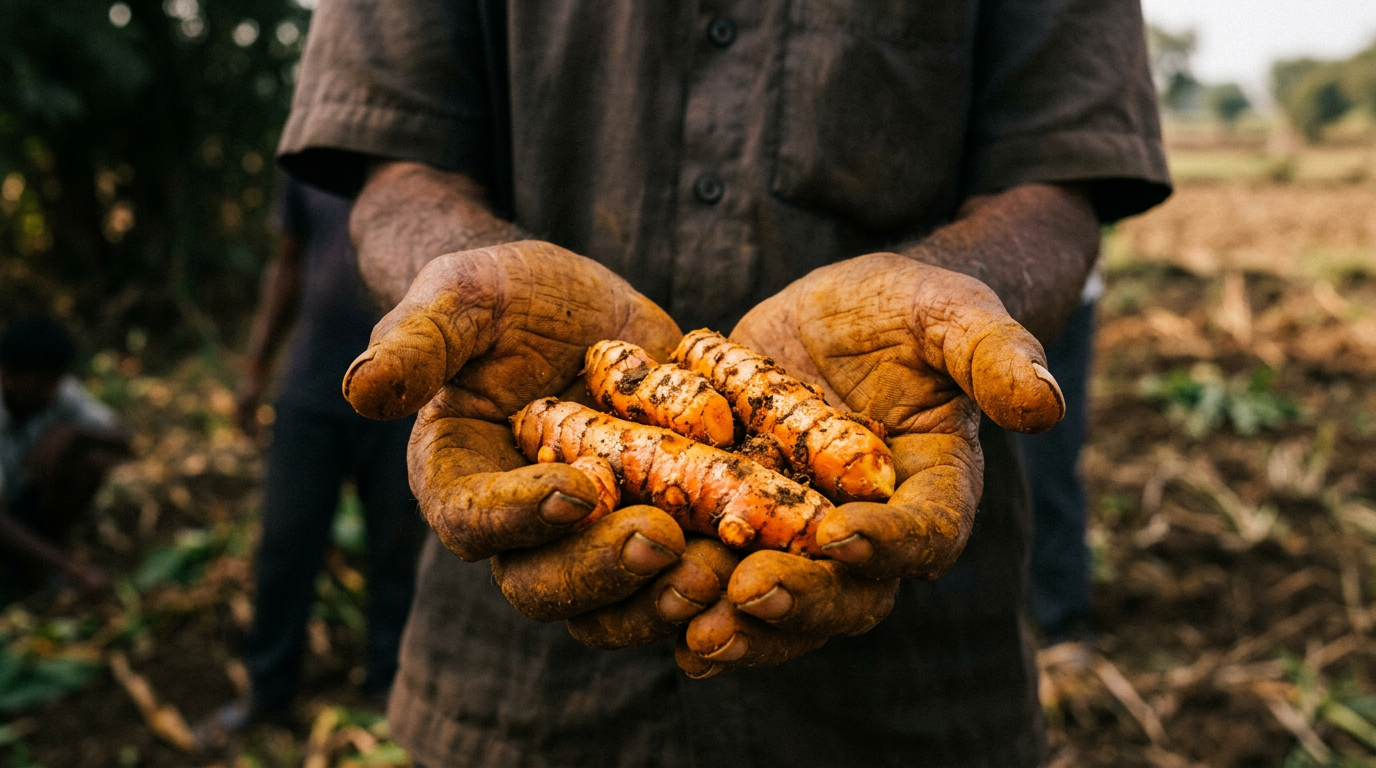
This level of partnership allows for something extraordinary: radical transparency. Because we know the people and the place behind every spice, we can provide a level of detail that’s impossible in the conventional market. We can tell you the district, the harvest date, and the specific cultivar of turmeric we're using.
This isn't just for a nice story on the label. This traceability is a cornerstone of our scientific process. Knowing the exact provenance allows us to test for what matters. For turmeric, it means verifying the curcumin content—the bioactive compound at the heart of its wellness benefits. For all our spices, it means testing for heavy metals and other contaminants to guarantee purity and safety [3]. When a supply chain is opaque, quality control is a guess. When it's transparent, it’s a science.
Ultimately, a system that values farmers as partners doesn't just feel better; it tastes better. Farmers who are paid a significant premium for quality are incentivized to focus on it. They are empowered to use regenerative agricultural practices that produce healthier soil and more flavorful, nutrient-dense spices [4]. They are no longer growing a bulk commodity; they are cultivating a craft.
Building these relationships is slow, patient work. It doesn’t scale with the speed of a software company and it can’t be boiled down to a simple logo. It requires cultural fluency, humility, and a long-term commitment. But the result is a more equitable, more resilient, and undeniably more delicious future of food. It’s a system built on a beautifully simple premise: that the person who grows your food deserves not just a fair price, but a seat at the table.
Sources & citations
- Balch, A. (2020). "Has Fairtrade been a failure?". Stanford Social Innovation Review. https://ssir.org/articles/entry/has_fairtrade_been_a_failure
- Food and Agriculture Organization of the United Nations. (2023). "Agricultural Cooperatives: A proven tool for sustainable development". https://www.fao.org/cooperatives/en/
- Aung, M. M., & Chang, Y. S. (2014). "Traceability in a food supply chain: Safety and quality perspectives". Food Control, 39, 172-184. https://www.sciencedirect.com/science/article/abs/pii/S095671351300531X
- Cornell University Small Farms Program. (n.d.). "Exploring the direct marketing of farm products". https://smallfarms.cornell.edu/resources/marketing-business-planning/