
In the world of wellness, the logic often seems simple: if a little is good, a lot must be better. We see it everywhere, from “triple-strength” formulas to “maximum potency” labels screaming from the shelf. This thinking has a certain intuitive appeal, but nature, and the human body, are rarely so linear. In fact, some of the most effective compounds in the botanical world operate on a more subtle principle, one where the right amount is a finely-tuned sweet spot, and more is not just ineffective, but can be counterproductive.
Nowhere is this truer than with Ashwagandha (Withania somnifera), the celebrated root of Ayurvedic tradition. For millennia, it has been revered as a Rasayana, a class of herbs known for their rejuvenating and life-extending properties [1]. Today, it’s best known as a premier adaptogen, an agent that helps the body modulate and adapt to stress. But as this ancient root moves from traditional preparations into standardized extracts and modern capsules, we’re running into a very modern problem: a misunderstanding of its dose-response relationship.
The “Megadose” Myth
When we take a supplement, we’re introducing a signal to a complex biological system. The body’s response to that signal is not always a straight line. Think of it like watering a plant. Too little water, and it wilts. The right amount, and it thrives. But too much water, and you drown the roots, creating a new set of problems. The effect doesn't just keep getting better as you add more.
In pharmacology and toxicology, this is known as a dose-response curve. For many substances, this curve is U-shaped or an inverted U. This phenomenon, sometimes called hormesis, describes a biphasic response where a low dose of a stressor (like a botanical compound) can be stimulating and beneficial, while a high dose is inhibitory or toxic [2]. The idea is that a small, manageable challenge prompts the body's adaptive and repair mechanisms to switch on, making the system stronger and more resilient. Too large a challenge overwhelms the system entirely.
This is the paradox at the heart of many powerful botanicals. The goal isn't to flood the body—it's to send the right signal. The conversation we should be having isn't about maximum quantity, but optimal dose.
Ashwagandha on the Curve
Clinical research on ashwagandha gives us fascinating clues about this “sweet spot” effect. Studies have successfully used a range of doses, typically from 250 mg to 600 mg of a standardized root extract per day, to achieve significant reductions in perceived stress and the stress hormone cortisol [3, 4].
What’s particularly telling is that “more” does not always equate to “better.” One landmark 2019 study published in Medicine compared a daily dose of 250 mg against a daily dose of 600 mg. Both groups saw significant reductions in stress and cortisol compared to a placebo. While the 600 mg group showed a slightly greater reduction in cortisol, both doses were remarkably effective. The study authors concluded that even the lower 250 mg dose was sufficient to produce a robust anti-stress effect [3].
This suggests we are not on a steep upward climb where every additional milligram brings dramatic new benefits. Instead, we are likely operating on a plateau or the gentle arc of an inverted U. There is a dosage window within which the root works its magic. Go below it, and the effect is lost. But go too far above it, and you may not be adding benefit; you could be simply increasing the load on the body or risking side effects like digestive upset or drowsiness, which are occasionally reported with very high intake [5].
Ancient Wisdom, Modern Precision
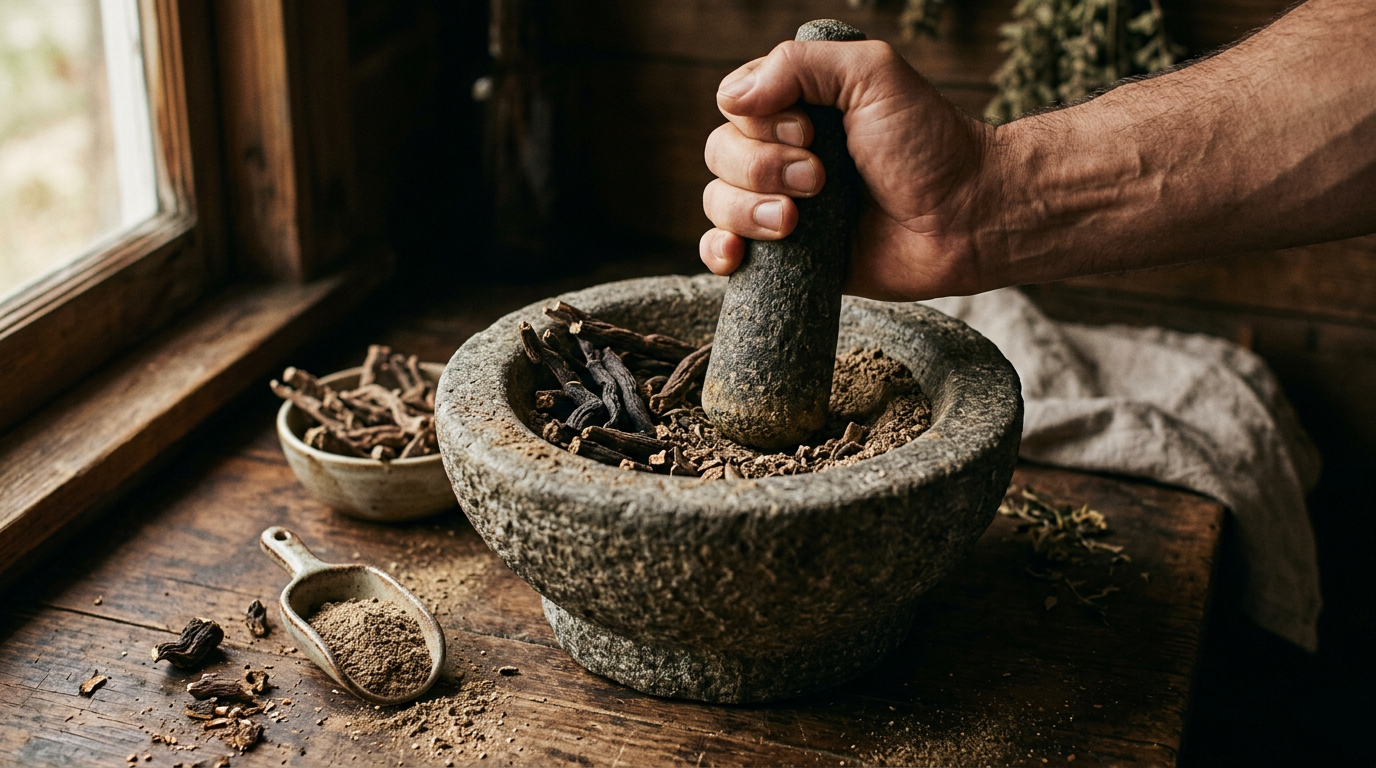
This scientific finding lines up beautifully with the wisdom of traditional use. In Ayurveda, ashwagandha was rarely administered as a high-potency, isolated extract. It was often consumed as a whole powder (churna), frequently mixed with other herbs, and delivered in a medium like warm milk or ghee. This traditional method offers several layers of innate wisdom.
First, using the whole root provides a complex symphony of compounds, not just a blast of the main active withanolides. This holistic profile may have built-in checks and balances. Second, the preparation itself—in milk, with fat—slows and buffers absorption, creating a gentler, more sustained signal to the body rather than a sudden spike. The tradition was never about brute force; it was about gentle, consistent persuasion.
As we seek to integrate these ancient botanicals into our modern lives, we risk losing this nuance. The impulse to standardize, concentrate, and megadose can strip away the very intelligence that made these plants effective for thousands of years. The future of botanical wellness lies not in maximizing single compounds, but in understanding the sophisticated interplay between dose, form, and the body’s own adaptive intelligence. For a plant as powerful as ashwagandha, the respect it deserves is not in its quantity, but in the precision of its use. The dose, it turns out, truly makes the medicine.
Sources & citations
- Speers, A. B., Cabey, K. A., Soumyanath, A., & Wright, K. M. (2021). Effects of Withania somnifera (Ashwagandha) on Stress and the Stress- Related Neuropsychiatric Disorders Anxiety, Depression, and Insomnia. Current Neuropharmacology, 19(9), 1468–1495. https://www.ncbi.nlm.nih.gov/pmc/articles/PMC8762185/
- Mattson, M. P. (2008). Hormesis: a fundamental concept in biology. Ageing Research Reviews, 7(1), 1–61. https://www.sciencedirect.com/science/journal/15681637
- Lopresti, A. L., Smith, S. J., Malvi, H., & Kodgule, R. (2019). An investigation into the stress-relieving and pharmacological actions of an ashwagandha (Withania somnifera) extract: A randomized, double-blind, placebo-controlled study. Medicine, 98(37), e17186. https://www.ncbi.nlm.nih.gov/pmc/articles/PMC6750292/
- Salve, J., Pate, S., Debnath, K., & Langade, D. (2019). Adaptogenic and Anxiolytic Effects of Ashwagandha Root Extract in Healthy Adults: A Double-blind, Randomized, Placebo-controlled Clinical Study. Cureus, 11(12), e6466. https://www.ncbi.nlm.nih.gov/pmc/articles/PMC6979308/
- Cleveland Clinic. (2023). Ashwagandha: What It Is, Benefits & Side Effects. https://health.clevelandclinic.org/what-is-ashwagandha