
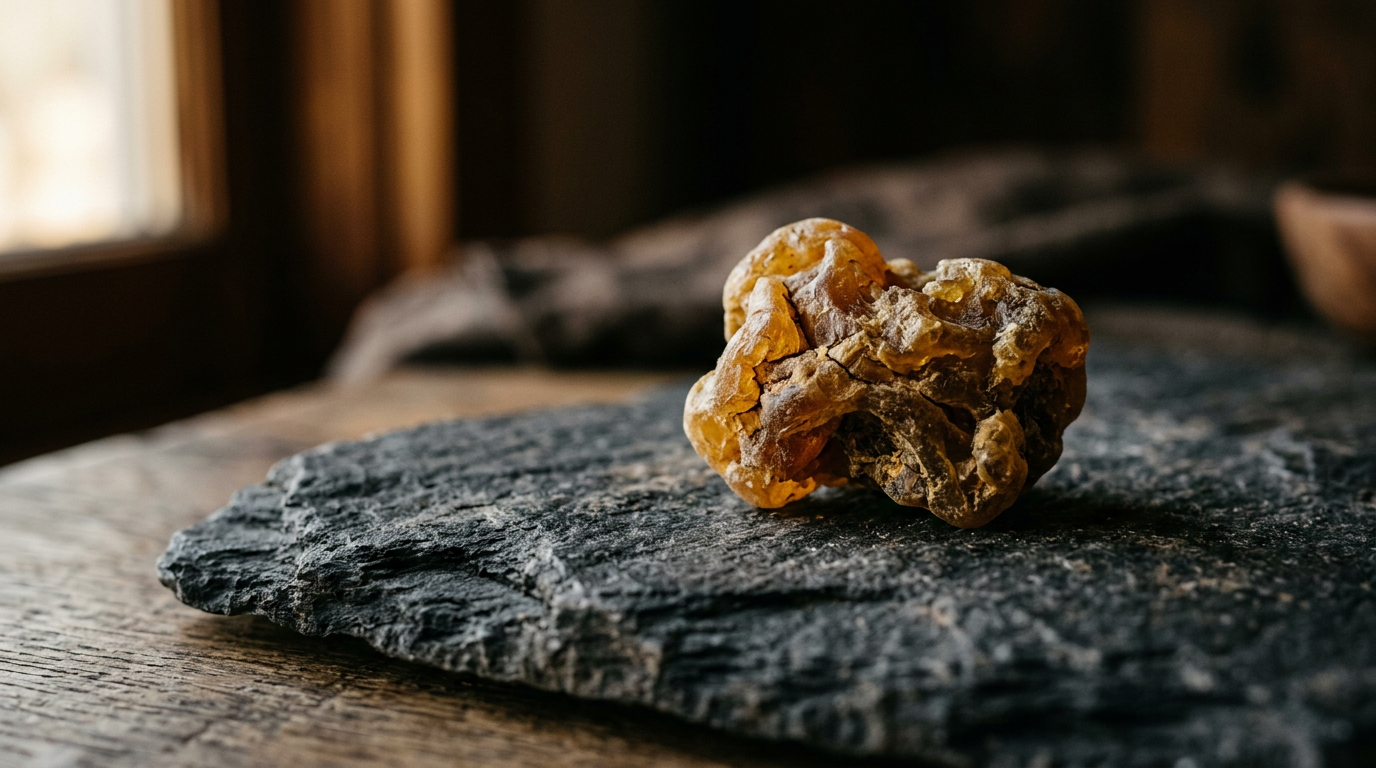
Open a jar of pure, potent aasafoetida for the first time, and you’ll understand why one of its less-flattering names is `devil’s dung`. The smell is an olfactory gut-punch—a potent wave of sulfur and what can only be described as aggressive funk. It’s the kind of scent that makes you question the judgment of anyone who would willingly put it in their food.
But then, a little magic happens. Sizzle a mere pinch of the resinous powder in hot ghee or oil, and the beast is tamed. The aggressive odor shapeshifts into a warm, savory perfume, redolent of sautéed onions, leeks, and garlic. That startling funk deepens into a rich, mouth-filling umami. This is asafoetida’s secret: a dramatic transformation that has made it an indispensable, if quiet, cornerstone of Indian cuisine for centuries.
What’s most remarkable, however, is that India wasn’t its first devotee. This culinary love affair is actually a story of preservation—of a forgotten flavor from the height of the Roman Empire.
A Ghost in the Western Pantry
Long before it ever graced a pot of dal, asafoetida, or hing as it’s known in Hindi, was a darling of ancient Roman kitchens. The Romans knew it as laserpitium, and it was prized as a more accessible version of silphium, a now-extinct giant fennel relative that was worth its weight in silver [1, 4]. Roman gastronome Apicius features it in his cookbook, De Re Coquinaria, using it to season everything from braised meat to lentils. Roman soldiers carried it on campaigns, and it was used not just for flavor, but as a digestive aid and a folk medicine to ward off illness [1].
So what happened? How did a spice celebrated from Britain to Mesopotamia simply vanish from the European palate? The answer lies in the tangled history of trade, agriculture, and shifting tastes. With the collapse of the Western Roman Empire, the intricate trade routes that carried asafoetida resin from the mountains of Persia and Afghanistan frayed and broke [1]. Unlike herbs that could be cultivated in European gardens, the Ferula assa-foetida plant is notoriously stubborn, thriving only in its native arid, high-altitude climes. As supplies dwindled, European cooks turned to what was readily available: the rapidly proliferating family of alliums, like garlic and onions.
Slowly, over generations, the memory of asafoetida's savory power faded from the West, leaving it a ghost in the spice cabinet of history.
The Keeper of the Flame
While Europe was forgetting, India was committing asafoetida to memory. Carried eastward along the same Silk Road arteries, the spice found fertile ground in Indian culture, particularly within the framework of Ayurveda, the traditional system of medicine.
In Ayurvedic practice, foods are classified by their effects on the body's elemental energies, or doshas. Legumes and lentils, while nutritious, are known to aggravate vata—the principle of air and ether associated with movement, lightness, and, when out of balance, digestive gas and bloating. Asafoetida is considered one of the most powerful vata-pacifying substances available [2].
This is why, in a stroke of culinary genius, a pinch of hing is almost always sizzled in oil and added to lentil and bean dishes across India. This practice, known as the tarka or chaunk, isn't just a flavor step; it’s a functional, intentional act of kitchen-as-pharmacy, a 5,000-year-old wisdom tradition that understood how to make food both delicious and digestible.
Asafoetida also solved a crucial culinary puzzle for Jain, Vaishnava, and certain Brahmin communities who traditionally avoid onions and garlic. These alliums are considered tamasic, or foods that can create heaviness and dull the mind. Asafoetida, with its miraculous ability to mimic their savory depth, became the perfect substitute, allowing for complex, deeply flavorful food that aligned with spiritual practice [3].
The Science of a Shapeshifter
Modern science is now catching up to what Ayurvedic practitioners have long known. Asafoetida’s fearsome aroma is due to a high concentration of sulfurous organic compounds, similar to those in alliums but far more volatile [2]. When heated in fat, these compounds undergo a thermal transformation, breaking down and recombining to create the mellow, leek-like flavors we prize.
More importantly, clinical research has begun to validate its use as a digestive aid. Studies have identified it as a potent carminative (an agent that prevents or relieves flatulence) and an antispasmodic, which helps calm the intestinal tract. One review of its pharmacological properties highlighted its traditional use for a range of gastrointestinal issues, lending clinical credence to the intuitive wisdom of adding it to a pot of beans [2].
But not all hing is created equal. The raw, sticky resin harvested from the plant’s root is incredibly potent. Most of what you find in stores is a compounded powder, mixed with rice or wheat flour to prevent clumping and tame the intensity. This is a crucial detail for two reasons: potency varies wildly depending on the ratio of resin to flour, and the common use of wheat makes many commercial brands unsuitable for those with gluten sensitivities. Sourcing pure, thoughtfully compounded hing is an art form, a signal of a supply chain built on craft rather than pure commodity.
Asafoetida’s journey is a powerful reminder that flavors are not static. They are travelers, shaped by the rise and fall of empires, preserved by cultural wisdom, and waiting to be rediscovered. It is not an exotic flavor from a faraway land, but a forgotten friend from our own shared past, kept safe in an Indian pantry.
Sources & citations
- “Asafoetida.” Encyclopædia Britannica, Encyclopædia Britannica, Inc., www.britannica.com/plant/asafoetida.
- Amalraj, Augustine, and Sreeraj Gopi. “Pharmacological activities of Ferula assa-foetida Oleo-Gum-Resin: A review.” Journal of Traditional and Complementary Medicine, vol. 7, no. 3, 2017, pp. 347–359. https://pubmed.ncbi.nlm.nih.gov/29215758/.
- Pandey, Umika. “The Wonder Spice That’s Better Than Garlic.” Atlas Obscura, 16 May 2018, www.atlasobscura.com/articles/what-is-hing-asafoetida.
- Gent, Caroline. “The mystery of the lost Roman herb.” BBC Future, 7 Sept. 2017, www.bbc.com/future/article/20170907-the-mystery-of-the-lost-roman-herb.