
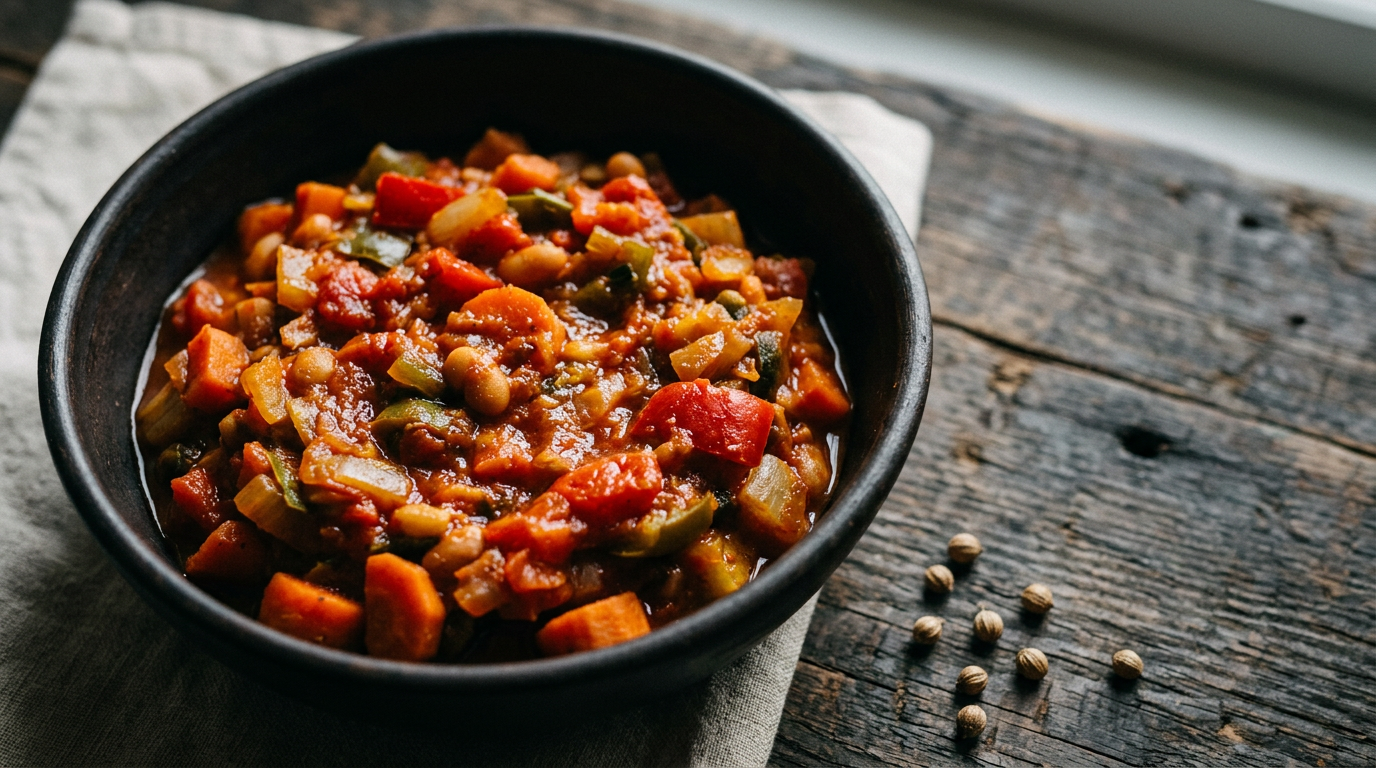
This is the definitive South African chakalaka recipe, a spicy vegetable relish that is the soul of any community braai. While many versions use a generic powder, ours builds deep, authentic flavor with single-origin coriander. It’s a simple shift that transforms the dish, creating a tribute to resilience and connection perfect for sharing on [Mandela Day](/festival/mandela-day).
The Soul of the Shebeen
Chakalaka wasn't born in a pristine test kitchen. It was born of necessity and ingenuity in the townships of Johannesburg. During the apartheid era, shebeens—once illegal taverns—were vital hubs of community and resistance. In their kitchens, a culinary creole was bubbling up. Portuguese, English, Dutch, and indigenous Southern African flavors met, and from humble ingredients, something extraordinary was made [1].
A can of tomatoes, an onion, some peppers, maybe a tin of beans—these were the building blocks. It was a dish designed for stretching, for sharing, for feeding a crowd that gathered to talk, laugh, and organize. Served alongside pap (maize porridge) or with grilled meat from a braai, chakalaka became more than food. It became a symbol of togetherness in the face of division. It’s a dish with a pulse, a history you can taste.
Beyond the Sachet: The Coriander Question
Walk down any supermarket aisle in South Africa and you’ll find chakalaka spice sachets. They promise convenience, a one-scoop solution. But they also promise uniformity, flattening a dish that should be vibrant and alive. The spirit of chakalaka is about using what you have, but using it with intention.
This is why we focus on one key ingredient: [/spice/coriander](/spice/coriander). Instead of a dusty, pre-mixed curry powder where every spice has lost its identity, we build our chakalaka around the bright, citrus-forward notes of single-origin Coriandrum sativum. The primary aromatic compound in coriander is linalool, which gives it that distinctive floral, almost piney scent [2]. In high-quality, recently ground coriander, linalool is abundant. In a generic blend that’s been sitting on a shelf for months, it’s a ghost.
By using both whole toasted seeds and freshly ground coriander, we layer the flavor. The toasted seeds provide a warm, nutty depth, while the ground spice, added near the end, brings a brilliant, fresh aroma. It’s a small detail that makes the entire dish taste more like itself.
A South African Chakalaka Recipe for Connection
This recipe is a foundation. Feel free to adjust the heat or the vegetables. It’s a forgiving dish that tastes even better the next day.
Yields: 6-8 servings
Prep time: 15 minutes
Cook time: 30-40 minutes
Ingredients:
- 2 tbsp vegetable oil
- 1 large onion, finely chopped
- 2 cloves garlic, minced
- 1-2 African bird's eye chilies (known as piri-piri in Kenya), finely chopped
- 1 green bell pepper, deseeded and chopped
- 1 red bell pepper, deseeded and chopped
- 2 large carrots, grated
- 1 tbsp whole coriander seeds
- 1 tbsp sweet paprika
- 2 tsp ground cumin
- 1 tsp freshly ground coriander
- 1 can (400g / 14oz) chopped tomatoes
- 1 can (410g / 14.5oz) baked beans in tomato sauce (or for a Nigerian twist, substitute with cooked ewa oloyin—honey beans)
- Salt and freshly ground black pepper to taste
Instructions:
- Toast the Seeds: In a large, dry saucepan or pot over medium heat, toast the whole coriander seeds for 1-2 minutes until fragrant. Remove them from the pot and lightly crush them in a mortar and pestle or with the flat side of a knife. Set aside.
- Sauté Aromatics: Add the vegetable oil to the same pot. Once shimmering, add the onion and cook until softened, about 5-7 minutes. Add the garlic and chili, cooking for another minute until fragrant.
- Build Flavor: Stir in the bell peppers and grated carrots. Cook for 5-7 minutes, until they begin to soften. Add the crushed coriander seeds, paprika, and ground cumin. Stir well to coat the vegetables and cook for one minute to bloom the spices.
- Simmer: Pour in the chopped tomatoes. Bring the mixture to a simmer, then reduce the heat to low, cover, and let it cook for 15 minutes, stirring occasionally. The vegetables should be tender and the sauce slightly thickened.
- Finish: Stir in the baked beans (or honey beans) and the freshly ground coriander. Cook for another 5 minutes until the beans are heated through. Season generously with salt and pepper.
Serve warm or at room temperature. This dish is a cornerstone of the vibrant food culture across [Southern Africa](/region/africa) and its spirit of communal eating echoes across the continent.
Chakalaka FAQ
What exactly is chakalaka?
Chakalaka is a spicy South African vegetable relish. It's typically served as a side dish with everything from pap (maize porridge) and samp to braaied (barbecued) meat and bread.
Can I make it ahead of time?
Yes, and you should! The flavors meld and deepen as it sits. Chakalaka is often even better the day after it's made. It will keep in an airtight container in the refrigerator for 3-5 days.
What do you serve with chakalaka?
Traditionally, it accompanies pap and boerewors (a South African sausage), grilled meats, or samp and beans. It's also fantastic as a relish on burgers or simply scooped up with crusty bread.
Why use both whole and ground coriander?
Toasting and crushing whole seeds creates a nutty, warm, foundational flavor. Adding freshly ground coriander at the end preserves its volatile aromatic compounds, adding a bright, citrusy top note that cuts through the richness.
Can I add other vegetables?
Absolutely. Common additions include shredded white cabbage, grated butternut squash, or chopped zucchini. Add them along with the peppers and carrots.
Sources & citations
- Britannica. "South African cuisine." Britannica.com, Accessed July 2026. https://www.britannica.com/topic/South-African-cuisine
- De Lacerda, A., et al. "Aroma Profile of Coriander (Coriandrum sativum L.) Essential Oil from Brazil." Journal of Essential Oil Research, 2021. https://pubmed.ncbi.nlm.nih.gov/
- United Nations. "Nelson Mandela International Day." un.org, Accessed July 2026. https://www.un.org/en/events/mandeladay/
- Food and Agriculture Organization of the United Nations. "Roots, tubers, plantains and bananas in human nutrition." fao.org, Accessed July 2026. https://www.fao.org/